
Overview
About this site
What the sources say
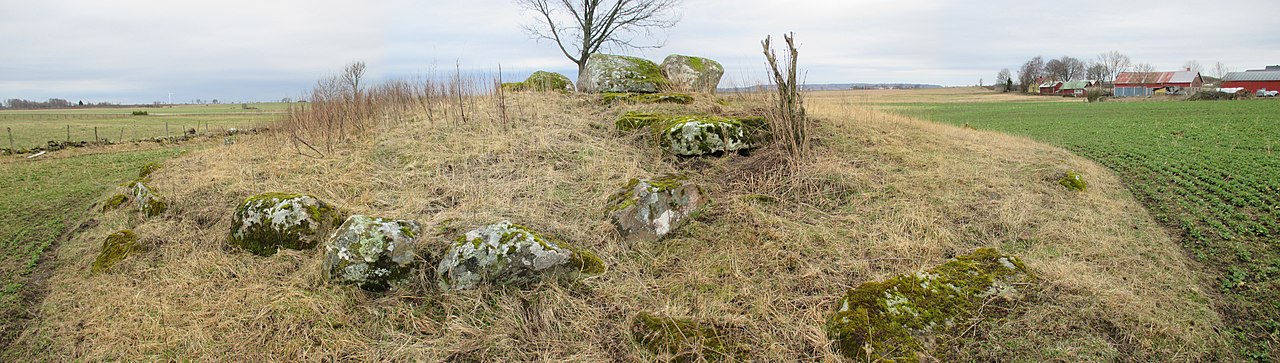
Luttra gånggrift is a passage tomb in Falköping Municipality, Sweden. In open records it appears as Wikidata item Q29580735, mapped at 58.1316° N, 13.5689° E.
Built from structured records, not from an articleSources and licences
Where it sits in time
The site's dated range, placed against world reference points.
The scale is logarithmic: each step to the left is about ten times older than the last.
The full article
About Luttra gånggrift
This kind of monument hereSources for this section
- en.wikipedia.orgCC BY-SA 4.0
- en.wikipedia.orgCC BY-SA 4.0
- en.wikipedia.orgCC BY-SA 4.0
- en.wikipedia.orgCC BY-SA 4.0
Sources for this section
- en.wikipedia.orgCC BY-SA 4.0
- en.wikipedia.orgCC BY-SA 4.0
- en.wikipedia.orgCC BY-SA 4.0
- en.wikipedia.orgCC BY-SA 4.0
In Denmark and Sweden the passage grave is the grandest form of the Funnel Beaker culture's megalithic tombs. A passage grave has a chamber under a mound, entered by a long passage of large stones. Nordic megalith architecture, the style of Scandinavia and northern Germany, emerged mainly between 3500 and 2800 BCE, and passage graves are one of its main types alongside dolmens, long barrows and stone cists. Further down this page, About this kind of monument gives the whole of “Scandinavian passage graves”.
DatingSources for this section
- en.wikipedia.orgCC BY-SA 4.0
Sources for this section
- en.wikipedia.orgCC BY-SA 4.0
Typological estimate, not a date for this site: monuments of this kind in this region are normally dated 3500 BCE to 2800 BCE. The range comes from what is known about passage tomb monuments in Sweden; nothing measured on this site itself is on record, so it may be younger or older than the range suggests.
The range rests on this regional background (source: the Wikipedia article “Nordic megalith architecture”): Swedish passage graves belong to the Nordic megalith tradition which emerged predominantly between 3500 and 2800 BC.
Landscape and neighbours
Counting outward from Luttra gånggrift, there are 3 catalogued sites within 1 km, 84 within 5 km and 291 within 10 km, and 14 of them are also classed as passage tomb. That puts it inside a dense cluster of monuments. It is one of 13 passage tomb records among the 791 sites catalogued in Falköping Municipality, Sweden.
The closest catalogued sites are Knaggårdens gånggrift (0.1 km south-east, passage tomb); Luttra 17:1 (0.3 km east, megalithic mound); Lockgårdens gånggrift (1.0 km south-east, passage tomb); Luttra 18:1 (1.4 km south-west, megalith). The catalogue is assembled from open records and is not complete, so unrecorded monuments may lie closer.
Records and protectionSources for this section
Sources for this section
Wikidata lists the site with the heritage status monument in Fornminnesregistret. The open records for it are Wikidata (Q29580735), where corrections and further identifiers can be added. Sites of this kind often lie on farmland or other private ground, so check local access rules before visiting and leave the monument as you found it.
How this page was madeSources for this section
Sources for this section
This page was built automatically from Wikidata (CC0), the heritage register named above and the regional article “Scandinavian passage graves”, written for the Atlas from the Wikipedia articles it cites (CC BY-SA 4.0), plus distances and counts computed from the catalogue coordinates. It contains no AI-written text.
Tradition and region
About this kind of monument
Scandinavian passage graves
In Denmark and Sweden the passage grave is the grandest form of the Funnel Beaker culture's megalithic tombs. A passage grave has a chamber under a mound, entered by a long passage of large stones. Nordic megalith architecture, the style of Scandinavia and northern Germany, emerged mainly between 3500 and 2800 BCE, and passage graves are one of its main types alongside dolmens, long barrows and stone cists.
Kong Asgers Høj on the Danish island of Møn is one of the best known. Its chamber is 10 metres long and 2 metres wide, with a passage 7.5 metres long. This kind of grave is found primarily in Denmark, Germany and Scandinavia, and only occasionally in France and the Netherlands. The tomb is structurally untouched since ancient times, though it may have been cleared at some time, and it was reused for secondary burial in the Corded Ware period. Passage graves were often used for generations. At Frälsegården in Sweden, genetic analysis of several dozen buried individuals suggests that the dead were largely male descendants of one ancestor, with women who had married in from outside, so such a tomb could belong to an extended family.
The passage grave tradition is thought to have originated in Brittany and been spread to other regions by colonists, a view found in the wider literature but one that remains debated.
Dating of Scandinavian tombs relies on the pottery of the Funnel Beaker culture and on radiocarbon dates from bone.
When visiting, look at the size of the capstones over the chamber, the kerbstones around the mound, and the line of the passage.
Paraphrased from Wikipedia: Passage grave, Wikipedia: Nordic megalith architecture, Wikipedia: Funnel beaker culture, Wikipedia: Kong Asgers Høj · CC BY-SA 4.0
Photographs
7 photographs, each with its author and licence
More photographs
Lore
Evidence & Lore
What the sources actually support — and, kept apart, what has been claimed.
What the evidence supports
Dates
Est. 3500–2800 BCEHow this date was established: Type comparisonTypical range for passage tombs in Sweden; this site has not been dated itself. Swedish passage graves belong to the Nordic megalith tradition which emerged predominantly between 3500 and 2800 BC.Source for this date
Where it stands
Sweden
The pin marks the monument itself — its exact point.
- Coordinates
- 58°07′54″ N, 13°34′08″ EFor a GPS or map app: 58.13158, 13.56888
Access is as our sources describe it; we have not visited the site to check.
Nearby
The closest sites in the Atlas, by straight line.



Sources
Every record behind this page, with the link it came from.
2 sources behind this page
- 01Wikidata Q29580735wikidata.org
- 02Source for this dateen.wikipedia.org
Image files
- Luttra gangrab 1.JPGAn-dCC BY-SA 3.0
- Luttra gangrab 2.JPGAn-dCC BY-SA 3.0
- The Luttra Neolithic Passage Grave.jpgNicklas Sjölund LarssonCC BY-SA 4.0
- Gånggriften i Luttra (Luttra 15) 2011-07-19 Bild 1.jpgGunnar CreutzCC0
- Gånggriften i Luttra (Luttra 15) 2011-07-19 Bild 2.JPGGunnar CreutzCC0
- Luttra 15-1 gånggrift 2218.jpgAchirdCC BY-SA 3.0
- Luttra 15-1 gånggrift 2221.jpgAchirdCC BY-SA 3.0
Report a correctionWrong date, name, photograph or source? Tell us and it will be put right.
Around this place
The ten nearest sites, by compass
Credit
Text, licence and sources
This page is assembled from open records (Wikidata, CC0; OpenStreetMap, ODbL) and a tradition article paraphrasing Wikipedia (CC BY-SA 4.0). No article exists for this site, and nothing here is written by a model.
- Wikidata Q29580735CC0
- en.wikipedia.orgCC BY-SA 4.0
- en.wikipedia.orgCC BY-SA 4.0
- en.wikipedia.orgCC BY-SA 4.0
- en.wikipedia.orgCC BY-SA 4.0