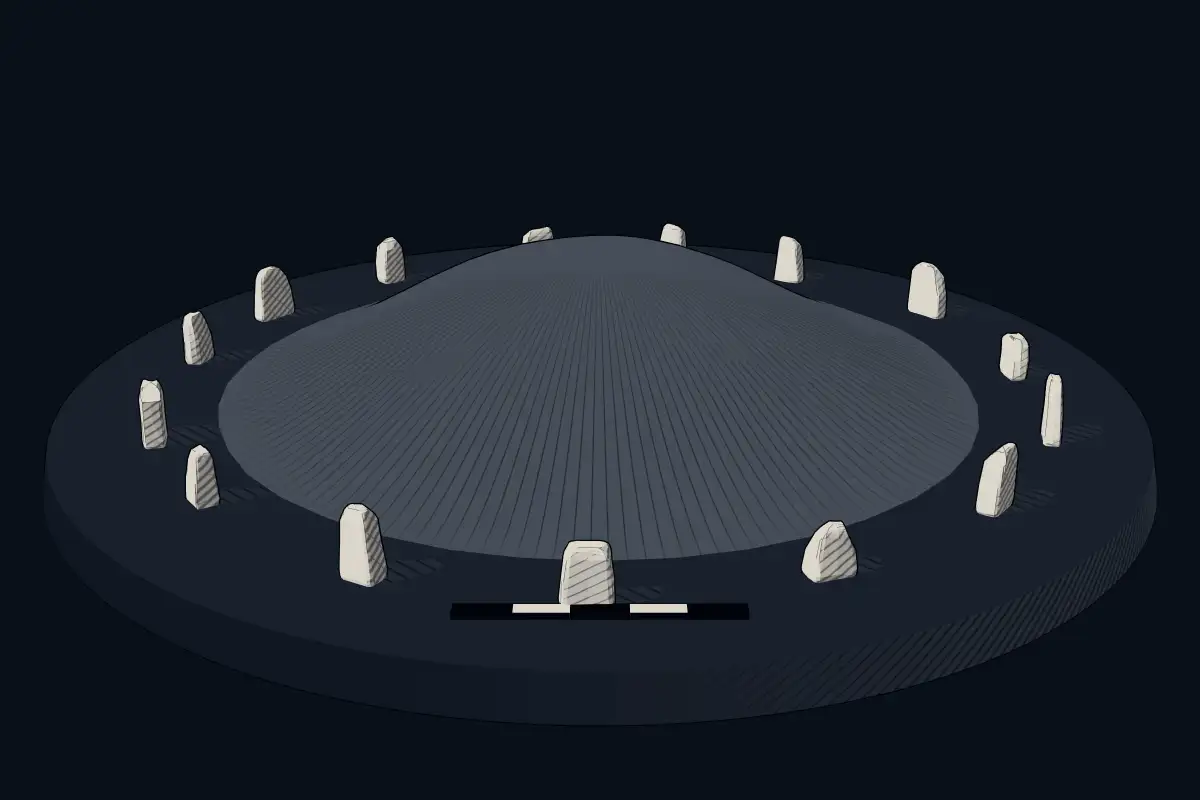
Megalithic mound (tumulus with integral stones)
Luttra 17:1
DatedEst. 2000 BCE–1050 CE
No licensed photograph yetWe have no photograph we may publish for this site, so the interpretive 3D view leads instead.
Overview
About this site
What the sources say
Luttra 17:1 is a megalithic mound recorded in Falköping Municipality, Sweden. The catalogue places it at 58.1305° N, 13.5742° E and links it to Wikidata item Q29580742.
Built from structured records, not from an articleSources and licences
Where it sits in time
The site's dated range, placed against world reference points.
The scale is logarithmic: each step to the left is about ten times older than the last.
The full article
About Luttra 17:1
This kind of monument hereSources for this section
- en.wikipedia.orgCC BY-SA 4.0
- en.wikipedia.orgCC BY-SA 4.0
- en.wikipedia.orgCC BY-SA 4.0
- en.wikipedia.orgCC BY-SA 4.0
Sources for this section
- en.wikipedia.orgCC BY-SA 4.0
- en.wikipedia.orgCC BY-SA 4.0
- en.wikipedia.orgCC BY-SA 4.0
- en.wikipedia.orgCC BY-SA 4.0
Sweden's landscape is thick with prehistoric graves, and most of the mounds in the Atlas are round earth mounds (gravhögar) or heaps of stone (rösen, or cairns). Many belong to the Nordic Bronze Age, roughly 1700 to 500 BCE, when the elite were buried beneath mounds of earth or stone. In the early part of that period the dead were often laid in oak coffins or stone cists; towards the end of the second millennium BCE cremation became the norm, and the ashes went into an urn or a small pit under a cairn. Further down this page, About this kind of monument gives the whole of “Swedish burial mounds and cairns”.
DatingSources for this section
- en.wikipedia.orgCC BY-SA 4.0
Sources for this section
- en.wikipedia.orgCC BY-SA 4.0
Typological estimate, not a date for this site: monuments of this kind in this region are normally dated 2000 BCE to 1050 CE. The range comes from what is known about megalithic mound monuments in Sweden; nothing measured on this site itself is on record, so it may be younger or older than the range suggests.
The range rests on this regional background (source: the Wikipedia article “Nordic Bronze Age”): Swedish barrows are mostly Bronze Age rosen of the Nordic Bronze Age (c. 2000-500 BC); the Viking-age royal mounds of Gamla Uppsala belong to the Viking Age (about 800-1050 CE).
Landscape and neighbours
Counting outward from Luttra 17:1, there are 3 catalogued sites within 1 km, 82 within 5 km and 290 within 10 km, and 102 of them are also classed as megalithic mound. That puts it inside a dense cluster of monuments. It is one of 423 megalithic mound records among the 791 sites catalogued in Falköping Municipality, Sweden.
Nearest to it are Knaggårdens gånggrift (0.3 km west, passage tomb); Luttra gånggrift (0.3 km west, passage tomb); Lockgårdens gånggrift (0.7 km south-east, passage tomb); Luttra 18:1 (1.4 km south-west, megalith). The catalogue is assembled from open records and is not complete, so unrecorded monuments may lie closer.
Records and protectionSources for this section
Sources for this section
Heritage records attach the status monument in Fornminnesregistret to this site. The open records for it are Wikidata (Q29580742), where corrections and further identifiers can be added. Access varies from open common land to private fields; check local access rules, ask where needed, and take care not to damage the monument.
How this page was madeSources for this section
Sources for this section
This page was built automatically from Wikidata (CC0), the heritage register named above and the regional article “Swedish burial mounds and cairns”, written for the Atlas from the Wikipedia articles it cites (CC BY-SA 4.0), plus distances and counts computed from the catalogue coordinates. It contains no AI-written text.
Tradition and region
About this kind of monument
Swedish burial mounds and cairns
Sweden's landscape is thick with prehistoric graves, and most of the mounds in the Atlas are round earth mounds (gravhögar) or heaps of stone (rösen, or cairns). Many belong to the Nordic Bronze Age, roughly 1700 to 500 BCE, when the elite were buried beneath mounds of earth or stone. In the early part of that period the dead were often laid in oak coffins or stone cists; towards the end of the second millennium BCE cremation became the norm, and the ashes went into an urn or a small pit under a cairn.
Many of these graves have not been excavated. Their dates are inferred from shape, setting and the grave goods of excavated neighbours, so the Atlas gives a range instead of a single year.
The showpiece is the King's Grave at Kivik in Scania, the remains of an unusually grand double burial of about the fifteenth century BCE. Its restored cairn is some 75 metres across and 3.5 metres high. At the centre is a cist about 4 metres long, built of ten upright slabs, eight of them carved on the inside with ships, a two-horse chariot, lur players, axes, birds and fish. Farmers opened the chamber in 1748 while taking stone for field walls, and the carvings were first recognised in 1756. The excavation of 1931 recovered only teeth, bone fragments and broken bronze, because the grave had been looted. In the nineteenth century some scholars read the carvings as the work of Phoenician settlers; that idea was later rejected.
When visiting, look for mounds on ridges with a view over farmland or water, for kerb stones at the foot of a cairn, and for a shallow dip in the top that often marks an old digging.
Paraphrased from Wikipedia: Tumulus, Wikipedia: Nordic Bronze Age, Wikipedia: Kivik grave, Wikipedia: Burial mound · CC BY-SA 4.0
See it in 3D
An interpretive reconstruction of the monument, standing on the real ground at its exact point, under the sun for that place and season. Drag to look around it.
The reconstruction is ours, not a survey: it shows what a monument of this type looks like, at the size the record gives for this one.
Lore
Evidence & Lore
What the sources actually support — and, kept apart, what has been claimed.
What the evidence supports
Dates
Est. 2000 BCE–1050 CEHow this date was established: Type comparisonTypical range for megalithic mounds in Sweden; this site has not been dated itself. Swedish barrows are mostly Bronze Age rosen of the Nordic Bronze Age (c. 2000-500 BC); the Viking-age royal mounds of Gamla Uppsala belong to the Viking Age (about 800-1050 CE).Source for this date
Where it stands
Sweden
The pin marks the monument itself — its exact point.
- Coordinates
- 58°07′50″ N, 13°34′27″ EFor a GPS or map app: 58.13046, 13.57416
Access is as our sources describe it; we have not visited the site to check.
Nearby
The closest sites in the Atlas, by straight line.


Sources
Every record behind this page, with the link it came from.
2 sources behind this page
- 01Wikidata Q29580742wikidata.org
- 02Source for this dateen.wikipedia.org
Report a correctionWrong date, name, photograph or source? Tell us and it will be put right.
Around this place
The ten nearest sites, by compass
Credit
Text, licence and sources
This page is assembled from open records (Wikidata, CC0; OpenStreetMap, ODbL) and a tradition article paraphrasing Wikipedia (CC BY-SA 4.0). No article exists for this site, and nothing here is written by a model.
- Wikidata Q29580742CC0
- en.wikipedia.orgCC BY-SA 4.0
- en.wikipedia.orgCC BY-SA 4.0
- en.wikipedia.orgCC BY-SA 4.0
- en.wikipedia.orgCC BY-SA 4.0