
Conjunto megalítico do Olival da Pêga
Datedc. 3250–2500 BCE
Photo Inacio Pires · CC BY-SA 3.0Source file on Wikimedia Commons

Overview
About this site
What the sources say
The Antas do Olival da Pêga are 2 dolmens located near the village of Telheiro, in the municipality of Reguengos de Monsaraz, in Évora, Portugal. Anta is the Portuguese name for a dolmen, a single-chamber megalithic tomb. These two Neolithic dolmens were used over a long period, from the Late Neolithic to the Chalcolithic. The tombs were originally identified by German archaeologists Georg and Vera Leisner, who excavated Anta 1, with Anta 2 being subsequently excavated from the 1990s by Victor Gonçalves and Ana Catarina Sousa of the Centre of Archaeology of the University of Lisbon (UNIARQ). In addition to the visible stones at the two sites, which are about 300 meters apart, many items have been found as a result of excavations. Over one hundred people were buried in each tomb. The proximity of the two tombs gives rise to the conclusion that both were part of the same megalithic complex.
Read on Wikipedia5 min readCC BY-SA 4.0
Age sources
How old this site is, and who says so.
Range across all claimsc. 3250–2500 BCE
Typical for this typeWhat this badge means
The published range for this kind of monument in this region. It is not a date for this site.
- 3250 BCEWikipedia: Antas do Olival da Pêga (infobox)Source: en.wikipedia.org
- 2500 BCEWikipedia: Antas do Olival da Pêga (infobox)Source: en.wikipedia.org
Where it sits in time
The site's dated range, placed against world reference points.
The scale is logarithmic: each step to the left is about ten times older than the last.
The full article
Conjunto megalítico do Olival da Pêga: the whole story
In briefSources for this section
- Wikipedia (English): Antas do Olival da PêgaCC BY-SA 4.0
Sources for this section
- Wikipedia (English): Antas do Olival da PêgaCC BY-SA 4.0
The Antas do Olival da Pêga are two dolmens near the village of Telheiro, in the municipality of Reguengos de Monsaraz, in Évora, Portugal. Anta is the Portuguese name for a dolmen, a single-chamber megalithic tomb. The two Neolithic dolmens, about 300 meters apart, were used over a long period, from the Late Neolithic to the Chalcolithic. Over one hundred people were buried in each tomb, and their proximity suggests that both were part of the same megalithic complex.
The tombs were first identified by the German archaeologists Georg and Vera Leisner, who excavated Anta 1. Anta 2 was excavated from the 1990s by Victor Gonçalves and Ana Catarina Sousa of the Centre of Archaeology of the University of Lisbon (UNIARQ).
Anta 1 is one of the tallest antas in Portugal. The tomb is polygonal with wide access, but despite the very large chamber the entrance corridor is relatively small. The Leisners found many artefacts that show use by a large community: necklace beads of quartz and other materials, bone figurines of rodents and rabbits, ceramic fragments of up to 200 vases, 134 schist plaques and a small idol in shale. Two stelae in the hallway and a paved courtyard suggested to them that the dolmen belonged to the 3rd millennium BCE, and four complexes were eventually identified.
Of Anta 2, only the large burial chamber (3.40m X 4m in diameter) is visible, with its capstone in situ. The Leisners reported it in 1951 but did not excavate, because the weak support for the capstone risked breaking it. The excavations of the 1990s dated the tomb to the end of the 4th millennium BCE and revealed a 16-meter-long corridor, the longest in Portugal, which connected the anta with four other funerary structures: three beehive tombs, or tholoi, and a grave. The corridor appears to have been built in two phases, and in the second two extensively decorated schist columns were installed.
Many items from around 2900-2500 BCE were found in one tholos, including bones, flint, chert and rhyolite blades, arrowheads, dart tips, axes, polished stone artifacts, hair pins, necklace beads, ceramics, a copper dagger and a bone figurine of a fox. Most of the items are stored at UNIARQ.
Anta 1Sources for this section
- Wikipedia (English): Antas do Olival da PêgaCC BY-SA 4.0
Sources for this section
- Wikipedia (English): Antas do Olival da PêgaCC BY-SA 4.0
Anta 1 is one of the tallest antas in Portugal. The tomb is polygonal with wide access. However, contrary to what is suggested by the very large chamber, the entrance corridor is relatively small. The Leisners found many artefacts, indicating the use of the tomb by a large community. They include necklace beads made of quartz and other materials in various shapes, bone figurines of rodents and rabbits, many ceramic fragments of up to 200 vases, with four showing decorations; 134 schist plaques; and a small idol in shale. They found two stelae in the hallway and a paved courtyard that suggested to them that the dolmen was from the 3rd millennium BCE. As their research progressed, four complexes were eventually identified.
Anta 2Sources for this section
- Wikipedia (English): Antas do Olival da PêgaCC BY-SA 4.0
Sources for this section
- Wikipedia (English): Antas do Olival da PêgaCC BY-SA 4.0
At present, only the large burial chamber (3.40m X 4m in diameter) of Anta 2 is visible, with the capstone in situ. The anta was first reported by the Leisners in 1951, at which time they saw little evidence of the existence of remains. They did not carry out any excavations because of the weak support for the capstone and the consequent risk of breaking it.
It was thus not until the 1990s that excavations were carried out, by Gonçalves and Sousa, which enabled them to date the tomb from the end of the 4th millennium BCE. Given the findings at excavations at other dolmens in Portugal the results at Anta 2 were unexpected. Gonçalves and Sousa identified a 16-meter-long corridor, the longest in Portugal, that connected the anta with four other funerary structures made up of three beehive tombs, or tholoi, and a grave. The corridor appeared to have been built in two phases. In the second, two extensively decorated schist columns (not granite like the rest of the complex) were installed. They found two stelae in the hallway, as well as a paved courtyard. Many items, dating from around 2900-2500 BCE, were found in one tholos, including bones; flint, chert and rhyolite blades; arrowheads; dart tips; axes; polished stone artifacts; hair pins; necklace beads; ceramics; a copper dagger, and a bone figurine of a fox. Most of the items found are stored at UNIARQ.
How this page was madeSources for this section
- Wikipedia (English): Antas do Olival da PêgaCC BY-SA 4.0
Sources for this section
- Wikipedia (English): Antas do Olival da PêgaCC BY-SA 4.0
The summary at the top of this page was written by Claude Sonnet 5.5 (2026-11-06) from the cited Wikipedia article “Antas do Olival da Pêga”. The numbers in it were checked automatically against the source text. The rest of the page is the article itself, the structured records and computed distances.
Tradition and region
About this kind of monument
Portuguese antas of the Alentejo
Around Évora, in the Alentejo, megalithic tombs are called antas, and some of the largest in Iberia stand here. The Great Dolmen of Zambujeiro, near Valverde in the municipality of Évora, is considered one of the biggest such structures in Iberia. Research has dated it to between 4000 and 3000 BCE, concurrent with the megalithic building of the Évora region, and it is linked to the Great Dolmen of Comenda da Igreja at Montemor-o-Novo. Henrique Leonor Pina excavated it in 1965, and although his methods caused some controversy, the work recovered slate tablets, necklaces, crosiers, copper objects, ceramics and carinated bowls. The Portuguese government declared it a national monument in 1971.
The finds show that the tombs were used for generations: slate tablets, personal ornaments and copper objects in the chambers reach into the Chalcolithic, so one anta can carry evidence for several centuries of burial custom. Excavated anta chambers are the main source for dating, since the stones themselves cannot be dated.
Nearby, the Almendres Cromlech is a large group of standing stones, a reminder that the Alentejo's megalithic landscape also includes open-air stone enclosures and single menhirs, not only tombs.
The Atlas's records here include small antas, some reduced to a few standing slabs, and many lack a secure excavation date. They are labelled with a typological range.
When visiting, look for the chamber and the passage that leads to it, and for the way the monument sits in its field. Check access in advance.
Paraphrased from Wikipedia: Great Dolmen of Zambujeiro, Wikipedia: Great Dolmen of Comenda da Igreja, Wikipedia: Almendres Cromlech, Wikipedia: Dolmen · CC BY-SA 4.0
From the article
Dated moments in the story
- 2500 BCE
Many items, dating from around 2900-2500 BCE, were found in one tholos, including bones; flint, chert and rhyolite blades; arrowheads; dart tips; axes; polished stone artifacts; hair pins; necklace beads; ceramics; a copper dagger, and a bone figurine of a fox.
Source - 1951
The anta was first reported by the Leisners in 1951, at which time they saw little evidence of the existence of remains.
Source
See it in 3D
An interpretive reconstruction of the monument, standing on the real ground at its exact point, under the sun for that place and season. Drag to look around it.
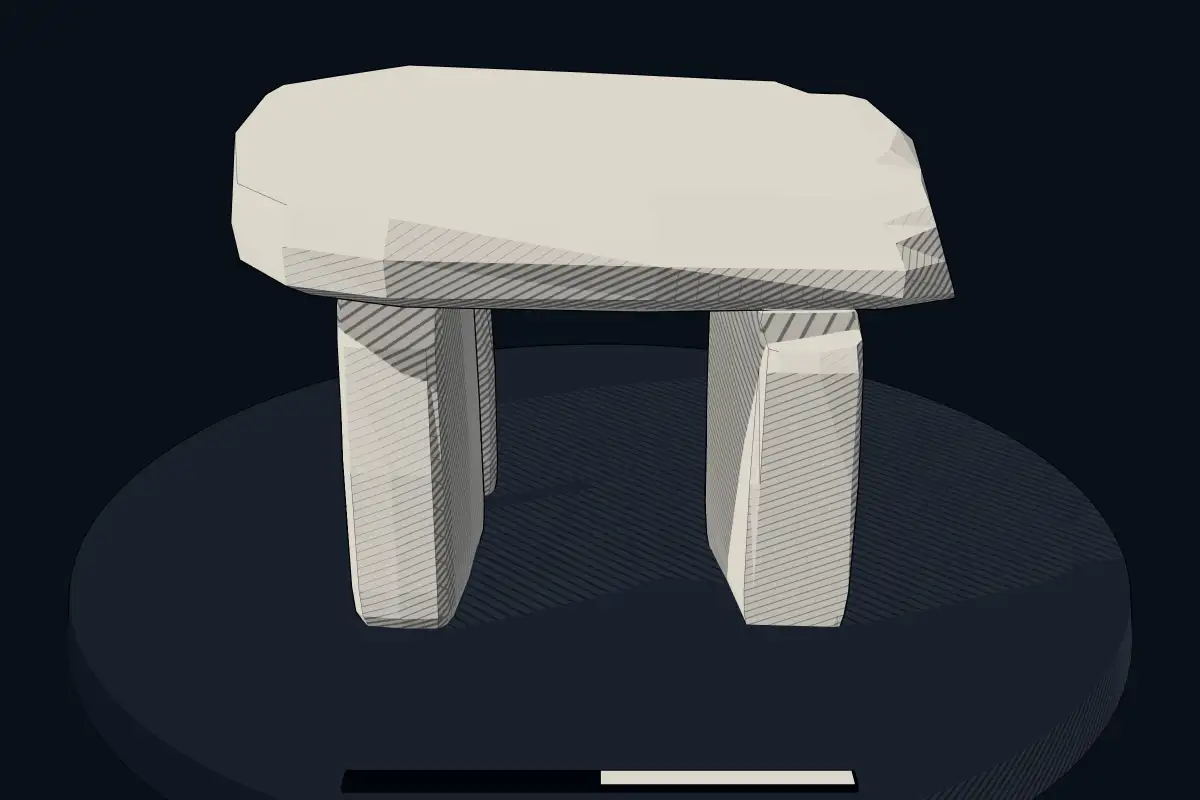
The reconstruction is ours, not a survey: it shows what a monument of this type looks like, at the size the record gives for this one.
Photographs
8 photographs, each with its author and licence
More photographs


Lore
Evidence & Lore
What the sources actually support — and, kept apart, what has been claimed.
What the evidence supports
Dates
Est. 4000–3000 BCEHow this date was established: Type comparisonTypical range for dolmens in Portugal; this site has not been dated itself. Most dolmens date from the Late Neolithic period (4000-3000 BCE); megalithic tombs at Algarve in Portugal date to c. 2500 BC.Source for this date
Where it stands
Portugal
The pin marks the monument itself — its exact point.
- Coordinates
- 38°27′06″ N, 7°23′56″ WFor a GPS or map app: 38.45159, -7.39887
Access is as our sources describe it; we have not visited the site to check.
Nearby
The closest sites in the Atlas, by straight line.
 Menhir von Barrocal2800–1800 BCE
Photo: Vitor Oliveira from Torres Vedras, PORTUGAL · CC BY-SA 2.0
 Menir da Abelhoa4000–1000 BCE
 Menir do Outeiro4000–1000 BCE
Photo: Vitor Oliveira from Torres Vedras, PORTUGAL · CC BY-SA 2.0
 Conjunto megalítico da Herdade do Xerez4000–1200 BCE
Photo: Vitor Oliveira from Torres Vedras, PORTUGAL · CC BY-SA 2.0
 Menir de Santa Margarida2800–1800 BCE
Photo: Vitor Oliveira from Torres Vedras, PORTUGAL · CC BY-SA 2.0
- Menhir de Santa Margarida2800–1800 BCE
Photo: Vitor Oliveira from Torres Vedras, PORTUGAL · CC BY-SA 2.0
- Megalithic complexAntas von Poço da Gateira
- Menhir (standing stone)Menir da Rocha dos Namorados4000–1000 BCE


Sources
Every record behind this page, with the link it came from.
3 sources behind this page
- 01Wikidata Q28962474wikidata.org
- 02Source for this dateen.wikipedia.org
- 03Wikipedia: Conjunto megalítico do Olival da Pêgaen.wikipedia.org
Image files
- Anta 2 do Olival da Pega.jpgInacio PiresCC BY-SA 3.0
- Anta2doOlivaldaPega.jpgRoundtheworldCC BY-SA 4.0
- Anta1doOlivaldaPega.jpgRoundtheworldCC BY-SA 4.0
- Anta 2 doOlival da Pega.jpgDescobrimentos novosCC BY-SA 4.0
- Anta do Olival da Pega (48809167551).jpgÁngel M. Felicísimo from Mérida, EspañaCC BY 2.0
- Dolmen de Olival da Pega (17161428687).jpgÁngel M. Felicísimo from Mérida, EspañaCC BY-SA 2.0
- Anta do Olival da Pega Reguengos de Monsaraz.jpgManuelvbotelhoCC BY-SA 3.0
- Anta do Olival da Pega Reguengos de Monsaraz 1.jpgManuelvbotelhoCC BY-SA 3.0
Report a correctionWrong date, name, photograph or source? Tell us and it will be put right.
Around this place
The ten nearest sites, by compass
- Menhir von Barrocal1.7 km SW
- Menir da Abelhoa1.8 km NE
- Menir do Outeiro2.1 km N
- Conjunto megalítico da Herdade do Xerez2.4 km E
- Menir de Santa Margarida2.7 km W
- Menhir de Santa Margarida2.7 km W
- Antas von Poço da Gateira4.7 km W
- Menir da Rocha dos Namorados6.7 km W
- Anta 2 da Herdade dos Cebolinhos12 km SW
- Núcleo de seis menires, na Herdade dos Perdigões13 km W
Credit
Text, licence and sources
Text from the Wikipedia article "Antas do Olival da Pêga" (English), licensed CC BY-SA 4.0; authors are listed in the page history. Reused under CC BY-SA 4.0. Read on Wikipedia · Edit history and authors