.jpg/1920px-Menir_de_Santa_Margarida_-_Portugal_(52849324324).jpg 1920w)
Menhir de Santa Margarida
DatedEst. 2800–1800 BCE
Photo Vitor Oliveira from Torres Vedras, PORTUGAL · CC BY-SA 2.0Source file on Wikimedia Commons

Overview
About this site
What the sources say
Le menhir de Santa Margarida est un monolithe situé dans la freguesia de Corval (pt) sur le territoire de la municipalité de Reguengos de Monsaraz (District d'Évora, Portugal)
.
Il est classé Immeuble d'intérêt public (Catégorie IIP) monument national depuis 1992.
Article in FrenchRead on Wikipedia3 min readCC BY-SA 4.0
Where it sits in time
The site's dated range, placed against world reference points.
The scale is logarithmic: each step to the left is about ten times older than the last.
The full article
Menhir de Santa Margarida: the whole story
In briefSources for this section
- Wikipedia (French): Menhir de Santa MargaridaCC BY-SA 4.0
Sources for this section
- Wikipedia (French): Menhir de Santa MargaridaCC BY-SA 4.0
Menhir de Santa Margarida is a standing stone in the freguesia of Corval, within the municipality of Reguengos de Monsaraz in the District of Évora, Portugal. It stands beside the municipal road linking Monsaraz to San Pedro do Corval, about 5 km from the latter place. The site is classified as a national monument and an Immeuble d'intérêt public (Catégorie IIP) since 1992.
The menhir is a thick monolith of medium-grained granite, about 3,20 m high above ground level. Its shape is rough, with a very broad base compared with its summit. Tooling marks are visible near the top. The better-preserved north and west sides carry twenty-five scattered hollows, while the south side retains traces of ornamentation, including a raised “baton” motif.
The standing stone is dated by typological estimate to 2800 BCE to 1800 BCE. No particular ancient use, burial association, legend, or later historical connection is stated for this site. Its recorded history includes its classification as a national monument and an Immeuble d'intérêt public (Catégorie IIP) since 1992.
Standing stones of this western European megalithic type are relatively unusual in Spain compared with dolmens, but are common in the northern half of the country, especially in the Basque Country, Navarre, northern Burgos and Palencia, Cantabria, and the Pyrenees. Such monuments usually stand alone or in small groups called cromlechs, often on elevated ground, and are not usually associated with burials. Portugal has its greatest concentration in the Alentejo.
No English Wikipedia article exists for it; the full text below is the French article "Menhir de Santa Margarida", shown in the original language.
Summary in EnglishSources for this section
- Wikipedia (French): Menhir de Santa MargaridaCC BY-SA 4.0
Sources for this section
- Wikipedia (French): Menhir de Santa MargaridaCC BY-SA 4.0
Menhir de Santa Margarida is a menhir (standing stone) in Reguengos de Monsaraz, Spain. A typological estimate: 2800 BCE to 1800 BCE. No English Wikipedia article exists for it; the full text below is the French article "Menhir de Santa Margarida", shown in the original language.
DescriptionSources for this section
- Wikipedia (French): Menhir de Santa MargaridaCC BY-SA 4.0
Sources for this section
- Wikipedia (French): Menhir de Santa MargaridaCC BY-SA 4.0
Le menhir de Santa Margarida est situé au bord de la route municipale reliant Monsaraz à San Pedro do Corval, à environ 5 km de ce dernier endroit.
C'est un monolithe épais de granite à grain moyen d'environ 3,20 m de haut au-dessus du niveau du sol. Il est de forme grossière, dont la base est très large par rapport au sommet, où des signes de façonnage sont visibles. Sur les côtés orientés au nord et à l'ouest, mieux conservés, on observe vingt-cinq fossettes éparses et, sur le côté sud, des vestiges d'ornementation où l'on peut identifier un « bâton » en relief.
How this page was madeSources for this section
- Wikipedia (French): Menhir de Santa MargaridaCC BY-SA 4.0
Sources for this section
- Wikipedia (French): Menhir de Santa MargaridaCC BY-SA 4.0
The summary at the top of this page was written by MiniMax-M3 (2026-11-08) from the cited Wikipedia article “Menhir de Santa Margarida”, translated from French. The numbers in it were checked automatically against the source text. The rest of the page is the article itself, the structured records and computed distances.
Tradition and region
About this kind of monument
Iberian menhirs
In Spain menhirs of the western European megalithic type are relatively unusual compared with dolmens, but are common sights in the northern half of the country, where at least 500 have been reported. They are particularly common in the Basque Country, Navarre, northern Burgos and Palencia, Cantabria and the Pyrenees, usually standing alone or in small groups (cromlechs) in elevated places. Most appear to date back to the Stone Age. They are not usually associated with burials, though at the Menhir of Cuesta del Molino in Burgos burials were made at least 2,000 years after the menhir was raised. The Arlobi menhir is one of the most recent examples.
Portugal's highest concentration is in the Alentejo, where the Menhir of Meada is the largest on the Iberian Peninsula. The Menhir of Outeiro, near Reguengos de Monsaraz in the district of Évora, is the second largest in Portugal: a granite monolith 5.6 metres high, about a metre across and an estimated eight tonnes. It was found lying on its side in 1969 by Henrique Leonor Pina and José Pires Gonçalves and re-erected about 1970, and was classified as a national monument in 1971. A hollow in its top has been read as a urethra, so that the stone is taken as phallic; that is an interpretation, not a fact.
The Almendres Cromlech near Évora is the largest group of structured menhirs on the Iberian Peninsula, and one of the largest in Europe. It belongs to the "megalithic universe of Évora", with parallels in the Portela de Mogos cromlech. Its beginnings have been put as far back as the sixth millennium BCE, which would make it extremely early, and it was rediscovered in 1966 by Henrique Leonor Pina.
When visiting, look for stones on high ground and note which way they face.
Paraphrased from Wikipedia: Menhir, Wikipedia: Menhir of Outeiro, Wikipedia: Almendres Cromlech, Wikipedia: List of menhirs · CC BY-SA 4.0
From the article
Dated moments in the story
- 1992
Il est classé Immeuble d'intérêt public (Catégorie IIP) monument national depuis 1992.
Source
See it in 3D
An interpretive reconstruction of the monument, standing on the real ground at its exact point, under the sun for that place and season. Drag to look around it.
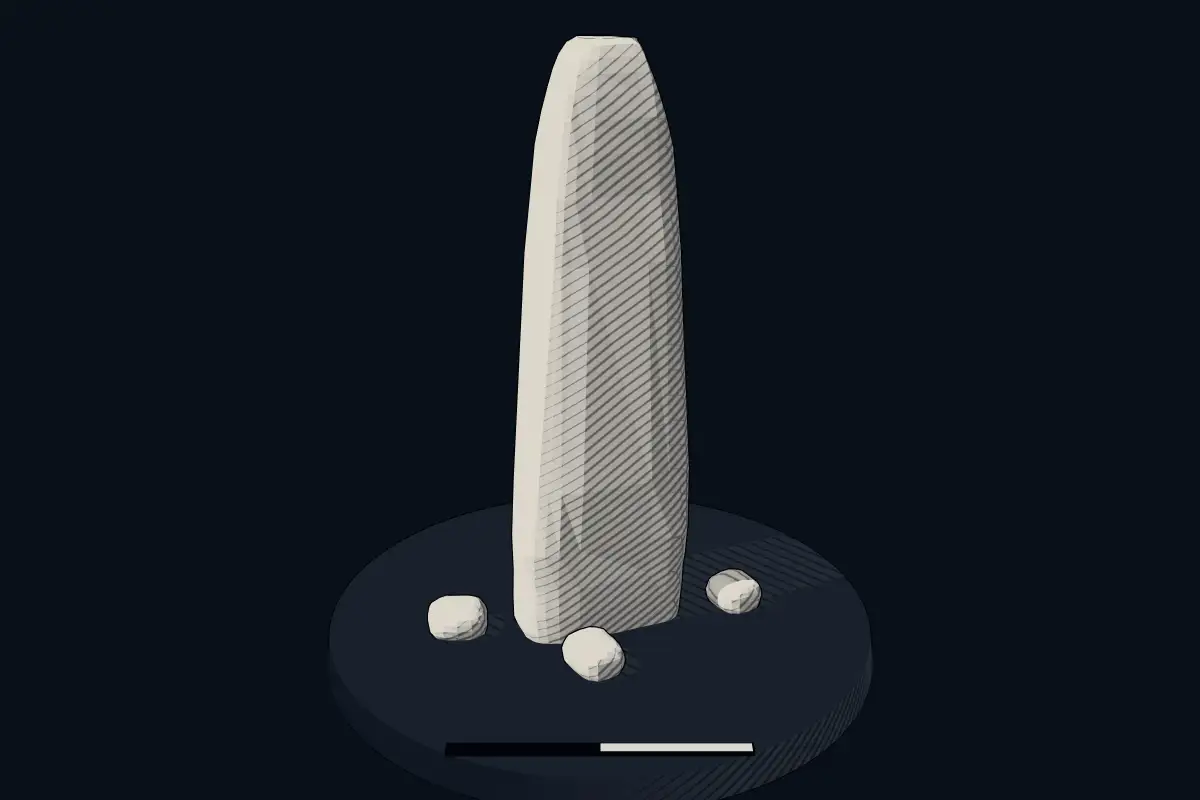
The reconstruction is ours, not a survey: it shows what a monument of this type looks like, at the size the record gives for this one.
Photographs
1 photograph, each with its author and licence
Lore
Evidence & Lore
What the sources actually support — and, kept apart, what has been claimed.
What the evidence supports
Dates
Est. 2800–1800 BCEHow this date was established: Type comparisonTypical range for menhirs in Spain; this site has not been dated itself. Standing stones are associated with the Beaker people of the European late Neolithic and early Bronze Age c. 2800-1800 BC.Source for this date
Where it stands
Spain
The pin marks the monument itself — its exact point.
- Coordinates
- 38°27′02″ N, 7°25′48″ WFor a GPS or map app: 38.45056, -7.43000
Access is as our sources describe it; we have not visited the site to check.
Nearby
The closest sites in the Atlas, by straight line.
 Menir de Santa Margarida2800–1800 BCE
Photo: Vitor Oliveira from Torres Vedras, PORTUGAL · CC BY-SA 2.0
 Menhir von Barrocal2800–1800 BCE
Photo: Vitor Oliveira from Torres Vedras, PORTUGAL · CC BY-SA 2.0
- Megalithic complexAntas von Poço da Gateira
 Conjunto megalítico do Olival da Pêga4000–3000 BCE
 Menir do Outeiro4000–1000 BCE
Photo: Vitor Oliveira from Torres Vedras, PORTUGAL · CC BY-SA 2.0
- Menhir (standing stone)Menir da Rocha dos Namorados4000–1000 BCE
 Menir da Abelhoa4000–1000 BCE
 Conjunto megalítico da Herdade do Xerez4000–1200 BCE
Photo: Vitor Oliveira from Torres Vedras, PORTUGAL · CC BY-SA 2.0


Sources
Every record behind this page, with the link it came from.
2 sources behind this page
- 01Wikidata Q134445049wikidata.org
- 02Source for this dateen.wikipedia.org
Image files
- Menir de Santa Margarida - Portugal (52849324324).jpgVitor Oliveira from Torres Vedras, PORTUGALCC BY-SA 2.0
Report a correctionWrong date, name, photograph or source? Tell us and it will be put right.
Lore, kept apart
Legends and claims
These are stories and claims reported by the sources. They are not evidence, and they never stand in for the dating above.
- Tradition
The standing stone is dated by typological estimate to 2800 BCE to 1800 BCE.
The standing stone is dated by typological estimate to 2800 BCE to 1800 BCE. No particular ancient use, burial association, legend, or later historical connection is stated for this site. Its recorded history includes its classification as a national monument and an Immeuble d'intérêt public (Catégorie IIP) since 1992.
Source
Around this place
The ten nearest sites, by compass
- Menir de Santa Margarida<0.1 km NE
- Menhir von Barrocal1.7 km SE
- Antas von Poço da Gateira2.2 km SW
- Conjunto megalítico do Olival da Pêga2.7 km E
- Menir do Outeiro3.9 km NE
- Menir da Rocha dos Namorados4.0 km W
- Menir da Abelhoa4.3 km E
- Conjunto megalítico da Herdade do Xerez5.2 km E
- Núcleo de seis menires, na Herdade dos Perdigões10.0 km W
- Anta 2 da Herdade dos Cebolinhos10 km S
Credit
Text, licence and sources
Text from the Wikipedia article "Menhir de Santa Margarida" (French), licensed CC BY-SA 4.0; authors are listed in the page history. Reused under CC BY-SA 4.0. Read on Wikipedia · Edit history and authors