
Conjunto de menires de Milrei e do Padrão
Datedc. 4500 BCE
Photo Pedro Ponce Asensio · CC BY-SA 4.0Source file on Wikimedia Commons

Overview
About this site
What the sources say
The Menhirs of Padrão are a group of fifteen megalithic menhirs located in the municipality of Vila do Bispo, in the Faro District of the Algarve region of Portugal. It is believed that they originally formed a large cromlech, or stone circle. An alternative interpretation is that they served as territorial possession markers. Evidence suggests that the site was more or less continuously occupied from the time of construction in around 4500 BCE, to the end of Muslim occupation of Portugal in the middle of the 13th century CE.
Read on Wikipedia6 min readCC BY-SA 4.0
Where it sits in time
The site's dated range, placed against world reference points.
The scale is logarithmic: each step to the left is about ten times older than the last.
The full article
Conjunto de menires de Milrei e do Padrão: the whole story
In briefSources for this section
- Wikipedia (English): Menhirs of PadrãoCC BY-SA 4.0
Sources for this section
- Wikipedia (English): Menhirs of PadrãoCC BY-SA 4.0
The Menhirs of Padrao, listed in the catalogue as the Conjunto de menires de Milrei e do Padrao, are a group of fifteen megalithic menhirs in the municipality of Vila do Bispo, in the Faro District of the Algarve region of Portugal. It is believed that they originally formed a large cromlech, or stone circle. An alternative interpretation is that they served as territorial possession markers. Evidence suggests that the site was more or less continuously occupied from the time of construction in around 4500 BCE to the end of Muslim occupation of Portugal in the middle of the 13th century CE.
The menhirs, probably erected during the Neolithic-Chalcolithic period, stand south of the village of Raposeira. Each of the fifteen was set on a different hilltop, giving a view of the surrounding coastal area as far as Sagres. All were carved from white limestone and had conical, subcylindrical, oval or parallelepiped shapes, with heights between 0.65 and 3 metres. Some bear cup marks and cords. The best-preserved, the Padrao Menhir, has a barely noticeable ring in relief at the top, a symbol also found on other menhirs in the region and interpreted as making the menhir represent a phallus. It is the only one still standing; all the others have fallen and some are in pieces.
The menhir numbered 9 is fragmented but of particular interest, because its base is a subcircular stone structure, about 5 metres in diameter, of limestone, sandstone and greywacke blocks. Finds there included percussion tools, flint flakes and fragments of prehistoric ceramic vessels, and a possible intentional deposit of a ceramic vessel with cockle and limpet shells. Near menhirs 1 and 2 an area rich in grave goods produced a combustion structure and a paving stone from the early Neolithic period, Roman and late-Roman building materials, and a necropolis used in the Visigothic and Islamic periods.
The menhirs were identified by Eduardo Prescott Vicente and Adolfo Silveira Martins, and excavated by Mario Varela Gomes. The Padrao Menhir was re-erected in 1984, after excavations. In 1994 new excavations found the remains of a settlement from around 4500 BCE, suggesting that the main menhir may be one of the oldest in Western Europe. Two menhirs are held in the Vila do Bispo museum with many of the finds.
The group is only a part of the estimated 250-300 menhirs found in Vila do Bispo, in an area of just 42 km2, the highest concentration of prehistoric monuments in the Iberian Peninsula. A joint classification of the Padrao and Milrei menhirs was decreed on 6 July 1983, but the process lapsed, and as of April 2026 the complex still lacked legal protection.
DescriptionSources for this section
- Wikipedia (English): Menhirs of PadrãoCC BY-SA 4.0
Sources for this section
- Wikipedia (English): Menhirs of PadrãoCC BY-SA 4.0
The menhirs, probably erected during the Neolithic-Chalcolithic period, are situated in the Padrão area of Vila do Bispo, south of the village of Raposeira. The best-preserved example, known as the Padrão Menhir, is located near the road between Raposeira and Praia da Ingrina, which divides the site. Each of the fifteen menhirs was situated on a different hilltop, allowing for a view of the surrounding coastal area as far as Sagres. They were all carved from white limestone and had conical, subcylindrical, oval, or parallelepiped shapes, with varied heights between 0.65 and 3 metres. Some of them have decorative elements, consisting of cup marks and cords. The Padrão Menhir is decorated with a barely noticeable ring in relief at the top, a symbol that has also been found on other menhirs in the region and is interpreted to have been used to make the menhir represent a phallus. The Padrão Menhir is the only one that is standing. All the others have fallen and some are in pieces. The Menhirs of Padrão are situated close to other prehistoric monuments, such as the Menhirs of Milrei and the Menhir of Aspradantes.
The menhir given the number 9 is one of those that are fragmented. It is of particular interest because its base is formed by a subcircular stone structure, about 5 metres in diameter, consisting of blocks of limestone, sandstone, and greywacke. A large number of findings were made at this particular site, including percussion tools, flint flakes, and remains of ceramic vessels from the prehistoric period. A possible intentional deposit was also discovered, which included a ceramic vessel and cockle and limpet shells. Close to menhirs 1 and 2, an area rich in grave goods was found, including a combustion structure and a paving stone from the early Neolithic period, building materials from Roman and late-Roman periods, and a necropolis used during the Visigothic and Islamic Gharb Al-Andalus periods. The dating of the grave goods allows us to identify a continuity of occupation and its incorporation into Mozarabic communities.
The Menhirs of Padrão are just a few of the estimated 250-300 menhirs found in Vila do Bispo, in an area of just 42 km2, the highest concentration of prehistoric monuments in the Iberian Peninsula.
ArchaeologySources for this section
- Wikipedia (English): Menhirs of PadrãoCC BY-SA 4.0
Sources for this section
- Wikipedia (English): Menhirs of PadrãoCC BY-SA 4.0
The menhirs were identified by Eduardo Prescott Vicente and Adolfo Silveira Martins, and archaeological excavations were subsequently carried out at the site by Mário Varela Gomes. The Padrão Menhir was re-erected in 1984, after excavations. In 1994, new excavations were carried out, during which the remains of an ancient settlement from around 4500 BCE during the Neolithic period were found. This suggests that the main menhir may be one of the oldest in Western Europe. Several tombs from the late Roman and medieval periods were also discovered, probably having been installed there due to the presence of the prehistoric monuments. Two of the menhirs are held in the Vila do Bispo museum,[1] together with many of the findings during the excavations.
ClassificationSources for this section
- Wikipedia (English): Menhirs of PadrãoCC BY-SA 4.0
Sources for this section
- Wikipedia (English): Menhirs of PadrãoCC BY-SA 4.0
On 6 July 1983, the Ministry of Culture issued a decree on the joint classification of the Padrão and Milrei menhirs, following an opinion from the Provisional National Commission of Archaeology, but this process eventually lapsed without being completed. In September 2010, the Regional Director of Culture for the Algarve announced her intention to finalize the classification processes for the various properties in the region that had already been approved as being of Public or National Interest, with only the final opinion of the Institute for the Management of Architectural and Archaeological Heritage and its publication in the Official Gazette remaining. However, as of April 2026, the complex still lacked legal protection.
How this page was madeSources for this section
- Wikipedia (English): Menhirs of PadrãoCC BY-SA 4.0
Sources for this section
- Wikipedia (English): Menhirs of PadrãoCC BY-SA 4.0
The summary at the top of this page was written by Claude Sonnet 5.5 (2026-11-06) from the cited Wikipedia article “Menhirs of Padrão”. The numbers in it were checked automatically against the source text. The rest of the page is the article itself, the structured records and computed distances.
Tradition and region
About this kind of monument
Iberian menhirs
In Spain menhirs of the western European megalithic type are relatively unusual compared with dolmens, but are common sights in the northern half of the country, where at least 500 have been reported. They are particularly common in the Basque Country, Navarre, northern Burgos and Palencia, Cantabria and the Pyrenees, usually standing alone or in small groups (cromlechs) in elevated places. Most appear to date back to the Stone Age. They are not usually associated with burials, though at the Menhir of Cuesta del Molino in Burgos burials were made at least 2,000 years after the menhir was raised. The Arlobi menhir is one of the most recent examples.
Portugal's highest concentration is in the Alentejo, where the Menhir of Meada is the largest on the Iberian Peninsula. The Menhir of Outeiro, near Reguengos de Monsaraz in the district of Évora, is the second largest in Portugal: a granite monolith 5.6 metres high, about a metre across and an estimated eight tonnes. It was found lying on its side in 1969 by Henrique Leonor Pina and José Pires Gonçalves and re-erected about 1970, and was classified as a national monument in 1971. A hollow in its top has been read as a urethra, so that the stone is taken as phallic; that is an interpretation, not a fact.
The Almendres Cromlech near Évora is the largest group of structured menhirs on the Iberian Peninsula, and one of the largest in Europe. It belongs to the "megalithic universe of Évora", with parallels in the Portela de Mogos cromlech. Its beginnings have been put as far back as the sixth millennium BCE, which would make it extremely early, and it was rediscovered in 1966 by Henrique Leonor Pina.
When visiting, look for stones on high ground and note which way they face.
Paraphrased from Wikipedia: Menhir, Wikipedia: Menhir of Outeiro, Wikipedia: Almendres Cromlech, Wikipedia: List of menhirs · CC BY-SA 4.0
From the article
Dated moments in the story
- 4500 BCE
Evidence suggests that the site was more or less continuously occupied from the time of construction in around 4500 BCE, to the end of Muslim occupation of Portugal in the middle of the 13th century CE.
Source - 4500 BCE
In 1994, new excavations were carried out, during which the remains of an ancient settlement from around 4500 BCE during the Neolithic period were found.
Source - 1983
On 6 July 1983, the Ministry of Culture issued a decree on the joint classification of the Padrão and Milrei menhirs, following an opinion from the Provisional National Commission of Archaeology, but this process eventually lapsed without being completed.
Source - 1984
The Padrão Menhir was re-erected in 1984, after excavations.
Source - 2010
In September 2010, the Regional Director of Culture for the Algarve announced her intention to finalize the classification processes for the various properties in the region that had already been approved as being of Public or National Interest, with only the final opinion of the Institute for the Management of...
Source - 2026
However, as of April 2026, the complex still lacked legal protection.
Source
See it in 3D
An interpretive reconstruction of the monument, standing on the real ground at its exact point, under the sun for that place and season. Drag to look around it.
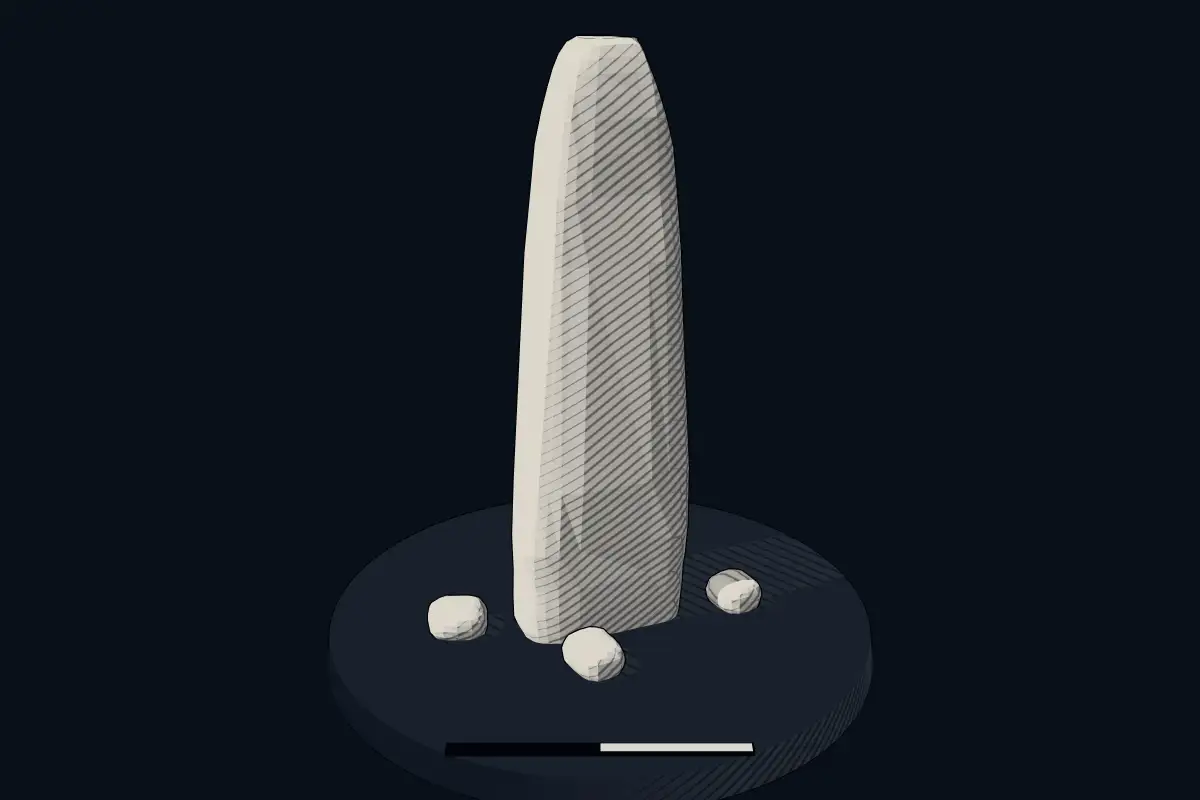
The reconstruction is ours, not a survey: it shows what a monument of this type looks like, at the size the record gives for this one.
Photographs
7 photographs, each with its author and licence
More photographs


Lore
Evidence & Lore
What the sources actually support — and, kept apart, what has been claimed.
What the evidence supports
Dates
Est. 4000–1000 BCEHow this date was established: Type comparisonTypological estimate, not a date for this site: a menhir in the Iberian Peninsula is normally dated between 4000 BCE and 1000 BCE (Atlas typological table).Source for this date
Measured facts
- Monument count
- fifteen megalithic menhirsSource: Monument count
- Location
- Vila do Bispo, Faro District, Algarve regionSource: Location
- Possible original form
- large cromlech, or stone circleSource: Possible original form
- Padrão Menhir re-erected
- 1984Source: Padrão Menhir re-erected
- Later excavation
- 1994Source: Later excavation
- Museum collection
- two menhirs and many excavated findsSource: Museum collection
- Heritage designation
- heritage without legal protectionSource: Heritage designation
Where it stands
Portugal
The pin marks the monument itself — its exact point.
- Coordinates
- 37°03′46″ N, 8°53′18″ WFor a GPS or map app: 37.06265, -8.88833
Access is as our sources describe it; we have not visited the site to check.
Nearby
The closest sites in the Atlas, by straight line.
 Menhire von Vila do Bispo e Raposeira2800–1800 BCE
- Menhir (standing stone)Menhires de Milrei2800–1800 BCE
 Menir de Aspradantes2800–1800 BCE
- Stone circleCrómlech de Amantes 23300–2500 BCE
 Menires do Cerro do Camacho2800–1800 BCE
- Stone circleCrómlech de Amantes 13300–2500 BCE
 Conjunto de menires de Vila do Bispo (Pedra Escorregadia; Casa do Francês; Amantes I; Amantes II; Cerro do Camacho)2800–1800 BCE
- Menhir (standing stone)Menhires de Casa do Francês2800–1800 BCE


Sources
Every record behind this page, with the link it came from.
2 sources behind this page
- 01Wikidata Q10328701wikidata.org
- 02Wikipedia (en)en.wikipedia.org
Image files
- Menir do Padrão.jpgPedro Ponce AsensioCC BY-SA 4.0
- Menir do Padrão near Raposeira - Portugal - 2015-08-03.jpgNorbert NagelCC BY-SA 4.0
- Menir Padrão.jpgRmatospiCC BY-SA 4.0
- Menir de Padrão, Raposeira.08-05-2018.jpgBextrelCC BY-SA 4.0
- Menir de Padrão - Portugal (52593538464).jpgVitor Oliveira from Torres Vedras, PORTUGALCC BY-SA 2.0
- Menir de Padrão - Portugal (52514417000).jpgVitor Oliveira from Torres Vedras, PORTUGALCC BY-SA 2.0
- Menir Raposeira.jpgZavial at pt.wikipediaPublic domain
Report a correctionWrong date, name, photograph or source? Tell us and it will be put right.
Around this place
The ten nearest sites, by compass
- Menhire von Vila do Bispo e Raposeira<0.1 km NW
- Menhires de Milrei0.8 km N
- Menir de Aspradantes2.4 km NE
- Crómlech de Amantes 22.4 km W
- Menires do Cerro do Camacho2.4 km W
- Crómlech de Amantes 12.5 km W
- Conjunto de menires de Vila do Bispo (Pedra Escorregadia; Casa do Francês; Amantes I; Amantes II; Cerro do Camacho)2.6 km W
- Menhires de Casa do Francês2.8 km W
- Rosa dos Ventos8.7 km SW
- Menir da Cabeça do Rochedo17 km NE
Credit
Text, licence and sources
Text from the Wikipedia article "Menhirs of Padrão" (English), licensed CC BY-SA 4.0; authors are listed in the page history. Reused under CC BY-SA 4.0. Read on Wikipedia · Edit history and authors
- Wikipedia (English): Menhirs of PadrãoCC BY-SA 4.0
- Wikidata Q10328701CC0