.jpg/1920px-Dolmen_da_Portelagem_(6).jpg 1920w)
Anta da Portelagem e Mamoas do Rápido
DatedEst. 4000–3000 BCE
Photo Sqjaques · CC BY-SA 4.0Source file on Wikimedia Commons
Overview
About this site
What the sources say
A Anta da Portelagem localiza-se na na freguesia de Vila Chã, Município de Esposende, Distrito de Braga, em Portugal.
Classifica-se este como um monumento megalítico pertencente a um conjunto de cerca de duas dezenas deles concentrados no planalto da freguesia (Necrópole Megalítica do Planalto Vilachanês).
Article in PortugueseRead on Wikipedia5 min readCC BY-SA 4.0
Where it sits in time
The site's dated range, placed against world reference points.
The scale is logarithmic: each step to the left is about ten times older than the last.
The full article
Anta da Portelagem e Mamoas do Rápido: the whole story
In briefSources for this section
Sources for this section
The Anta da Portelagem is in the parish of Vila Chã, in the municipality of Esposende, in the district of Braga, Portugal. It is a megalithic monument belonging to a group of about twenty concentrated on the plateau of the parish, known as the Megalithic Necropolis of the Vilachanês Plateau. It dates from around 3000 BC.
The monument consists of a relatively well-preserved tumulus and a stone covering that rests against the slabs of the chamber. The chamber is sub-rectangular and was originally formed by 14 or 15 granite orthostats of varying volume and size. Today 12 remain, some partly fragmented, and of its roof only one large slab survives.
Francisco Martins Sarmento explored the monument in the late nineteenth century. His excavation recovered 5 arrowheads of quartz and flint and a carinated vessel with a handle, decorated with nipple-like bumps on the carination. More recently a team from the Universidade Portucalense, led by Dr. Eduardo Jorge Lopes da Silva, collected further arrowheads and some fragments of Bell Beaker pottery. Knives, necklace beads, grinding stones and other objects of granite and schist were also found. The material is kept in the Municipal Museum of Esposende, and the monuments are being classified by IGESPAR.
The Mamoas do Rápido, in the same parish and the same group, are made up of three monuments: two mounds and one dolmen. Only the Rápido III dolmen has been excavated. The other two are unexcavated but show signs of having been broken into, as there are holes in the top of the earth cap where a burial chamber seems to lie.
Rápido III is in good condition. Inside it has engravings and paintings representing megalithic funerary art, and some of its orthostats carry engravings that the most recent research team is studying.
No English Wikipedia article exists for it; the full text below is the Portuguese article "Anta da Portelagem e Mamoas do Rápido", shown in the original language.
Summary in EnglishSources for this section
Sources for this section
Anta da Portelagem e Mamoas do Rápido is a dolmen in Vila Chã, Portugal. A typological estimate: 4000 BCE to 3000 BCE. No English Wikipedia article exists for it; the full text below is the Portuguese article "Anta da Portelagem e Mamoas do Rápido", shown in the original language.
HistóriaSources for this section
Sources for this section
A Anta da Portelagem é um monumento megalítico que data de cerca de 3000 a.C., e que foi objeto de prospecção arqueológica em fins do século XIX por Francisco Martins Sarmento. Do espólio recolhido nessa escavação constam 5 pontas de seta em quartzo e sílex e um vaso com asa carenado e decorado com mamilos sobre a carena.
Recentemente foi objecto de uma nova intervenção, por parte de uma equipa da Universidade Portucalense, dirigida pelo Dr. Eduardo Jorge Lopes da Silva. Nesta, para além de mais pontas de seta, foram recolhidos também alguns fragmentos de cerâmica campaniforme.
O material recolhido nas intervenções encontra-se depositado no Museu Municipal de Esposende. Além das pontas de setas e de fragmentos cerâmicos, foram encontrados ainda facas e contas de colar, entre mós de rebolo e outros materiais em pedra de granito e xisto.
Os monumentos encontram-se em via de classificação pelo IGESPAR.
CaracterísticasSources for this section
Sources for this section
A Anta da Portelagem é constituído por um "tumulus" relativamente bem conservado e uma couraça pétrea que encosta às lajes da câmara. Esta, por sua vez, tem uma forma sub-rectangular e originalmente seria formada por 14 ou 15 esteios graníticos de volumetria e tamanho variável. Presentemente, restam 12 esteios, alguns dos quais parcialmente fragmentados. Da sua cobertura resta, somente, uma laje de proporções avantajadas.
Dólmen do RapídoSources for this section
Sources for this section
As Mamoas do Rápido localizam-se na freguesia de Vila Chã, concelho de Esposende, distrito de Braga, em Portugal.
Fazem parte dos monumentos megalíticos pertencentes a um conjunto de cerca de duas dezenas deles concentrados no planalto da freguesia.
História
O conjunto do Rapido é formado, contudo, por três monumentos, sendo duas mamoas e um dólmen. Apenas foi escavado o dolmem do Rapído III, estando os outros dois monumentos ainda por escavar. Porém, encontram-se marcas de terem sido violados, pois há buracos no ato da calote de terra, onde parece haver uma câmara funerária.
Foi objecto de uma nova intervenção, por parte de uma equipa da Universidade Portucalense, dirigida pelo Dr. Eduardo Jorge Lopes da Silva. Nesta, para além de mais pontas de seta, foram recolhidos também alguns fragmentos de cerâmica.
O material recolhido nas intervenções encontra-se depositado no Museu Municipal de Esposende. Além das pontas de setas e de fragmentos cerâmicos, foram encontrados ainda facas e contas de colar, entre mós de rebolo e outros materiais em pedra de granito e xisto.
Os monumento encontram-se em via de classificação pelo IGESPAR.
Características
O dólmen III do Rápido encontra-se em bom estado de conservação e integra-se num grupo de três mamoas situadas na mesma zona. Destas, é a única intervencionada até ao presente momento e apresenta no seu interior uma série de gravuras e pinturas, representativas da arte funerária megalítica.
No que toca à temática decorativa, por vezes usual neste tipo de monumentos, sabemos que alguns dos esteios possuem gravados (arte rupestre) e que estão a ser estudados pela equipa que procedeu aos mais recentes trabalhos.
How this page was madeSources for this section
Sources for this section
The summary at the top of this page was written by Claude Sonnet 5.5 (2026-11-06) from the cited Wikipedia article “Anta da Portelagem e Mamoas do Rápido”, translated from Portuguese. The numbers in it were checked automatically against the source text. The rest of the page is the article itself, the structured records and computed distances.
Tradition and region
About this kind of monument
Portuguese antas of the Alentejo
Around Évora, in the Alentejo, megalithic tombs are called antas, and some of the largest in Iberia stand here. The Great Dolmen of Zambujeiro, near Valverde in the municipality of Évora, is considered one of the biggest such structures in Iberia. Research has dated it to between 4000 and 3000 BCE, concurrent with the megalithic building of the Évora region, and it is linked to the Great Dolmen of Comenda da Igreja at Montemor-o-Novo. Henrique Leonor Pina excavated it in 1965, and although his methods caused some controversy, the work recovered slate tablets, necklaces, crosiers, copper objects, ceramics and carinated bowls. The Portuguese government declared it a national monument in 1971.
The finds show that the tombs were used for generations: slate tablets, personal ornaments and copper objects in the chambers reach into the Chalcolithic, so one anta can carry evidence for several centuries of burial custom. Excavated anta chambers are the main source for dating, since the stones themselves cannot be dated.
Nearby, the Almendres Cromlech is a large group of standing stones, a reminder that the Alentejo's megalithic landscape also includes open-air stone enclosures and single menhirs, not only tombs.
The Atlas's records here include small antas, some reduced to a few standing slabs, and many lack a secure excavation date. They are labelled with a typological range.
When visiting, look for the chamber and the passage that leads to it, and for the way the monument sits in its field. Check access in advance.
Paraphrased from Wikipedia: Great Dolmen of Zambujeiro, Wikipedia: Great Dolmen of Comenda da Igreja, Wikipedia: Almendres Cromlech, Wikipedia: Dolmen · CC BY-SA 4.0
From the article
Dated moments in the story
- 3000 BCE
A Anta da Portelagem é um monumento megalítico que data de cerca de 3000 a.C., e que foi objeto de prospecção arqueológica em fins do século XIX por Francisco Martins Sarmento.
Source
See it in 3D
An interpretive reconstruction of the monument, standing on the real ground at its exact point, under the sun for that place and season. Drag to look around it.
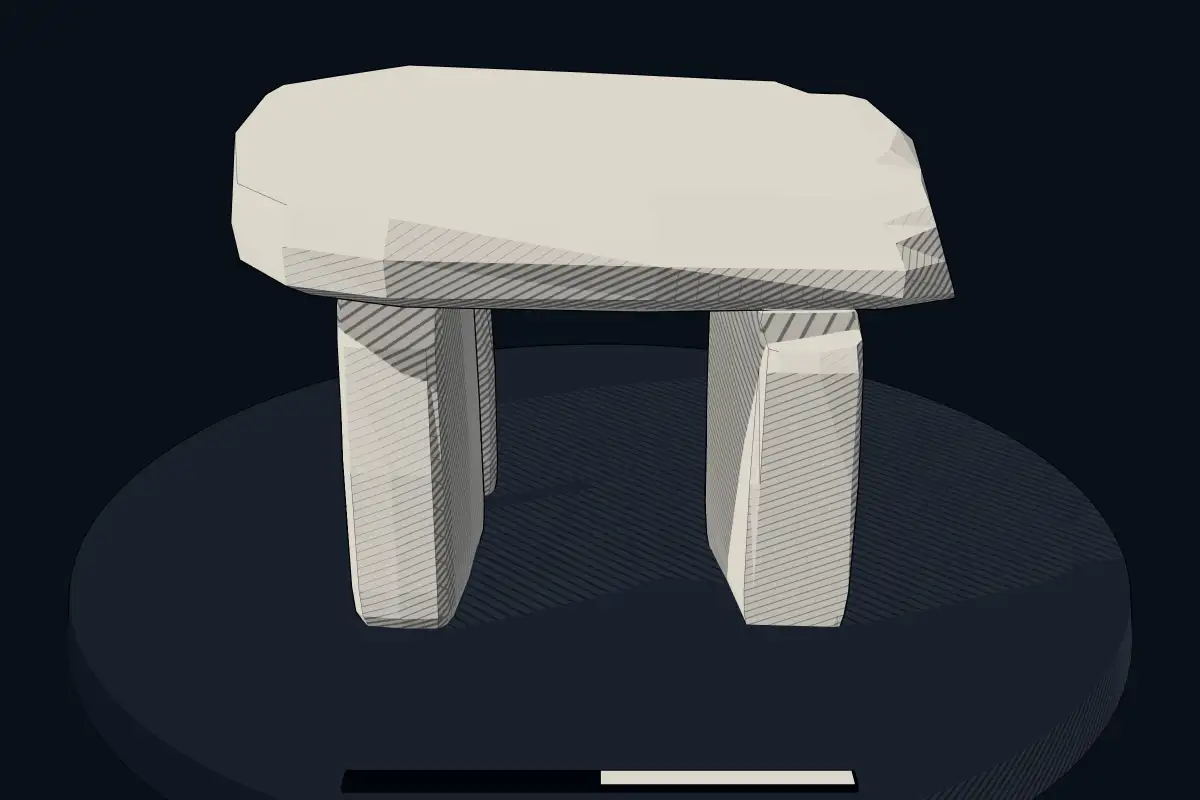
The reconstruction is ours, not a survey: it shows what a monument of this type looks like, at the size the record gives for this one.
Photographs
4 photographs, each with its author and licence
More photographs
Lore
Evidence & Lore
What the sources actually support — and, kept apart, what has been claimed.
What the evidence supports
Dates
Est. 4000–3000 BCEHow this date was established: Type comparisonTypical range for dolmens in Portugal; this site has not been dated itself. Most dolmens date from the Late Neolithic period (4000-3000 BCE); megalithic tombs at Algarve in Portugal date to c. 2500 BC.Source for this date
Where it stands
Portugal
The pin marks the monument itself — its exact point.
- Coordinates
- 41°34′42″ N, 8°45′44″ WFor a GPS or map app: 41.57832, -8.76233
Access is as our sources describe it; we have not visited the site to check.
Nearby
The closest sites in the Atlas, by straight line.


Sources
Every record behind this page, with the link it came from.
2 sources behind this page
- 01Wikidata Q9616854wikidata.org
- 02Source for this dateen.wikipedia.org
Image files
Report a correctionWrong date, name, photograph or source? Tell us and it will be put right.
Around this place
The ten nearest sites, by compass
- Rapído dolmen<0.1 km N
- Menir de São Bartolomeu do Mar2.5 km W
- Menir de São Paio de Antas2.5 km N
- Mamoa do Chão da Pica23 km N
- Mamoa de Eireira25 km N
- Mamoa de Aspra26 km N
- Dólmen de Vile27 km N
- Anta da Barrosa27 km N
- Via romana de Braga a Tui - 14 marcos miliários (série capela)28 km NE
- Nécropole mégalithique de Bustelo28 km NE
Credit
Text, licence and sources
Text from the Wikipedia article "Anta da Portelagem e Mamoas do Rápido" (Portuguese), licensed CC BY-SA 4.0; authors are listed in the page history. Reused under CC BY-SA 4.0. Read on Wikipedia · Edit history and authors