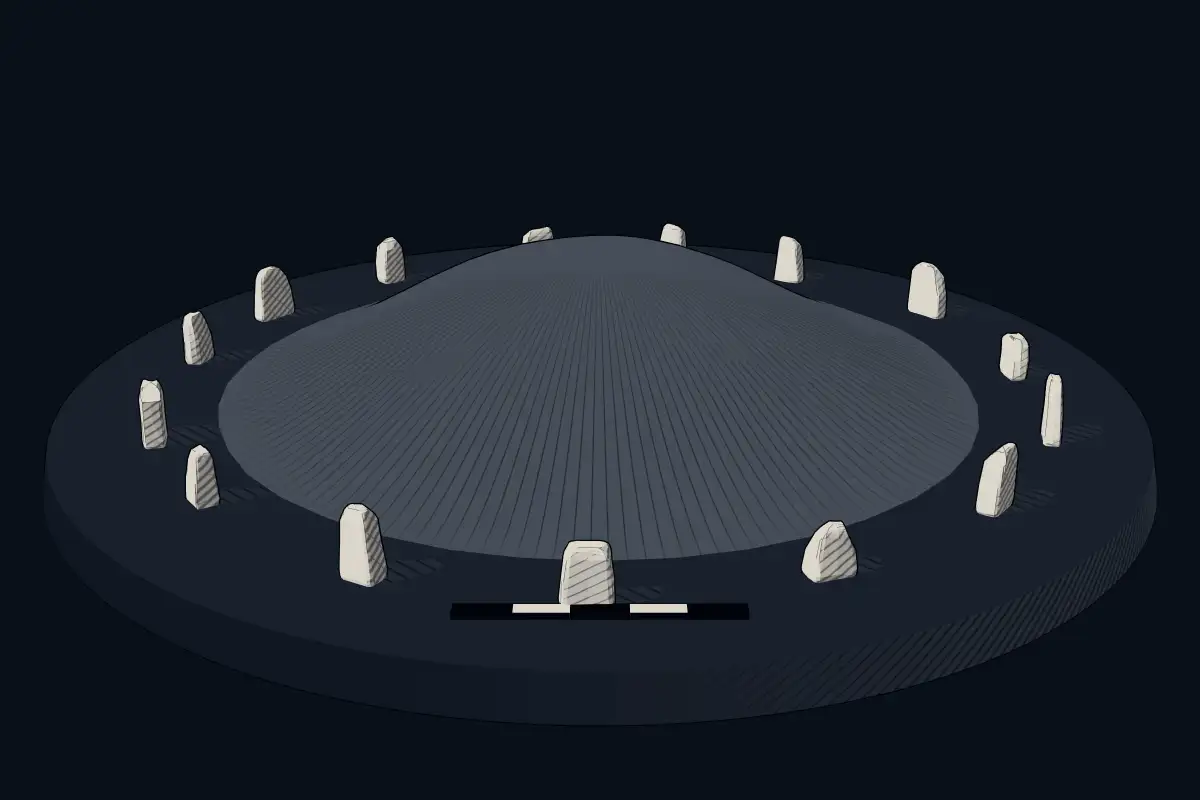
Megalithic mound (tumulus with integral stones)
Kurmaičių pilkapynas
No licensed photograph yetWe have no photograph we may publish for this site, so the interpretive 3D view leads instead.
Overview
About this site
What the sources say
Kurmaičių pilkapynas (saugomos kultūros vertybės: unikalūs kodai – 5237, 12258, 27085; senieji registro kodai – A1713, A1714, A1715; senieji kultūros paminklų sąrašo Nr. AR519, IP2405A) – pilkapiai pietvakarinėje Kretingos rajono savivaldybės teritorijos dalyje, Kurmaičių kaime (Kretingos seniūnija), Akmenos upės (Padvarių tvenkinio) dešiniajame krante.
Article in LithuanianRead on Wikipedia5 min readCC BY-SA 4.0
The full article
Kurmaičių pilkapynas: the whole story
In briefSources for this section
- Wikipedia (Lithuanian): Kurmaičių pilkapynasCC BY-SA 4.0
Sources for this section
- Wikipedia (Lithuanian): Kurmaičių pilkapynasCC BY-SA 4.0
Kurmaičių pilkapynas is a group of burial mounds in Kurmaičių village, in the southwestern part of Kretingos rajono savivaldybės, on the right bank of the Akmenos River near the Padvarių tvenkinys. The cemetery includes solitary mounds and groups of mounds spread between the Akmenos and Bažnyčios kalnas hills. Fourteen mound locations were known, and 10 mounds were investigated.
The investigated mounds were 6–18 m across and 0,6-1,5 m high. They were covered with one or several stone rings, and most were paved with stones. Each contained 2–7 cremation graves, with the burnt remains placed in clay urns or without urns. The urns were hand-built and had smooth or slightly roughened surfaces. One black, bowl-shaped urn with a smooth surface and a handle was characteristic of the Lužitėnų culture. A woman’s grave included brass head ornaments: 2 coiled temple rings and 6 spiral looped temple rings.
The mounds and one separate grave outside them are dated to V–I a. pr. m. e. Research was carried out in 1940 by Pranas Baleniūnas, in 1948 and 1950–1951 by Pranas Kulikauskas, and in 2010 by Algimantas Merkevičius. The finds are held by Vytauto Didžiojo karo muziejus and Lietuvos nacionalinis muziejus. Other investigations were made in 1959, 1982 and 1992.
Several mounds were damaged or destroyed. In 1924–1927, Nikodimas Tamošauskis dug a trench through the mound called Pilalė and found 3 stone-built graves, cremated bones and ceramic vessels. Two mounds near the junction of the Akmenos and an unnamed stream were destroyed for building stone, and 2 mounds were dug out in 1941 for a military installation. Local people traditionally called the mounds Pilalės; legends associated them with Swedish soldiers, hidden church treasures and a priest who celebrated services there.
No English Wikipedia article exists for it; the full text below is the Lithuanian article "Kurmaičių pilkapynas", shown in the original language.
Summary in EnglishSources for this section
- Wikipedia (Lithuanian): Kurmaičių pilkapynasCC BY-SA 4.0
Sources for this section
- Wikipedia (Lithuanian): Kurmaičių pilkapynasCC BY-SA 4.0
Kurmaičių pilkapynas is a megalithic mound (tumulus with integral stones) in Kretinga Municipality, Lithuania. No English Wikipedia article exists for it; the full text below is the Lithuanian article "Kurmaičių pilkapynas", shown in the original language.
PilkapynasSources for this section
- Wikipedia (Lithuanian): Kurmaičių pilkapynasCC BY-SA 4.0
Sources for this section
- Wikipedia (Lithuanian): Kurmaičių pilkapynasCC BY-SA 4.0
Pilkapyną sudarė tarp Akmenos ir Bažnyčios kalnu vadinamos kalvos išsibarstę pavieniai pilkapiai ir pilkapių grupės, iš kurių žinomos 14 pilkapių vietos. 10 pilkapių buvo Kurmaičių kapinyno teritorijoje. Pirmasis pilkapis įrengtas kalvos pietrytinėje papėdėje. 180 m į šiaurės vakarus nuo jo kalvos šiauriniame gale buvo 2 pilkapiai, o 70 m į rytus nuo jų – 7 pilkapių grupė. 160 m į rytus nuo I pilkapio upės pakrantėje stūkso pilkapio, vad. Pilale, liekanos (unikalus kodas 27085), nuo kurių 30 m į pietryčius buvo dar vienas pilkapis. 300 m nuo I pilkapio į pietryčius, Akmenos ir bevardžio jos intako santakos aukštumoje išliko dar 2 pilkapių vieta (unikalus kodas 12258).
Teritorijos plotas: Kurmaičių kapinyne esančių pilkapių – 4,7 ha (bendra su kapinynu), Kurmaičių pilkapio, vad. Pilale – 0,32 ha, Kurmaičių 2 pilkapių vietos – 0,8 ha.
IstorijaSources for this section
- Wikipedia (Lithuanian): Kurmaičių pilkapynasCC BY-SA 4.0
Sources for this section
- Wikipedia (Lithuanian): Kurmaičių pilkapynasCC BY-SA 4.0
Kurmaičių ir jo žemės pietiniame pakraštyje susiformavusio Tintelių kaimo žemėje pilkapiai buvo žinomi nuo seno. Vietos gyventojai tradiciškai juos vadino Pilalėmis. Iš jų dydžiu išsiskyrė Akmenos pakrantėje buvęs pilkapis, vadintas Pilale, Pilalių kalnu. Padavimai bylojo, kad jį supylė švedų kareiviai, įsirengę ant kalvelės karinę stovyklą. Kitos legendos mena, kad kalvelės požemiuose esą paslėpti bažnytiniai lobiai (aukso monstrancijos, taurės, vyskupų lazdos ir pan.), kad sekmadieniais iš kalvelės išeina kunigas, atlaiko čia pamaldas ir nežinia kur pradingsta. 1924–1927 m. pilkapį perkasė vietos gyventojas Nikodimas Tamošauskis, jaunystėje dalyvavęs skitų pilkapių tyrinėjimuose Ukrainoje. Skersai pilkapio jis iškasė 8 m pločio ir 4 m gylio perkasą, kurioje rado 3 griautinius kapus, degintinių kaulų, keramikos šukių. Tarpukariu pilkapis buvo laikomas piliakalniu.
Į pietryčius nuo jo pakrantėje buvusį kitą pilkapį, taip pat vadintą Pilale, nuplovė Akmenos upė, o jo liekanos buvo nustumdytos formuojant tvenkinį. Į pietus nuo minėtų pilkapių ties Akmenos ir bevardžio upelio santaka buvę 2 pilkapiai sunaikinti kasant iš jų akmenis statyboms.
Bažnyčios kalno šiauriniame gale buvusius 2 pilkapius 1941 m. perkasė raudonarmiečiai, planavę čia įrengti dotą. Likusieji pilkapiai apardyti XX a. I pusėje dirbant žemės ūkio darbus.
Bažnyčios kalno teritorijoje ir aplinkoje esantys pilkapiai ir kapinynas XX a. 7 dešimtmetyje buvo paskelbti landšaftiniu istoriniu draustiniu, o 1972 m. įrašyti į respublikinės reikšmės archeologijos paminklų sąrašą (AR519). Lietuvos Respublikos kultūros vertybių registre jie saugomi kaip sudėtinė Kurmaičių kapinyno dalis. Prie Akmenos upės esantis Kurmaičių pilkapis, vad. Pilale, ir Kurmaičių pilkapių vieta 2003 m. įrašyti į kultūros vertybių registro archeologinių vietų sąrašą (A1714, A1715), o 2005 m. pripažinti valstybės saugomomis kultūros vertybėmis.
TyrimaiSources for this section
- Wikipedia (Lithuanian): Kurmaičių pilkapynasCC BY-SA 4.0
Sources for this section
- Wikipedia (Lithuanian): Kurmaičių pilkapynasCC BY-SA 4.0
1940 m. pilkapius tyrė Pranas Baleniūnas (Vytauto Didžiojo kultūros muziejus), 1948, 1950–1951 m. – Pranas Kulikauskas (Lietuvos mokslų akademijos Istorijos institutas), 2010 m. – Algimantas Merkevičius (Vilniaus universitetas). 1959 m. žvalgė Juozas Mickevičius (Kretingos kraštotyros muziejus), 1982 m. – Mokslinė metodinė kultūros paminklų apsaugos taryba (tyrimų vadovas Romas Olišauskas), 1992 m. – Lietuvos kultūros paveldo mokslinis centras (tyrimų vadovas Vilnius Morkūnas).
Ištirta 10 pilkapių. Pilkapiai buvo 6–18 m skersmens, 0,6-1,5 m aukščio, apdėti vienu arba keliais akmenų vainikais, dauguma išgrįsti akmenimis. Pilkapiuose rasta po 2–7 degintinius kapus. Sudegintų mirusiųjų palaikai laidoti molinėse urnose ir be jų. Urnos lipdytos, lygiu arba šiek tiek brūkšniuotu paviršiumi. Viena urna juodos spalvos, lygiu paviršiumi, dubens pavidalo, su ąsele, būdinga Lužitėnų kultūrai. Laidota dažniausiai be įkapių arba su negausiomis įkapėmis. Viename moters kape rasta žalvarinių galvos apdangalo papuošalų: 2 įvijiniai antsmilkiniai ir 6 sraiginės kilpinės įvijos, puošiančios kepurėlę.
Sudegintų mirusiųjų palaikai laidoti taip pat tarp pilkapių, lygioje vietoje iškastose duobėse. 2010 m. aptiktame kape sudeginti mirusiojo palaikai buvę supilti į dubens pavidalo urną lygiu paviršiumi, kuri iš viršaus buvusi pridengta plokščiu akmeniu. Aplinkoje ištirtos 3 stulpavietės, o atokiau nuo kapo – apeiginė ugniavietė.
Pilkapiai ir pavienis kapas už pilkapių ribų datuojami V–I a. pr. m. e.
Radinius saugo Vytauto Didžiojo karo muziejus ir Lietuvos nacionalinis muziejus.
NuorodosSources for this section
- Wikipedia (Lithuanian): Kurmaičių pilkapynasCC BY-SA 4.0
Sources for this section
- Wikipedia (Lithuanian): Kurmaičių pilkapynasCC BY-SA 4.0
[http://www.heritage.lt/vak/vako.php?kaim=Kurmai�?ių_km.&valsc=Kretingos_vals.&byla=18&id=2826 Valstybės archeologijos komisjos medžiaga. – Kultūros paveldo centro paveldosaugos biblioteka. – Ap. 1, b. 18. – L. 26–28, 32, 33, 35, 38, 42–46, 55, 57, 59, 60] Archyvuota kopija 2016-03-05 iš Wayback Machine projekto.
Kurmaičiuose atkasė kelių tūkstantmečių senumo urną. – Vakarų ekspresas – 2010, rugpjūčio 10
Lina Buikienė. Kurmaičių pilkapynas. – Kretingos krašto enciklopedija, 2010 Archyvuota kopija 2016-03-06 iš Wayback Machine projekto.
How this page was madeSources for this section
- Wikipedia (Lithuanian): Kurmaičių pilkapynasCC BY-SA 4.0
Sources for this section
- Wikipedia (Lithuanian): Kurmaičių pilkapynasCC BY-SA 4.0
The summary at the top of this page was written by MiniMax-M3 (2026-11-07) from the cited Wikipedia article “Kurmaičių pilkapynas”, translated from Lithuanian. The numbers in it were checked automatically against the source text. The rest of the page is the article itself, the structured records and computed distances.
Tradition and region
About this kind of monument
Baltic barrow cemeteries
Along the southern and eastern shores of the Baltic, burial mounds mark the territories of the Baltic peoples. In Lithuanian they are called pilkapiai, and the Atlas's Lithuanian and Belarusian records are mostly cemeteries of small mounds recorded in national registers. They are barrow cemeteries and not megaliths.
The deepest root of the tradition is the West Baltic barrow culture of the early Iron Age, from which most of the Western Baltic culture arose. That culture, of the Bronze Age and Iron Age along the southern coast of the Baltic, was ethnically Baltic and shared similar monuments and funeral rites; its tribes included the Old Prussians, Galindians, Yotvingians and Skalvians. Further north, the Curonians, a medieval Baltic tribe of the fifth to sixteenth centuries CE, lived on the coast of what are now western Latvia and Lithuania, and their neighbours the Samogitians lived inland to the east. Mounds of the broader barrow tradition, the kurgans, had spread into eastern and northern Europe as early as the third millennium BCE.
Because a cemetery is made up of many small mounds, it records an ordinary community and not a single ruler. Many of these mounds have not been excavated, so the Atlas gives them a broad range and does not claim a date.
When visiting, look for a group of small round mounds under trees or on a river terrace, and note how the mounds are laid out along the terrace or ridge.
Paraphrased from Wikipedia: Western Baltic culture, Wikipedia: Curonians, Wikipedia: Samogitians, Wikipedia: Kurgan, Wikipedia: Tumulus · CC BY-SA 4.0
From the article
Dated moments in the story
- 1924
1924–1927 m. pilkapį perkasė vietos gyventojas Nikodimas Tamošauskis, jaunystėje dalyvavęs skitų pilkapių tyrinėjimuose Ukrainoje.
Source - 1948
1940 m. pilkapius tyrė Pranas Baleniūnas (Vytauto Didžiojo kultūros muziejus), 1948, 1950–1951 m. – Pranas Kulikauskas (Lietuvos mokslų akademijos Istorijos institutas), 2010 m. – Algimantas Merkevičius (Vilniaus universitetas).
Source - 2010
Kurmaičiuose atkasė kelių tūkstantmečių senumo urną. – Vakarų ekspresas – 2010, rugpjūčio 10 Lina Buikienė.
Source - 2010
Kurmaičių pilkapynas. – Kretingos krašto enciklopedija, 2010 Archyvuota kopija 2016-03-06 iš Wayback Machine projekto.
Source - 2016
26–28, 32, 33, 35, 38, 42–46, 55, 57, 59, 60] Archyvuota kopija 2016-03-05 iš Wayback Machine projekto.
Source
See it in 3D
An interpretive reconstruction of the monument, standing on the real ground at its exact point, under the sun for that place and season. Drag to look around it.
The reconstruction is ours, not a survey: it shows what a monument of this type looks like, at the size the record gives for this one.
Where it stands
Lithuania
The pin marks the monument itself — its exact point.
- Coordinates
- 55°55′42″ N, 21°15′05″ EFor a GPS or map app: 55.92823, 21.25129
Access is as our sources describe it; we have not visited the site to check.
Nearby
The closest sites in the Atlas, by straight line.


Sources
Every record behind this page, with the link it came from.
1 source behind this page
- 01Wikidata Q12661834wikidata.org
Report a correctionWrong date, name, photograph or source? Tell us and it will be put right.
Lore, kept apart
Legends and claims
These are stories and claims reported by the sources. They are not evidence, and they never stand in for the dating above.
- Tradition
Several mounds were damaged or destroyed.
Several mounds were damaged or destroyed. In 1924–1927, Nikodimas Tamošauskis dug a trench through the mound called Pilalė and found 3 stone-built graves, cremated bones and ceramic vessels. Two mounds near the junction of the Akmenos and an unnamed stream were destroyed for building stone, and 2 mounds were dug out in 1941 for a military installation. Local people traditionally called the mounds Pilalės; legends associated them with Swedish soldiers, hidden church treasures and a priest who celebrated services there.
Source
Around this place
The ten nearest sites, by compass
Credit
Text, licence and sources
Text from the Wikipedia article "Kurmaičių pilkapynas" (Lithuanian), licensed CC BY-SA 4.0; authors are listed in the page history. Reused under CC BY-SA 4.0. Read on Wikipedia · Edit history and authors