
Megalithic mound (tumulus with integral stones)
Cheonmachong
Photo Symtux · CC BY-SA 4.0Source file on Wikimedia Commons
Overview
About this site
Overview
Cheonmachong (Korean: 천마총; literally 'sky horse tomb'), formerly Tomb No. 155, is a tumulus in Gyeongju, South Korea, inside the tomb complex of Daereungwon. It was built in the style of Silla and is believed to date probably from the fifth century, but perhaps from the sixth century CE. It was the tomb of an unknown king of the Silla Kingdom; there is a strong view that it is the tomb of King Jijeung.
Read on Wikipedia3 min readCC BY-SA 4.0
Article
Cheonmachong
The tomb, in typical Silla style, is a wood-lined chamber running east to west, covered by a mound of boulders and earth.
DescriptionSources for this section
- Wikipedia (English): CheonmachongCC BY-SA 4.0
Sources for this section
- Wikipedia (English): CheonmachongCC BY-SA 4.0
The tomb, in typical Silla style, is a wood-lined chamber running east to west, covered by a mound of boulders and earth. This kind of tomb is said to follow the pattern of a Scytho-Iranian tomb at Pazyryk, Russia. The mound is 47 metres in diameter, 157 metres in circumference and 12.7 metres in height.
ExcavationsSources for this section
- Wikipedia (English): CheonmachongCC BY-SA 4.0
Sources for this section
- Wikipedia (English): CheonmachongCC BY-SA 4.0
Excavation of the tomb began on April 16, 1973. The deceased is estimated to have been around 5 feet 3 inches (160 cm) tall.
FindsSources for this section
- Wikipedia (English): CheonmachongCC BY-SA 4.0
Sources for this section
- Wikipedia (English): CheonmachongCC BY-SA 4.0
The chamber contained a lacquered wooden coffin with burial goods placed around it. A total of 11,500 artifacts were recovered. The tomb takes its name from a painting of a white horse on a birch bark saddle flap. The horse, a Cheonma (Korean flying horse), has eight legs and is depicted with wings on its feet. The painting is a rare example of surviving Silla painting and indicates a strong influence from the Korean kingdom of Goguryeo. The other side of the saddle flaps shows horsemen and a phoenix. The burial of horse trappings and the sacrifice of a horse with the king shows the importance of horse culture in Silla society and indicates the central role of the king in the shamanism practised by the people.
Other finds include a gold crown and a gold girdle, both with jade comma-shaped beads, gold bracelets, and gold rings for every finger of the buried king. A chest held iron kettles, pottery, bronze vessels, lacquerware, saddles and a sword 98 centimetres long. The girdle is similar to one found in the Gold Crown Tomb, and the dragon motif in gold plates matches treasures of King Muryeong of Baekje. These royal trappings indicate that a king was buried in the tomb.
The gold crown is considered one of the most valuable gold crowns of Silla. It has a large cluster with three branch-shaped ornaments and two deer-horn-shaped ornaments, and is set with jade and spangles. It was made by combining four gold plates decorated with bore patterns, and is believed to have been placed on top of a hat made of birch bark. Patterns including the T-charge, diamond-shaped and twisted dragon patterns were drilled into it.
ContextSources for this section
- Wikipedia (English): CheonmachongCC BY-SA 4.0
Sources for this section
- Wikipedia (English): CheonmachongCC BY-SA 4.0
In and around Gyeongju, the capital of the Korean kingdom of Silla (57 BCE to 935 CE), great round earth mounds still rise among the modern streets. The main group is Daereungwon, a complex of 23 tombs of kings, queens and nobles of the Silla period. In tombs of this kind the coffin was placed below ground level or partly above it and then covered first with stones and then with earth, which made the tomb sturdy and hard for looters to enter. The Gyeongju Historic Areas were designated a World Heritage Site in 2000.
Tradition and region
About this kind of monument
Silla tumuli of Korea and Asian mounds
In and around Gyeongju, the capital of the Korean kingdom of Silla (57 BCE to 935 CE), great round earth mounds still rise among the modern streets. The main group is Daereungwon, a complex of 23 tombs of kings, queens and nobles of the Silla period. In these tombs the coffin was placed below ground level or partly above it, and then covered first with stones and then with earth, which made the tomb sturdy and hard for looters to enter; a great many relics survived until their rediscovery in the present era. The tombs were first excavated in the Japanese colonial period (Geumgwanchong in 1921, Geumnyeongchong and Singnichong in 1924, Seobongchong in 1926) and later, after 1945, Houchong, Machong, Ssangsangchong and, in 1973, Cheonmachong.
The Gyeongju Historic Areas were designated a World Heritage Site in 2000. Silla was one of the Three Kingdoms of Korea, with Goguryeo and Paekche, and was one of the longest-lasting countries in Korean history. Elsewhere in the south of the peninsula, the Gaya confederacy built its own tumulus cemeteries.
The Atlas has only a few Chinese mounds of this kind.
Dating relies on the objects in the tombs and on pottery styles; some mounds are tied to named rulers on the strength of later tradition, an attribution that is uncertain.
When visiting, look at the smooth grassy domes of the Daereungwon park, at the differences in height and size between royal and noble tombs, and at Cheonmachong, one of the tombs excavated in 1973.
Paraphrased from Wikipedia: Daereungwon, Wikipedia: Cheonmachong, Wikipedia: Silla, Wikipedia: Gaya confederacy, Wikipedia: Gyeongju Historic Areas · CC BY-SA 4.0
From the article
Dated moments in the story
- 1973
Excavation of the tomb began on April 16, 1973 and is believed to date probably from the fifth century but perhaps from the sixth century CE.
Source
See it in 3D
An interpretive reconstruction of the monument, standing on the real ground at its exact point, under the sun for that place and season. Drag to look around it.
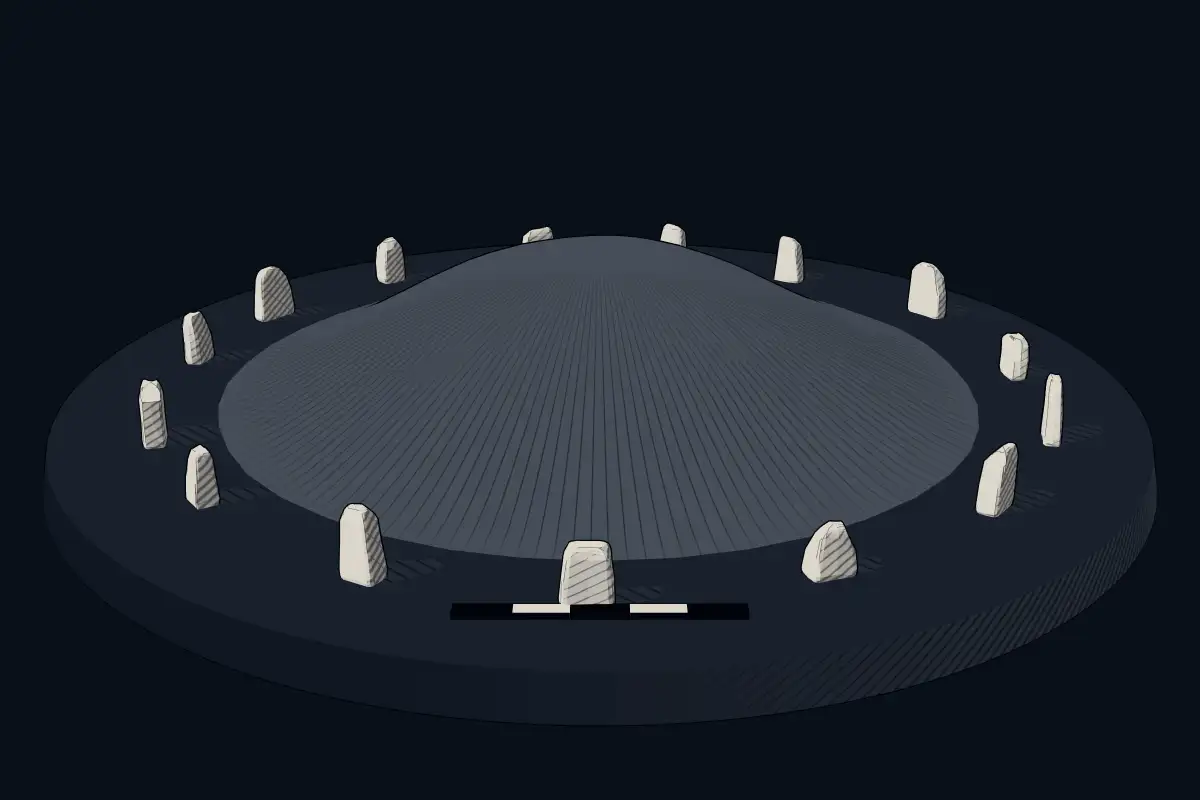
The reconstruction is ours, not a survey: it shows what a monument of this type looks like, at the size the record gives for this one.
Photographs
2 photographs, each with its author and licence
More photographs
Where it stands
South Korea
The pin marks the monument itself — its exact point.
- Coordinates
- 35°50′16″ N, 129°12′45″ EFor a GPS or map app: 35.83778, 129.21250
Access is as our sources describe it; we have not visited the site to check.
Nearby
The closest sites in the Atlas, by straight line.


Sources
Every record behind this page, with the link it came from.
2 sources behind this page
- 01Wikidata Q491496wikidata.org
- 02Wikipedia: Cheonmachongen.wikipedia.org
Image files
- 천마총.jpgSymtuxCC BY-SA 4.0
- 慶州-大陵苑-天馬塚.jpgDe-Shao Liu ( Terry850324 )CC BY-SA 4.0
Report a correctionWrong date, name, photograph or source? Tell us and it will be put right.
Around this place
The ten nearest sites, by compass
- Son Siyang Jeongryeobi0.2 km SW
- Gyeongju Geumcheok-ri Ancient Tombs8.3 km W
- 포항 중성리 신라비11 km SE
- Pohang Naengsu-ri Silla Stele33 km N
- 경산 임당동과 조영동 고분군42 km W
- Yeongyeongchukseongbi50 km W
- Bullodong Tumuli in Daegu52 km W
- 대구 무술명 오작비54 km W
- Ancient Tombs in Bukjeong-ri, Yangsan56 km S
- Ancient Tombs in Singi-ri, Yangsan56 km S
Credit
Text, licence and sources
Adapted from the Wikipedia article "Cheonmachong" (English), licensed CC BY-SA 4.0; authors are listed in the page history. Reused under CC BY-SA 4.0. Read on Wikipedia · Edit history and authors
- Wikipedia (English): CheonmachongCC BY-SA 4.0
- Wikidata Q491496CC0