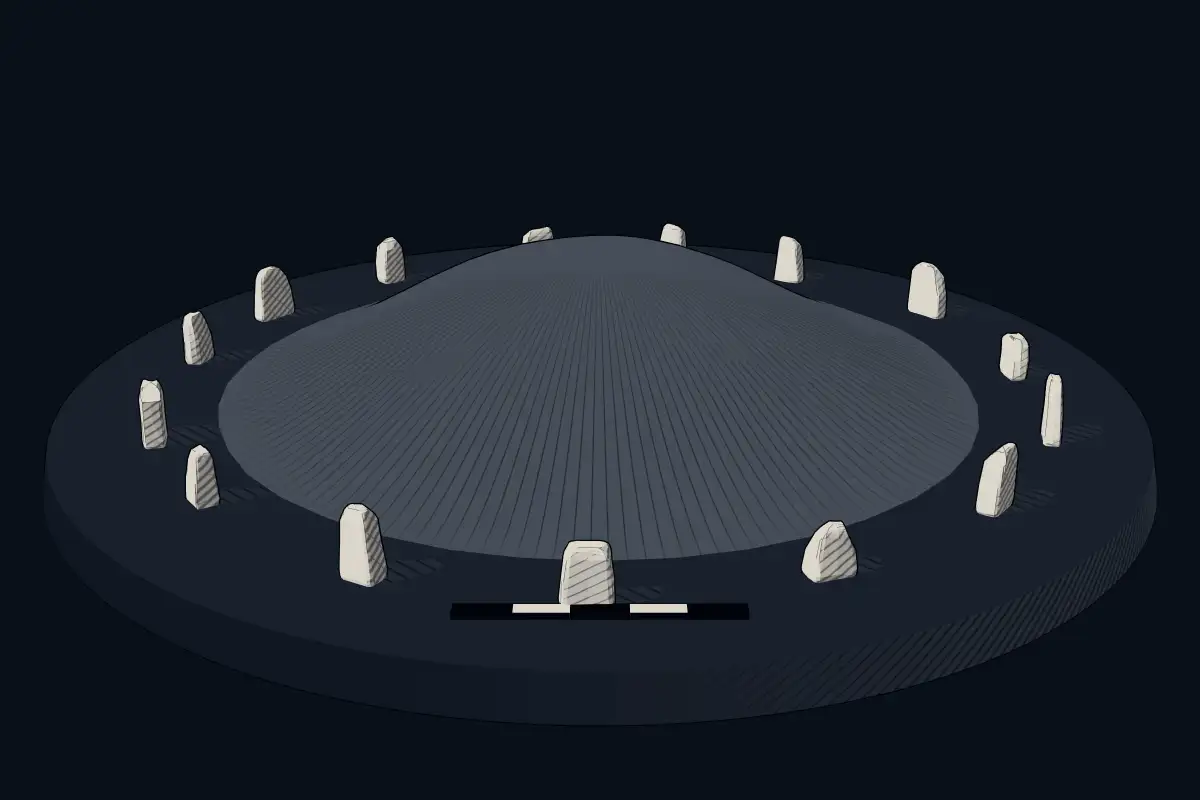
Megalithic mound (tumulus with integral stones)
柳瀬古墳群
DatedEst. 250–650 CE
No licensed photograph yetWe have no photograph we may publish for this site, so the interpretive 3D view leads instead.
Overview
About this site
What the sources say
柳瀬古墳群(やなせこふんぐん)は、埼玉県秩父郡皆野町大字柳瀬にあった古墳群である。
Article in JapaneseRead on Wikipedia2 min readCC BY-SA 4.0
Where it sits in time
The site's dated range, placed against world reference points.
The scale is logarithmic: each step to the left is about ten times older than the last.
The full article
柳瀬古墳群: the whole story
In briefSources for this section
- Wikipedia (Japanese): 柳瀬古墳群CC BY-SA 4.0
Sources for this section
- Wikipedia (Japanese): 柳瀬古墳群CC BY-SA 4.0
柳瀬古墳群 is a group of burial mounds in 大字柳瀬, 皆野町, 埼玉県, in Japan. Three mounds were located to the northwest of 円福寺. Two have disappeared, leaving only part of 柳瀬1号墳, which was cut down and partly survives as a horizontal stone chamber.
柳瀬1号墳 is a round mound with a diameter of about 10メートル. Its burial chamber is a two-passage type with side walls, known as a 両袖型横穴式石室, measuring 3.6メートル in total length. Finds included 鉄鏃, a fragment of 大刀, 環状鏡板付轡, and fragments of 胡籙.
The mound was excavated in 1991(平成3年). Based on the form of its stone chamber, its construction is generally dated to the first half or middle of the 7世紀. The excavated finds were designated a 町指定有形文化財 on 1993(平成5年)5月28日.
Kofun are the large burial mounds of ancient Japan, built mainly between the middle of the third century and the early seventh century CE. Alongside the keyhole-shaped form, monuments of this kind also include plain round mounds, double-rectangle mounds, and square mounds.
No English Wikipedia article exists for it; the full text below is the Japanese article "柳瀬古墳群", shown in the original language.
Summary in EnglishSources for this section
- Wikipedia (Japanese): 柳瀬古墳群CC BY-SA 4.0
Sources for this section
- Wikipedia (Japanese): 柳瀬古墳群CC BY-SA 4.0
柳瀬古墳群 is a megalithic mound (tumulus with integral stones) in Japan. A typological estimate: 250 CE to 650 CE. No English Wikipedia article exists for it; the full text below is the Japanese article "柳瀬古墳群", shown in the original language.
概要Sources for this section
- Wikipedia (Japanese): 柳瀬古墳群CC BY-SA 4.0
Sources for this section
- Wikipedia (Japanese): 柳瀬古墳群CC BY-SA 4.0
円福寺の北西に3基の古墳が所在した。そのうち柳瀬1号墳は削平され横穴式石室の一部が残存している。他の2基は消滅した。1号墳は1991年(平成3年)に発掘調査された。
柳瀬1号墳Sources for this section
- Wikipedia (Japanese): 柳瀬古墳群CC BY-SA 4.0
Sources for this section
- Wikipedia (Japanese): 柳瀬古墳群CC BY-SA 4.0
径約10メートルの円墳。主体部は胴張りのある両袖型横穴式石室で、全長3.6メートルである。副葬品は、鉄鏃・大刀片・環状鏡板付轡・胡籙(ころく/やなぐい)片が出土している。この古墳の築造年代については、石室の形態などから7世紀前半から中頃とみられている。出土遺物は1993年(平成5年)5月28日付けで町指定有形文化財に指定された。
参考文献Sources for this section
- Wikipedia (Japanese): 柳瀬古墳群CC BY-SA 4.0
Sources for this section
- Wikipedia (Japanese): 柳瀬古墳群CC BY-SA 4.0
塩野博 『埼玉の古墳 比企・秩父』pp505、さきたま出版会、2004年
How this page was madeSources for this section
- Wikipedia (Japanese): 柳瀬古墳群CC BY-SA 4.0
Sources for this section
- Wikipedia (Japanese): 柳瀬古墳群CC BY-SA 4.0
The summary at the top of this page was written by MiniMax-M3 (2026-11-08) from the cited Wikipedia article “柳瀬古墳群”, translated from Japanese. The numbers in it were checked automatically against the source text. The rest of the page is the article itself, the structured records and computed distances.
Tradition and region
About this kind of monument
Japanese kofun tumuli
Kofun are the great burial mounds of ancient Japan, built mainly between the middle of the third century and the early seventh century CE. The period takes its name from them. The most distinctive form is the keyhole-shaped mound (zempō-kōen-fun), with one square end and one round end seen from above, but there are also plain round mounds, double-rectangle mounds and square mounds. Orientation is not fixed: in the Mozu group at Sakai, some round parts face north and others east.
The largest is Daisenryō kofun at Sakai in Osaka, the biggest kofun in Japan, thought to have been built over some twenty years in the middle of the fifth century. By common acceptance it is the tomb of Emperor Nintoku, and the Imperial Household Agency treats it as such, but this cannot be confirmed because the mound has not been excavated. It stands in the Mozu group, which once had more than a hundred tombs of which fewer than half remain; the group and the neighbouring Furuichi cluster were inscribed on the UNESCO World Heritage List in 2019. The mounds were built on a plateau overlooking Osaka Bay, near the ancient coastline.
Dating rests on mound shape, pottery and grave goods. Haniwa, which means "clay circle", are terracotta cylinders and figures of houses, animals and people that were arranged in rings and rows around and on top of the mounds. Smaller kofun are very numerous and sit in groups in every region of Japan.
When visiting, look for the moat that surrounds the larger mounds, for the stepped outline of terraces, and for reconstructed haniwa in museums and parks beside the tombs.
Paraphrased from Wikipedia: Kofun, Wikipedia: Daisen Kofun, Wikipedia: Haniwa, Wikipedia: Mozu Tombs · CC BY-SA 4.0
See it in 3D
An interpretive reconstruction of the monument, standing on the real ground at its exact point, under the sun for that place and season. Drag to look around it.
The reconstruction is ours, not a survey: it shows what a monument of this type looks like, at the size the record gives for this one.
Lore
Evidence & Lore
What the sources actually support — and, kept apart, what has been claimed.
What the evidence supports
Dates
Est. 250–650 CEHow this date was established: Type comparisonTypical range for megalithic mounds in Japan; this site has not been dated itself. Japanese kofun burial mounds were mainly constructed between the middle of the 3rd century and the early 7th century AD.Source for this date
Where it stands
Japan
The pin marks the monument itself — its exact point.
- Coordinates
- 36°03′57″ N, 139°05′23″ EFor a GPS or map app: 36.06572, 139.08975
Access is as our sources describe it; we have not visited the site to check.
Nearby
The closest sites in the Atlas, by straight line.
 Enfun Ōtsuka Kofun250–650 CE
- Megalithic mound (tumulus with integral stones)Kanasaki Kofun Cluster250–650 CE
 Akiyama Kofun Group250–650 CE
- Megalithic mound (tumulus with integral stones)長沖古墳群250–650 CE
- Megalithic mound (tumulus with integral stones)穴八幡古墳250–650 CE
- Megalithic mound (tumulus with integral stones)白岩銚子塚古墳250–650 CE
- Megalithic mound (tumulus with integral stones)青柳古墳群250–650 CE
- Megalithic mound (tumulus with integral stones)金鑚神社古墳250–650 CE


Sources
Every record behind this page, with the link it came from.
2 sources behind this page
- 01Wikidata Q17222239wikidata.org
- 02Source for this dateen.wikipedia.org
Report a correctionWrong date, name, photograph or source? Tell us and it will be put right.
Around this place
The ten nearest sites, by compass
Credit
Text, licence and sources
Text from the Wikipedia article "柳瀬古墳群" (Japanese), licensed CC BY-SA 4.0; authors are listed in the page history. Reused under CC BY-SA 4.0. Read on Wikipedia · Edit history and authors
- Wikipedia (Japanese): 柳瀬古墳群CC BY-SA 4.0
- Wikidata Q17222239CC0