
Megalithic mound (tumulus with integral stones)
Shingai Kofun
DatedEst. 250–650 CE
Photo Saigen Jiro · CC0Source file on Wikimedia Commons
Overview
About this site
What the sources say
新改古墳(しんがいこふん、新改横走古墳)は、高知県香美市土佐山田町新改にある古墳。形状は円墳。新改古墳群を構成する古墳の1つ。香美市指定史跡に指定されている。
Article in JapaneseRead on Wikipedia2 min readCC BY-SA 4.0
Where it sits in time
The site's dated range, placed against world reference points.
The scale is logarithmic: each step to the left is about ten times older than the last.
The full article
Shingai Kofun: the whole story
In briefSources for this section
- Wikipedia (Japanese): 新改古墳CC BY-SA 4.0
Sources for this section
- Wikipedia (Japanese): 新改古墳CC BY-SA 4.0
Shingai Kofun is a burial mound at 新改, 土佐山田町, 香美市, 高知県, Japan. It is one of the 新改古墳群 and the largest mound in that group, which is spread along the 新改川. The round mound measures 15 metres across and 5 metres high.
Its burial chamber is a large side-entered horizontal stone chamber. It is 9.4 metres long, comprising a 玄室 measuring 6.6 metres by 1.9 metres by 3 metres and a 羨道 measuring 2.8 metres by 1.6 metres by 1.8 metres. The 1854 安政南海地震 damaged the chamber: part of its ceiling fell and the left wall of the 玄室 was lost.
Finds from the chamber include ornaments made from 碧玉, glass and small beads, together with iron arrowheads, knives and a 大刀鍔. Horse equipment included gilt-bronze fittings, 雲珠, 杏葉, leather fittings and a bridle. 須恵器 was also found.
The mound is dated to around the beginning of the 7th century, in the TK209型式期, at the end of the Kofun period. It followed the earlier 伏原大塚古墳, an early leader's tomb associated with the earliest TK43型式期 phase in 高知平野. By the TK209型式期, the position of leading rulers had moved to 小蓮古墳, although 伏原大塚古墳 continued to receive later burials. The site has been a 香美市指定史跡 since 1964年(昭和39年)10月27日.
No English Wikipedia article exists for it; the full text below is the Japanese article "新改古墳", shown in the original language.
Summary in EnglishSources for this section
- Wikipedia (Japanese): 新改古墳CC BY-SA 4.0
Sources for this section
- Wikipedia (Japanese): 新改古墳CC BY-SA 4.0
Shingai Kofun is a megalithic mound (tumulus with integral stones) in Kami, Japan. A typological estimate: 250 CE to 650 CE. No English Wikipedia article exists for it; the full text below is the Japanese article "新改古墳", shown in the original language.
概要Sources for this section
- Wikipedia (Japanese): 新改古墳CC BY-SA 4.0
Sources for this section
- Wikipedia (Japanese): 新改古墳CC BY-SA 4.0
高知県中部、新改川沿いの山麓に築造された古墳である。新改川沿いには新改古墳群が分布し、そのうちで最大規模になる。
墳形は円形で、直径15メートル・高さ5メートルを測る。埋葬施設は片袖式の横穴式石室であり、石室全長9.4メートルを測る大型石室になる。石室内からは副葬品として、装身具(碧玉製管玉・ガラス製丸玉・小玉)・鉄製品(鉄鏃・鉄刀子・大刀鍔)・馬具(金銅製辻金具・雲珠・杏葉・革金具・轡)・須恵器が出土している。
築造時期は、古墳時代終末期の7世紀初頭(TK209型式期)頃と推定される。旧土佐山田町域では、高知平野における最初期(TK43型式期)の盟主墳である伏原大塚古墳(香美市土佐山田町楠目)に後続する大型古墳になるが、新改古墳の時期(TK209型式期)には盟主墳の地位は小蓮古墳(南国市)に移動して伏原大塚古墳の追葬も続いており、高知平野における大小首長の変遷を考察するうえで重要視される。
古墳域は1964年(昭和39年)に旧土佐山田町指定史跡(現在は香美市指定史跡)に指定されている。
遺跡歴Sources for this section
- Wikipedia (Japanese): 新改古墳CC BY-SA 4.0
Sources for this section
- Wikipedia (Japanese): 新改古墳CC BY-SA 4.0
嘉永7年(1854年)、安政南海地震で石室が損壊。
1964年(昭和39年)10月27日、旧土佐山田町指定史跡に指定(現在は香美市指定史跡)。
埋葬施設Sources for this section
- Wikipedia (Japanese): 新改古墳CC BY-SA 4.0
Sources for this section
- Wikipedia (Japanese): 新改古墳CC BY-SA 4.0
埋葬施設としては片袖式横穴式石室が構築されている。石室の規模は次の通り。
石室全長:9.4メートル
玄室:長さ6.6メートル、幅1.9メートル、高さ3メートル
羨道:長さ2.8メートル、幅1.6メートル、高さ1.8メートル
石室は安政南海地震の際に損壊しており、天井石の一部が落下し、玄室左側壁が失われている。
文化財Sources for this section
- Wikipedia (Japanese): 新改古墳CC BY-SA 4.0
Sources for this section
- Wikipedia (Japanese): 新改古墳CC BY-SA 4.0
香美市指定文化財
史跡
新改古墳 - 1964年(昭和39年)10月27日指定。
関連施設Sources for this section
- Wikipedia (Japanese): 新改古墳CC BY-SA 4.0
Sources for this section
- Wikipedia (Japanese): 新改古墳CC BY-SA 4.0
高知県立歴史民俗資料館(南国市岡豊町八幡) - 新改古墳の出土品を展示。
参考文献Sources for this section
- Wikipedia (Japanese): 新改古墳CC BY-SA 4.0
Sources for this section
- Wikipedia (Japanese): 新改古墳CC BY-SA 4.0
史跡説明板(土佐山田町教育委員会、1991年設置)
「横走古墳」『高知県の地名』平凡社〈日本歴史地名大系40〉、1983年。ISBN 4582490409。
『高知県後期古墳資料集I』高知大学人文学部考古学研究室〈高知大学考古学調査研究報告第7冊〉、2009年。 - リンクは奈良文化財研究所「全国文化財総覧」。
How this page was madeSources for this section
- Wikipedia (Japanese): 新改古墳CC BY-SA 4.0
Sources for this section
- Wikipedia (Japanese): 新改古墳CC BY-SA 4.0
The summary at the top of this page was written by MiniMax-M3 (2026-11-08) from the cited Wikipedia article “新改古墳”, translated from Japanese. The numbers in it were checked automatically against the source text. The rest of the page is the article itself, the structured records and computed distances.
Tradition and region
About this kind of monument
Japanese kofun tumuli
Kofun are the great burial mounds of ancient Japan, built mainly between the middle of the third century and the early seventh century CE. The period takes its name from them. The most distinctive form is the keyhole-shaped mound (zempō-kōen-fun), with one square end and one round end seen from above, but there are also plain round mounds, double-rectangle mounds and square mounds. Orientation is not fixed: in the Mozu group at Sakai, some round parts face north and others east.
The largest is Daisenryō kofun at Sakai in Osaka, the biggest kofun in Japan, thought to have been built over some twenty years in the middle of the fifth century. By common acceptance it is the tomb of Emperor Nintoku, and the Imperial Household Agency treats it as such, but this cannot be confirmed because the mound has not been excavated. It stands in the Mozu group, which once had more than a hundred tombs of which fewer than half remain; the group and the neighbouring Furuichi cluster were inscribed on the UNESCO World Heritage List in 2019. The mounds were built on a plateau overlooking Osaka Bay, near the ancient coastline.
Dating rests on mound shape, pottery and grave goods. Haniwa, which means "clay circle", are terracotta cylinders and figures of houses, animals and people that were arranged in rings and rows around and on top of the mounds. Smaller kofun are very numerous and sit in groups in every region of Japan.
When visiting, look for the moat that surrounds the larger mounds, for the stepped outline of terraces, and for reconstructed haniwa in museums and parks beside the tombs.
Paraphrased from Wikipedia: Kofun, Wikipedia: Daisen Kofun, Wikipedia: Haniwa, Wikipedia: Mozu Tombs · CC BY-SA 4.0
See it in 3D
An interpretive reconstruction of the monument, standing on the real ground at its exact point, under the sun for that place and season. Drag to look around it.
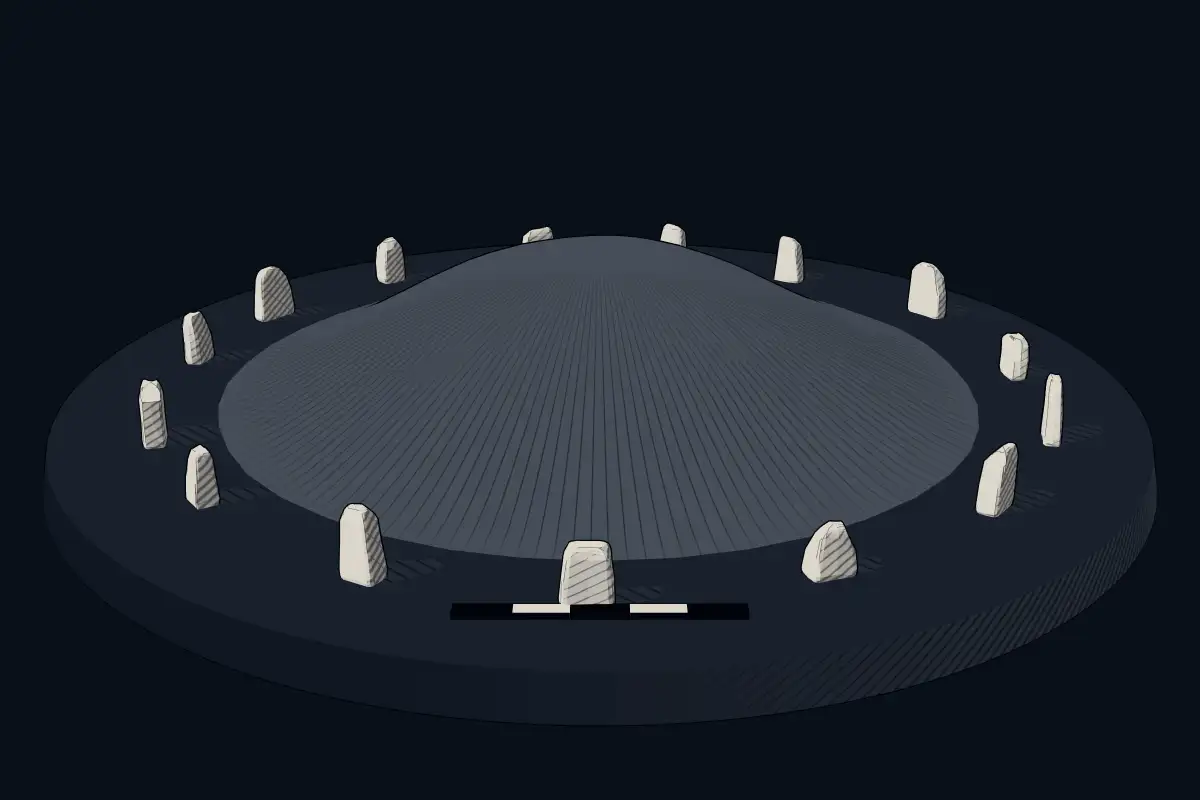
The reconstruction is ours, not a survey: it shows what a monument of this type looks like, at the size the record gives for this one.
Photographs
6 photographs, each with its author and licence
More photographs
Lore
Evidence & Lore
What the sources actually support — and, kept apart, what has been claimed.
What the evidence supports
Dates
Est. 250–650 CEHow this date was established: Type comparisonTypical range for megalithic mounds in Japan; this site has not been dated itself. Japanese kofun burial mounds were mainly constructed between the middle of the 3rd century and the early 7th century AD.Source for this date
Where it stands
Japan
The pin marks the monument itself — its exact point.
- Coordinates
- 33°37′24″ N, 133°40′28″ EFor a GPS or map app: 33.62333, 133.67431
Access is as our sources describe it; we have not visited the site to check.
Nearby
The closest sites in the Atlas, by straight line.


Sources
Every record behind this page, with the link it came from.
2 sources behind this page
- 01Wikidata Q104057153wikidata.org
- 02Source for this dateen.wikipedia.org
Image files
- Shingai Kofun, funkyu.jpgSaigen JiroCC0
- Shingai Kofun, 3D-B.jpgSaigen JiroCC0
- Shingai Kofun, 3D-N.jpgSaigen JiroCC0
- Shingai Kofun, entrance.jpgSaigen JiroCC0
- Shingai Kofun, genshitsu-1.jpgSaigen JiroCC0
- Shingai Kofun, genshitsu-2.jpgSaigen JiroCC0
Report a correctionWrong date, name, photograph or source? Tell us and it will be put right.
Around this place
The ten nearest sites, by compass
Credit
Text, licence and sources
Text from the Wikipedia article "新改古墳" (Japanese), licensed CC BY-SA 4.0; authors are listed in the page history. Reused under CC BY-SA 4.0. Read on Wikipedia · Edit history and authors
- Wikipedia (Japanese): 新改古墳CC BY-SA 4.0
- Wikidata Q104057153CC0