
Megalithic mound (tumulus with integral stones)
Nagaune Kofun Cluster
DatedEst. 250–650 CE
Photo Saigen Jiro · CC0Source file on Wikimedia Commons
Overview
About this site
What the sources say
長畝古墳群(ながうねこふんぐん)は、高知県南国市岡豊町にある古墳群。史跡指定はされていない。
4基の古墳によって構成されており、うち、2号墳、3号墳、4号墳については発掘調査がおこなわれた。その結果、時期の異なる古墳が3期にわたって営まれていたことが判明した。
Article in JapaneseRead on Wikipedia2 min readCC BY-SA 4.0
Where it sits in time
The site's dated range, placed against world reference points.
The scale is logarithmic: each step to the left is about ten times older than the last.
The full article
Nagaune Kofun Cluster: the whole story
In briefSources for this section
- Wikipedia (Japanese): 長畝古墳群CC BY-SA 4.0
Sources for this section
- Wikipedia (Japanese): 長畝古墳群CC BY-SA 4.0
Nagaune Kofun Cluster is a group of four burial mounds at 岡豊町, 南国市, 高知県, Japan. It lies on a ridge at an elevation of 62 meters. Three mounds were excavated as an emergency archaeological investigation from June to December 1994 during construction of 高知自動車道; 長畝1号墳 lay outside the investigated area.
The cluster contains mounds from different periods, with three phases of use identified. 長畝2号墳, dated to the latter half of the 4th century, has two burial structures, including a 竪穴式石槨 made from split 礫岩 and a second chamber with a 粘土槨 and fitted wooden coffin. 長畝3号墳, probably from the latter half of the 5th century, has a 竪穴式石室, the first of its kind detected in 高知県.
長畝4号墳 dates to the second quarter of the 6th century and has a round mound, 周溝, an early 横穴式石室, and features associated with 墓前祭祀. Finds included 須恵器, 36 鉄鏃, 41 beads, 銀製耳飾り, iron tools, 馬具, and three 刀子. Its 墓前祭祀 continued from the late 6th century to the beginning of the 7th century.
The three excavated mounds were moved about one kilometer to the northeast when 高知自動車道 opened. They now form 長畝古墳公園, where examples from the early, middle, and late periods of the kofun era can be observed together. The cluster is not designated as a 史跡. Such monuments in Japan are great burial mounds, often built between the middle of the third century and the early seventh century CE; besides keyhole-shaped mounds, they include round, double-rectangle, and square forms.
No English Wikipedia article exists for it; the full text below is the Japanese article "長畝古墳群", shown in the original language.
Summary in EnglishSources for this section
- Wikipedia (Japanese): 長畝古墳群CC BY-SA 4.0
Sources for this section
- Wikipedia (Japanese): 長畝古墳群CC BY-SA 4.0
Nagaune Kofun Cluster is a megalithic mound (tumulus with integral stones) in Nankoku, Japan. Wikidata describes it as: kofun in Nankoku, Kōchi, Japan. A typological estimate: 250 CE to 650 CE. No English Wikipedia article exists for it; the full text below is the Japanese article "長畝古墳群", shown in the original language.
概要Sources for this section
- Wikipedia (Japanese): 長畝古墳群CC BY-SA 4.0
Sources for this section
- Wikipedia (Japanese): 長畝古墳群CC BY-SA 4.0
当古墳群は、南国市岡豊町定林寺字長畝の標高62メートルの尾根のうえに所在する古墳群であり、1994年(平成6年)6月から12月にかけて、高知自動車道建設にともなう緊急調査として高知県文化財団埋蔵文化財センターによって発掘調査が実施された。調査対象は2号墳・3号墳・4号墳の3基である。尾根上方に所在する後期古墳、長畝1号墳は調査対象区外であった。
長畝2号墳
主体部を2基有する。
1号主体部は、竪穴式石槨によるもので石材は礫岩の割石である。礫岩の埋設状況から、棺は刳抜式の割竹形木棺であったと推定される。墓壙は長辺3.3メートル、短辺1.4メートルの長方形で、出土した遺物は、鉄剣2、鉄鏃10、鉄製鎌1、鉄製鎌先1、鉄斧1、刀子1、土師器壺1などである。
2号主体部は、1号主体部にほぼ接するが主軸はほぼ直角方向であり、全体ではTの字状況を呈する。墓壙は長辺2.3メートル、短辺0.7メートルの長方形で、粘土槨に組み合わせ式木棺を安置したものと思われるが、槨の底部両端には礫岩の割石が敷かれていた。おそらくは木棺の安定のためと推定される。遺物は出土していない。
出土した遺物、検出した遺構の特徴から4世紀後半の年代が想定される。
長畝3号墳
2号墳1号主体部と隣接し、現状では周溝や明確な墳丘は認めがたいので1号墳と同じ位置に墳丘を築いた可能性もあり、墳丘規模を明らかにするのは難しいが、主体部の東側で盛土の痕跡とみられる堆積を確認している。直径12メートル弱の円墳であった可能性も考えられる。主体部は竪穴式石室で、高知県内で初めての検出である。形態的には小竪穴式石室に属する。出土した遺物は鉄鏃2点と土師器片1点のみである。
出土遺物に乏しいが検出遺構の特徴と合わせ考えて、だいたい5世紀後半の時期が考えられる。
長畝4号墳
2号墳、3号墳と異なり、等高線が墳形をあらわし、東側に周溝も認められる。このことより、直径10.1メートルの円墳であり、周溝をふくめると長径13.6メートル、短径11.6メートルのやや楕円形となる。また、周溝の延長上の西側に平場が設けられており、平場からみて墳丘付け根部分に不整形土坑、さらに不整形土坑の両側に柱穴2基を検出している。これらは、墓前祭祀にかかわる一連の遺構と考えられる。
主体部は、竪穴系横口石室の影響の認められる初期横穴式石室となっており、玄室に5段、羨道に3段の石積みをのこしている。天井石は失われていた。副葬品は、有蓋の高坏5、長頸壺1、短頸壺1、広口壺3、グラス形土器1(いずれも須恵器)が玄室入り口付近より、鉄鏃36、須恵器長頸壺1、同短頸壺1、鉄製鍬先1、鉄鎌1、鉄斧1、馬具(轡)1、管玉・練玉・ガラス小玉・ソロバン玉など玉類(計41)、銀製耳飾り1、刀子3が玄室奥壁および奥壁と棺の間周辺より見つかった。須恵器は在地生産の可能性が高く、窯業生産開始の点からも注目される。
出土遺物、検出遺構の特徴から6世紀の第2四半期が考えられる。墓前祭祀は6世紀末葉から7世紀初頭まで継続したものと考えられる。
長畝古墳公園Sources for this section
- Wikipedia (Japanese): 長畝古墳群CC BY-SA 4.0
Sources for this section
- Wikipedia (Japanese): 長畝古墳群CC BY-SA 4.0
現在、調査の終わった3基の古墳は、高知自動車道開通にともない、遺跡東北東およそ1キロメートルの地点に移築保存され、「長畝古墳公園」となっている。ここでは、同一尾根上に築かれた古墳時代前期・中期・後期のそれぞれの古墳の規模や構造を実際に観察することができる。
How this page was madeSources for this section
- Wikipedia (Japanese): 長畝古墳群CC BY-SA 4.0
Sources for this section
- Wikipedia (Japanese): 長畝古墳群CC BY-SA 4.0
The summary at the top of this page was written by MiniMax-M3 (2026-11-08) from the cited Wikipedia article “長畝古墳群”, translated from Japanese. The numbers in it were checked automatically against the source text. The rest of the page is the article itself, the structured records and computed distances.
Tradition and region
About this kind of monument
Japanese kofun tumuli
Kofun are the great burial mounds of ancient Japan, built mainly between the middle of the third century and the early seventh century CE. The period takes its name from them. The most distinctive form is the keyhole-shaped mound (zempō-kōen-fun), with one square end and one round end seen from above, but there are also plain round mounds, double-rectangle mounds and square mounds. Orientation is not fixed: in the Mozu group at Sakai, some round parts face north and others east.
The largest is Daisenryō kofun at Sakai in Osaka, the biggest kofun in Japan, thought to have been built over some twenty years in the middle of the fifth century. By common acceptance it is the tomb of Emperor Nintoku, and the Imperial Household Agency treats it as such, but this cannot be confirmed because the mound has not been excavated. It stands in the Mozu group, which once had more than a hundred tombs of which fewer than half remain; the group and the neighbouring Furuichi cluster were inscribed on the UNESCO World Heritage List in 2019. The mounds were built on a plateau overlooking Osaka Bay, near the ancient coastline.
Dating rests on mound shape, pottery and grave goods. Haniwa, which means "clay circle", are terracotta cylinders and figures of houses, animals and people that were arranged in rings and rows around and on top of the mounds. Smaller kofun are very numerous and sit in groups in every region of Japan.
When visiting, look for the moat that surrounds the larger mounds, for the stepped outline of terraces, and for reconstructed haniwa in museums and parks beside the tombs.
Paraphrased from Wikipedia: Kofun, Wikipedia: Daisen Kofun, Wikipedia: Haniwa, Wikipedia: Mozu Tombs · CC BY-SA 4.0
See it in 3D
An interpretive reconstruction of the monument, standing on the real ground at its exact point, under the sun for that place and season. Drag to look around it.
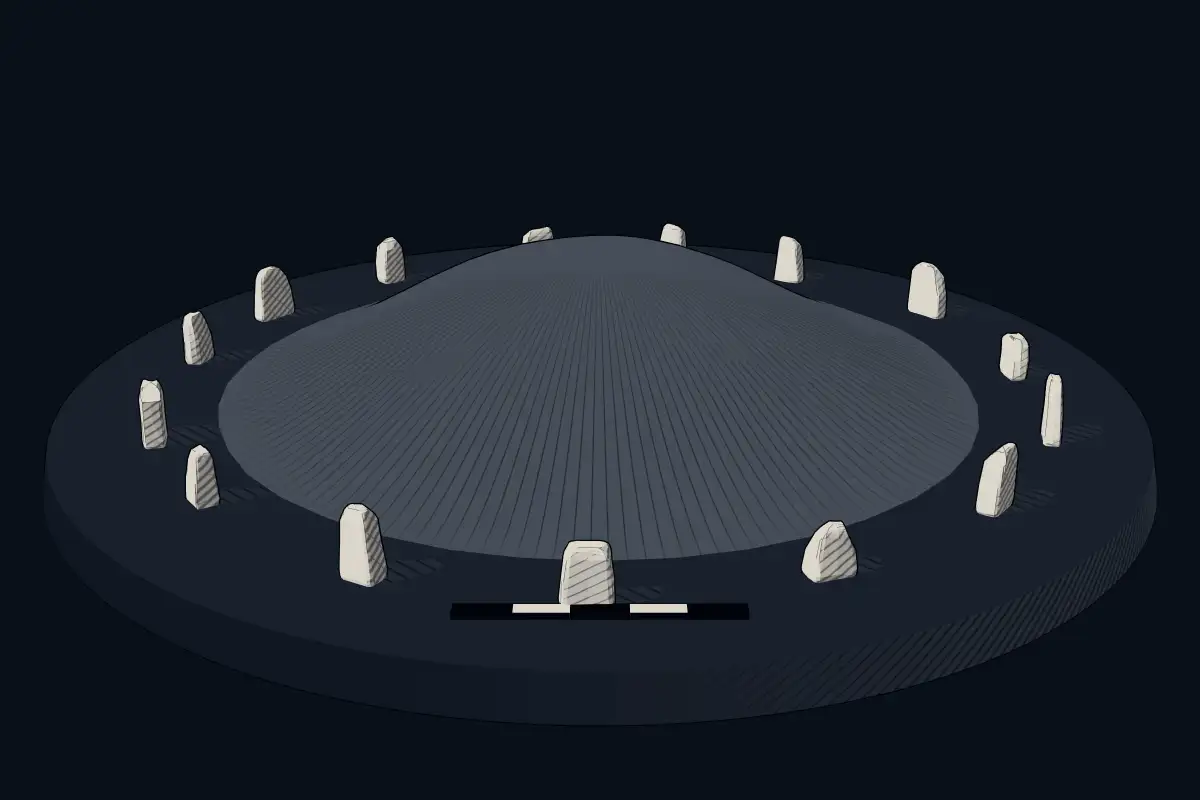
The reconstruction is ours, not a survey: it shows what a monument of this type looks like, at the size the record gives for this one.
Photographs
2 photographs, each with its author and licence
More photographs
Lore
Evidence & Lore
What the sources actually support — and, kept apart, what has been claimed.
What the evidence supports
Dates
Est. 250–650 CEHow this date was established: Type comparisonTypical range for megalithic mounds in Japan; this site has not been dated itself. Japanese kofun burial mounds were mainly constructed between the middle of the 3rd century and the early 7th century AD.Source for this date
Where it stands
Japan
The pin marks the monument itself — its exact point.
- Coordinates
- 33°36′09″ N, 133°37′00″ EFor a GPS or map app: 33.60249, 133.61655
Access is as our sources describe it; we have not visited the site to check.
Nearby
The closest sites in the Atlas, by straight line.


Sources
Every record behind this page, with the link it came from.
2 sources behind this page
- 01Wikidata Q11653515wikidata.org
- 02Source for this dateen.wikipedia.org
Image files
- Nagaune Kofun Group, gaikan.jpgSaigen JiroCC0
- 長畝2号墳1号主体部出土 鉄剣.JPGSaigen JiroPublic domain
Report a correctionWrong date, name, photograph or source? Tell us and it will be put right.
Around this place
The ten nearest sites, by compass
Credit
Text, licence and sources
Text from the Wikipedia article "長畝古墳群" (Japanese), licensed CC BY-SA 4.0; authors are listed in the page history. Reused under CC BY-SA 4.0. Read on Wikipedia · Edit history and authors
- Wikipedia (Japanese): 長畝古墳群CC BY-SA 4.0
- Wikidata Q11653515CC0