
Megalithic mound (tumulus with integral stones)
Mitani Ishifune Kofun
DatedEst. 250–650 CE
Photo Saigen Jiro · CC0Source file on Wikimedia Commons

Overview
About this site
What the sources say
三谷石舟古墳(みたにいしふねこふん)は、香川県高松市三谷町にある古墳。形状は前方後円墳。高松市指定史跡に指定されている。
Article in JapaneseRead on Wikipedia2 min readCC BY-SA 4.0
Where it sits in time
The site's dated range, placed against world reference points.
The scale is logarithmic: each step to the left is about ten times older than the last.
The full article
Mitani Ishifune Kofun: the whole story
In briefSources for this section
- Wikipedia (Japanese): 三谷石舟古墳CC BY-SA 4.0
Sources for this section
- Wikipedia (Japanese): 三谷石舟古墳CC BY-SA 4.0
Mitani Ishifune Kofun is a large burial mound in Mitanimachi, Takamatsu, Kagawa, Japan. It stands on a ridge in the southern part of the Takamatsu plain, south of the city centre, with a reservoir called 石舟池 immediately to its north. It was designated a Takamatsu City designated historic site in 2014 (平成26年).
The mound has a keyhole-shaped plan known as 前方後円墳, with a rectangular front section pointing southwest. The rear circular section is built in two stages and the front section in one. The mound is 88 metres long, with a total length of 101 metres when the surrounding shield-shaped platform is included. It is the largest in the Takamatsu plain, the fourth largest of all kofun in Kagawa, and the third largest 前方後円墳 in the prefecture.
A hollowed-out boat-shaped stone coffin, the type after which the mound is named, is exposed at the centre of the rear circular section. Its details are not known, but it is known to have been set inside a facility within the mound. The stone came from 鷲ノ山 in Kokubunji-machi, and the coffin measures 3 metres long and 0.76 metres wide. A stone pillow forms the head end inside, and a rope-lifting projection is formed at the foot outside.
Judging from the coffin type, construction is estimated to have begun in the early middle period of the Kofun era, placing the mound between 250 CE and 650 CE. Monuments of this kind in Japan are the great burial mounds built mainly between the middle of the third century and the early seventh century CE, a period that takes its name from them. The most distinctive form is the keyhole-shaped mound, seen from above with one square end and one round end.
No English Wikipedia article exists for it; the full text below is the Japanese article "三谷石舟古墳", shown in the original language.
Summary in EnglishSources for this section
- Wikipedia (Japanese): 三谷石舟古墳CC BY-SA 4.0
Sources for this section
- Wikipedia (Japanese): 三谷石舟古墳CC BY-SA 4.0
Mitani Ishifune Kofun is a megalithic mound (tumulus with integral stones) in Japan. A typological estimate: 250 CE to 650 CE. No English Wikipedia article exists for it; the full text below is the Japanese article "三谷石舟古墳", shown in the original language.
概要Sources for this section
- Wikipedia (Japanese): 三谷石舟古墳CC BY-SA 4.0
Sources for this section
- Wikipedia (Japanese): 三谷石舟古墳CC BY-SA 4.0
高松市街地から南方、高松平野南部の尾根上に位置する古墳である。古墳北側には溜め池(石舟池)が隣接する。
墳形は前方後円形で、前方部を南西方に向ける。墳丘は後円部が2段築成、前方部が1段築成。墳丘長は88メートルを測るが、これは香川県内の全古墳では第4位、香川県内の前方後円墳では第3位の規模で、高松平野では最大規模になる。墳丘周囲には盾形の基壇状施設が巡らされている。埋葬施設は明らかでないが、施設内部に据えられていた刳抜式の舟形石棺の棺身が、現在では後円部中央に露出する。石棺型式などより、築造年代は古墳時代中期初頭頃と推定される。
古墳域は2014年(平成26年)に高松市指定史跡に指定されている。
墳丘Sources for this section
- Wikipedia (Japanese): 三谷石舟古墳CC BY-SA 4.0
Sources for this section
- Wikipedia (Japanese): 三谷石舟古墳CC BY-SA 4.0
墳丘の規模は次の通り。
古墳総長:101メートル - 墳丘周囲の盾形の基壇状施設を含めた全長。
墳丘長:88メートル
後円部 - 2段築成。
直径:44メートル
高さ:4.5メートル
前方部 - 1段築成。
長さ:44メートル
幅:27メートル
高さ:3.6メートル
くびれ部
幅:20メートル
埋葬施設Sources for this section
- Wikipedia (Japanese): 三谷石舟古墳CC BY-SA 4.0
Sources for this section
- Wikipedia (Japanese): 三谷石舟古墳CC BY-SA 4.0
埋葬施設に関する詳細は明らかでないが、現在は後円部中央に刳抜式の舟形石棺の棺身が露出しており、施設内部にこの石棺が据えられていたことが知られる。石棺の石材は国分寺町鷲ノ山産で、長さ3メートル、幅0.76メートルを測る。石棺内面には頭位に石枕が形成され、外面には足側に縄掛突起が形成されている。
文化財Sources for this section
- Wikipedia (Japanese): 三谷石舟古墳CC BY-SA 4.0
Sources for this section
- Wikipedia (Japanese): 三谷石舟古墳CC BY-SA 4.0
高松市指定文化財
史跡
三谷石舟古墳 - 2014年(平成26年)3月10日指定。
参考文献Sources for this section
- Wikipedia (Japanese): 三谷石舟古墳CC BY-SA 4.0
Sources for this section
- Wikipedia (Japanese): 三谷石舟古墳CC BY-SA 4.0
史跡説明板(三谷地区地域おこし事業推進委員会、1994年設置)
「三谷石舟古墳」『日本歴史地名大系 38 香川県の地名』平凡社、1989年。ISBN 4582490387。
How this page was madeSources for this section
- Wikipedia (Japanese): 三谷石舟古墳CC BY-SA 4.0
Sources for this section
- Wikipedia (Japanese): 三谷石舟古墳CC BY-SA 4.0
The summary at the top of this page was written by MiniMax-M3 (2026-11-08) from the cited Wikipedia article “三谷石舟古墳”, translated from Japanese. The numbers in it were checked automatically against the source text. The rest of the page is the article itself, the structured records and computed distances.
Tradition and region
About this kind of monument
Japanese kofun tumuli
Kofun are the great burial mounds of ancient Japan, built mainly between the middle of the third century and the early seventh century CE. The period takes its name from them. The most distinctive form is the keyhole-shaped mound (zempō-kōen-fun), with one square end and one round end seen from above, but there are also plain round mounds, double-rectangle mounds and square mounds. Orientation is not fixed: in the Mozu group at Sakai, some round parts face north and others east.
The largest is Daisenryō kofun at Sakai in Osaka, the biggest kofun in Japan, thought to have been built over some twenty years in the middle of the fifth century. By common acceptance it is the tomb of Emperor Nintoku, and the Imperial Household Agency treats it as such, but this cannot be confirmed because the mound has not been excavated. It stands in the Mozu group, which once had more than a hundred tombs of which fewer than half remain; the group and the neighbouring Furuichi cluster were inscribed on the UNESCO World Heritage List in 2019. The mounds were built on a plateau overlooking Osaka Bay, near the ancient coastline.
Dating rests on mound shape, pottery and grave goods. Haniwa, which means "clay circle", are terracotta cylinders and figures of houses, animals and people that were arranged in rings and rows around and on top of the mounds. Smaller kofun are very numerous and sit in groups in every region of Japan.
When visiting, look for the moat that surrounds the larger mounds, for the stepped outline of terraces, and for reconstructed haniwa in museums and parks beside the tombs.
Paraphrased from Wikipedia: Kofun, Wikipedia: Daisen Kofun, Wikipedia: Haniwa, Wikipedia: Mozu Tombs · CC BY-SA 4.0
See it in 3D
An interpretive reconstruction of the monument, standing on the real ground at its exact point, under the sun for that place and season. Drag to look around it.
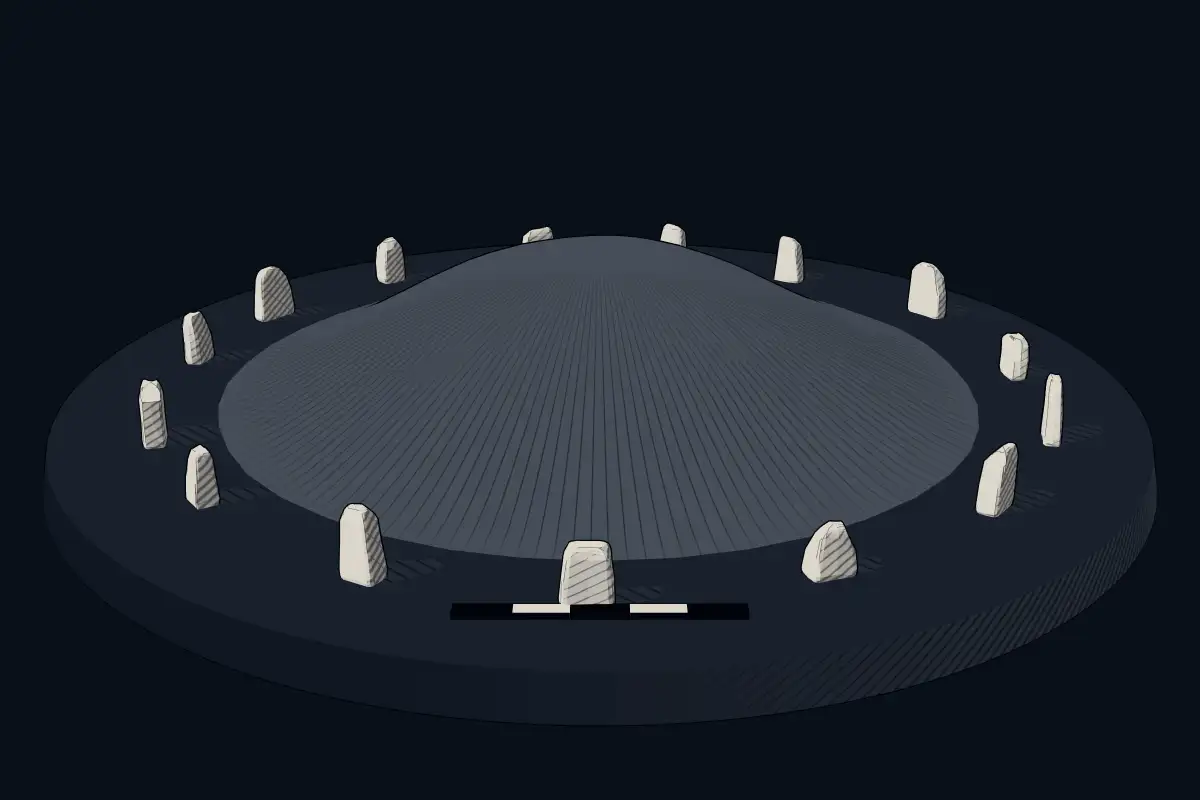
The reconstruction is ours, not a survey: it shows what a monument of this type looks like, at the size the record gives for this one.
Photographs
2 photographs, each with its author and licence
More photographs

Lore
Evidence & Lore
What the sources actually support — and, kept apart, what has been claimed.
What the evidence supports
Dates
Est. 250–650 CEHow this date was established: Type comparisonTypical range for megalithic mounds in Japan; this site has not been dated itself. Japanese kofun burial mounds were mainly constructed between the middle of the 3rd century and the early 7th century AD.Source for this date
Where it stands
Japan
The pin marks the monument itself — its exact point.
- Coordinates
- 34°16′10″ N, 134°04′30″ EFor a GPS or map app: 34.26948, 134.07487
Access is as our sources describe it; we have not visited the site to check.
Nearby
The closest sites in the Atlas, by straight line.
 Takamatsu Chausuyama Kofun250–650 CE
 Hisamoto Kofun250–650 CE
 Yamashita Kofun250–650 CE
- Megalithic mound (tumulus with integral stones)鶴尾神社4号墳250–650 CE
 Iwaseoyama Kofun Cluster4000–1200 BCE
- Megalithic mound (tumulus with integral stones)相作馬塚古墳250–650 CE
- Megalithic mound (tumulus with integral stones)長崎鼻古墳250–650 CE
- Megalithic mound (tumulus with integral stones)Tsuda Kofun Cluster4000–1200 BCE


Sources
Every record behind this page, with the link it came from.
2 sources behind this page
- 01Wikidata Q28657675wikidata.org
- 02Source for this dateen.wikipedia.org
Image files
- Mitani Ishifune Kofun, zenpoubu.jpgSaigen JiroCC0
- Mitani Ishifune Kofun, zenkei.jpgSaigen JiroCC0
Report a correctionWrong date, name, photograph or source? Tell us and it will be put right.
Around this place
The ten nearest sites, by compass
Credit
Text, licence and sources
Text from the Wikipedia article "三谷石舟古墳" (Japanese), licensed CC BY-SA 4.0; authors are listed in the page history. Reused under CC BY-SA 4.0. Read on Wikipedia · Edit history and authors
- Wikipedia (Japanese): 三谷石舟古墳CC BY-SA 4.0
- Wikidata Q28657675CC0