
Megalithic mound (tumulus with integral stones)
Hisamoto Kofun
DatedEst. 250–650 CE
Photo Saigen Jiro · CC0Source file on Wikimedia Commons

Overview
About this site
What the sources say
久本古墳(ひさもとこふん)は、香川県高松市新田町にある古墳。形状は円墳。高松市指定史跡に指定されている。
本項目では久本古墳の北にある山下古墳についても解説する。
Article in JapaneseRead on Wikipedia3 min readCC BY-SA 4.0
Where it sits in time
The site's dated range, placed against world reference points.
The scale is logarithmic: each step to the left is about ten times older than the last.
The full article
Hisamoto Kofun: the whole story
In briefSources for this section
- Wikipedia (Japanese): 久本古墳CC BY-SA 4.0
Sources for this section
- Wikipedia (Japanese): 久本古墳CC BY-SA 4.0
Hisamoto Kofun is a megalithic burial mound in Shinden-chō, Takamatsu, Kagawa, Japan. It is a circular mound designated a historic site by Takamatsu City. The mound stands on the western foot of Tateishiyama in eastern Takamatsu Plain and forms part of a local group of large stone burial mounds, alongside the lost Koyama Kofun and nearby Yamashita Kofun.
The heavily cut-down mound is 36 metres across. A surrounding ditch is 10.5 metres wide on the south side and 5 metres on the west, with an outer embankment 3.5 metres wide. Including these features, the mound measures 46 metres across across the ditch and 53 metres including the embankment. Its large burial chamber is a two-passage horizontal stone chamber opening south, built with massive andesite stones and measuring 10.8 metres long.
The chamber was looted, but excavations in 1975 and 2002 recovered numerous Sue ware vessels, an iron arrowhead, earthenware, and a bronze vessel with a stand. It also contained a stone shelf and a turtle-shell-shaped earthenware coffin, both unique finds of their kinds in Kagawa. The bronze vessel is also the only known example from Kagawa and indicates connections with the Kinai region and Buddhist culture, although it may have served as a luxury dish locally.
Hisamoto Kofun was probably built in the late sixth or early seventh century, at the end of the Kofun period, and continued to be used for worship into the latter part of the seventh century. The excavation suggests a single burial. The chamber’s stone construction shows features associated with horizontal stone chambers in Kyushu, while the coffin resembles one from Kozuka Tomb No. 2 in Nara, pointing to links with the Yamato region.
No English Wikipedia article exists for it; the full text below is the Japanese article "久本古墳", shown in the original language.
Summary in EnglishSources for this section
- Wikipedia (Japanese): 久本古墳CC BY-SA 4.0
Sources for this section
- Wikipedia (Japanese): 久本古墳CC BY-SA 4.0
Hisamoto Kofun is a megalithic mound (tumulus with integral stones) in Takamatsu, Japan. A typological estimate: 250 CE to 650 CE. No English Wikipedia article exists for it; the full text below is the Japanese article "久本古墳", shown in the original language.
概要Sources for this section
- Wikipedia (Japanese): 久本古墳CC BY-SA 4.0
Sources for this section
- Wikipedia (Japanese): 久本古墳CC BY-SA 4.0
香川県中部、高松平野東部の立石山西麓に築造された古墳である。墳丘は大きく削平を受けているほか、1975年(昭和50年)・2002年度(平成14年度)に発掘調査が実施されている。
墳形は円形で、直径36メートルを測る。墳丘周囲には幅10.5メートル(南側)・5メートル(西側)の周溝が、その外側に幅3.5メートルの周堤が巡らされ、周溝を含めた直径は46メートル、周堤を含めた直径は53メートルを測る。埋葬施設は両袖式の横穴式石室で、南方向に開口する。石室全長10.8メートルを測る大型石室であり、石材には安山岩の巨石が使用される。石室奥壁には石棚を付し、石棚下には土師質の亀甲型陶棺を据える。石室内は盗掘に遭っているが、発掘調査では副葬品として多量の須恵器のほか、承盤付銅鋺・鉄鏃・土師器が出土している。
築造時期は、古墳時代終末期の6世紀末葉-7世紀初頭頃と推定され、7世紀後半頃までの祭祀が認められる(埋葬回数は1回か)。いずれも香川県内では唯一となる、石棚付石室・土師質亀甲型陶棺・承盤付銅鋺の点で特色を示す古墳になる。周辺では巨石墳として小山古墳(非現存)・山下古墳(後述)の築造も知られるほか、後背丘陵上では群集墳が分布しており、久本古墳・小山古墳・山下古墳の3基は一帯の首長墓(綾公氏や秦氏の墓か)と想定される。また当地の豪族と、北方における屋嶋城築城との関連性の点でも注目される。
古墳域は1975年(昭和50年)に高松市指定史跡に指定されている。
遺跡歴Sources for this section
- Wikipedia (Japanese): 久本古墳CC BY-SA 4.0
Sources for this section
- Wikipedia (Japanese): 久本古墳CC BY-SA 4.0
1975年(昭和50年)
石室・墳丘の保存整備に伴う調査:第1-2次調査(久本古墳発掘調査団、2004年に報告)。
3月13日、高松市指定史跡に指定。
2002年度(平成14年度)、市道改良に伴う調査:第3次調査(高松市教育委員会、2004年に報告)。
埋葬施設Sources for this section
- Wikipedia (Japanese): 久本古墳CC BY-SA 4.0
Sources for this section
- Wikipedia (Japanese): 久本古墳CC BY-SA 4.0
埋葬施設としては両袖式横穴式石室が構築されており、南方向に開口する。石室の規模は次の通り。
石室全長:10.8メートル
玄室:長さ4.6メートル、幅2.6メートル、高さ3.5メートル
羨道:長さ6.2メートル、幅1.6メートル、高さ2メートル
石室の石材には安山岩の巨石が使用される。石室(および墳丘)の構築に際しては高麗尺(1尺=約35.6センチメートル)の使用が推測され、玄室の奥壁が墳丘の中心として基準になる。玄門部の立柱石は内側に張り出し、その上部には楣石を置くという九州系横穴式石室の特徴を示す。また羨門にも立柱石が認められ、羨道部は複室構造の前室のような形態をとる。羨門立柱石は鑵子塚古墳(観音寺市)でも知られ、関係性が指摘される。
また玄室には、奥壁に接する位置に石棚を付し、石棚を有する石室としては香川県では唯一の例になる。両側壁にかけて渡した一枚石(長さ約3メートル・幅1.5メートル・厚さ0.5-0.6メートル)を棚とし、床面から棚下は1.7-1.8メートルを測る。石棚の多い九州・紀伊地方では石棚を奥壁・両側壁に組み込むのに対し、中国・四国地方では石棚を両側壁のみに組み込んでおり、本古墳も後者の例に属する。棚下では後述の土師質陶棺を据えることから、この石棚は棺を庇状に覆う役割とされる。
玄室内の石棚下には土師質陶棺が据えられており、確実な土師質陶棺の出土としては香川県で唯一の例になる。亀甲型陶棺であり、突帯幅は1.5-2センチメートルと狭いものになる。当該時期の陶棺は大和地方に集中し、本古墳の陶棺も狐塚2号横穴(奈良県奈良市)の陶棺と似ることから、大和地域との関係性が指摘される。
出土品Sources for this section
- Wikipedia (Japanese): 久本古墳CC BY-SA 4.0
Sources for this section
- Wikipedia (Japanese): 久本古墳CC BY-SA 4.0
石室内は盗掘に遭っているが、発掘調査では次の副葬品が出土している。
承盤付銅鋺
鉄鏃
須恵器
土師器
上記のうちでは特に銅鋺が注目され、銅鋺の出土は香川県内で唯一の例になる。銅鋺は仏具であり、畿内との結びつきや仏教文化の影響を示す遺物になるが、地方では豪華な食器として使用されたと推測される。
山下古墳Sources for this section
- Wikipedia (Japanese): 久本古墳CC BY-SA 4.0
Sources for this section
- Wikipedia (Japanese): 久本古墳CC BY-SA 4.0
山下古墳(やましたこふん)は、久本古墳の北約600メートルにある古墳。史跡指定はされていない。
墳丘封土はほとんどが流失しており、元々の墳形は明らかでない。埋葬施設は両袖式の横穴式石室で、南方向に開口する。石室の規模は次の通り。
石室全長:現存9.0メートル
玄室:長さ5.05メートル、幅2.55-2.85メートル、現在高さ2.5-2.8メートル(推定復元約3メートル)
羨道:長さ4メートル、幅1.5メートル、現在高さ1.2メートル
石室の石材はすべて安山岩である。玄室の規模は一帯の古墳では最大であり、玄室の天井石は巨石1枚である。副葬品は詳らかでない。
文化財Sources for this section
- Wikipedia (Japanese): 久本古墳CC BY-SA 4.0
Sources for this section
- Wikipedia (Japanese): 久本古墳CC BY-SA 4.0
高松市指定文化財
史跡
久本古墳 - 1975年(昭和50年)3月13日指定。
関連施設Sources for this section
- Wikipedia (Japanese): 久本古墳CC BY-SA 4.0
Sources for this section
- Wikipedia (Japanese): 久本古墳CC BY-SA 4.0
高松市歴史資料館(高松市昭和町) - 久本古墳の出土品を展示。
参考文献Sources for this section
- Wikipedia (Japanese): 久本古墳CC BY-SA 4.0
Sources for this section
- Wikipedia (Japanese): 久本古墳CC BY-SA 4.0
(記事執筆に使用した文献)
久本古墳 史跡説明板(高松市教育委員会設置)
地方自治体発行
『高松指定史跡 久本古墳 -保存整備・市道新田町61号線道路改良に伴う埋蔵文化財発掘調査報告書-』高松市教育委員会〈高松市埋蔵文化財調査報告第71集〉、2004年。 - リンクは奈良文化財研究所「全国文化財総覧」。
事典類
『香川県の地名』平凡社〈日本歴史地名大系38〉、1989年。ISBN 4582490387。
「久本古墳」、「山下古墳」。
『日本古墳大辞典』東京堂出版、1989年。ISBN 4490102607。
阿部里司「久本古墳」。
関連文献Sources for this section
- Wikipedia (Japanese): 久本古墳CC BY-SA 4.0
Sources for this section
- Wikipedia (Japanese): 久本古墳CC BY-SA 4.0
(記事執筆に使用していない関連文献)
『高松市山下古墳調査報告』香川県教育委員会、1980年。
『高松市の文化財 -まもるまなぶつたえる-』高松市教育委員会、2011年。
How this page was madeSources for this section
- Wikipedia (Japanese): 久本古墳CC BY-SA 4.0
Sources for this section
- Wikipedia (Japanese): 久本古墳CC BY-SA 4.0
The summary at the top of this page was written by MiniMax-M3 (2026-11-07) from the cited Wikipedia article “久本古墳”, translated from Japanese. The numbers in it were checked automatically against the source text. The rest of the page is the article itself, the structured records and computed distances.
Tradition and region
About this kind of monument
Japanese kofun tumuli
Kofun are the great burial mounds of ancient Japan, built mainly between the middle of the third century and the early seventh century CE. The period takes its name from them. The most distinctive form is the keyhole-shaped mound (zempō-kōen-fun), with one square end and one round end seen from above, but there are also plain round mounds, double-rectangle mounds and square mounds. Orientation is not fixed: in the Mozu group at Sakai, some round parts face north and others east.
The largest is Daisenryō kofun at Sakai in Osaka, the biggest kofun in Japan, thought to have been built over some twenty years in the middle of the fifth century. By common acceptance it is the tomb of Emperor Nintoku, and the Imperial Household Agency treats it as such, but this cannot be confirmed because the mound has not been excavated. It stands in the Mozu group, which once had more than a hundred tombs of which fewer than half remain; the group and the neighbouring Furuichi cluster were inscribed on the UNESCO World Heritage List in 2019. The mounds were built on a plateau overlooking Osaka Bay, near the ancient coastline.
Dating rests on mound shape, pottery and grave goods. Haniwa, which means "clay circle", are terracotta cylinders and figures of houses, animals and people that were arranged in rings and rows around and on top of the mounds. Smaller kofun are very numerous and sit in groups in every region of Japan.
When visiting, look for the moat that surrounds the larger mounds, for the stepped outline of terraces, and for reconstructed haniwa in museums and parks beside the tombs.
Paraphrased from Wikipedia: Kofun, Wikipedia: Daisen Kofun, Wikipedia: Haniwa, Wikipedia: Mozu Tombs · CC BY-SA 4.0
See it in 3D
An interpretive reconstruction of the monument, standing on the real ground at its exact point, under the sun for that place and season. Drag to look around it.
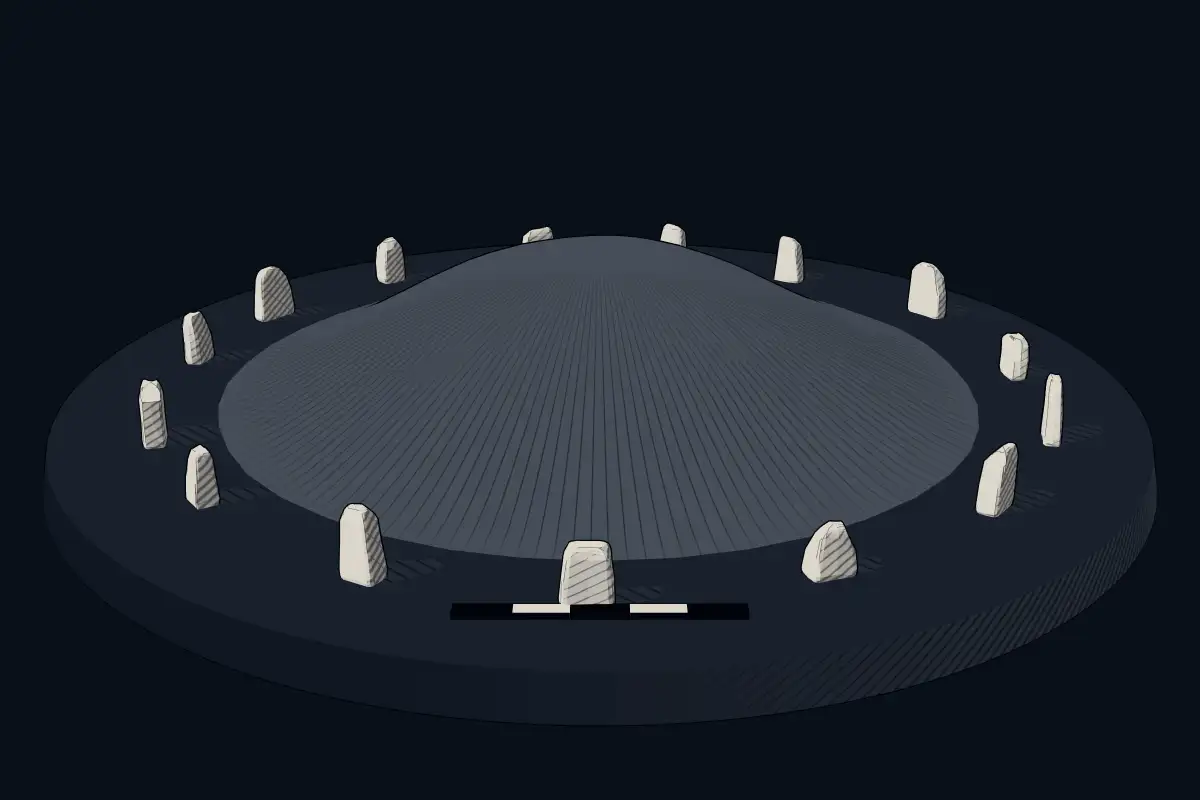
The reconstruction is ours, not a survey: it shows what a monument of this type looks like, at the size the record gives for this one.
Photographs
6 photographs, each with its author and licence
More photographs


Lore
Evidence & Lore
What the sources actually support — and, kept apart, what has been claimed.
What the evidence supports
Dates
Est. 250–650 CEHow this date was established: Type comparisonTypical range for megalithic mounds in Japan; this site has not been dated itself. Japanese kofun burial mounds were mainly constructed between the middle of the 3rd century and the early 7th century AD.Source for this date
Where it stands
Japan
The pin marks the monument itself — its exact point.
- Coordinates
- 34°18′55″ N, 134°06′22″ EFor a GPS or map app: 34.31517, 134.10603
Access is as our sources describe it; we have not visited the site to check.
Nearby
The closest sites in the Atlas, by straight line.
 Yamashita Kofun250–650 CE
 Takamatsu Chausuyama Kofun250–650 CE
 Mitani Ishifune Kofun250–650 CE
- Megalithic mound (tumulus with integral stones)鶴尾神社4号墳250–650 CE
- Megalithic mound (tumulus with integral stones)長崎鼻古墳250–650 CE
 Iwaseoyama Kofun Cluster4000–1200 BCE
- Megalithic mound (tumulus with integral stones)相作馬塚古墳250–650 CE
- Megalithic mound (tumulus with integral stones)Tsuda Kofun Cluster4000–1200 BCE


Sources
Every record behind this page, with the link it came from.
2 sources behind this page
- 01Wikidata Q84638275wikidata.org
- 02Source for this dateen.wikipedia.org
Image files
- Hisamoto Kofun, 3D-B.jpgSaigen JiroCC0
- Hisamoto Kofun, 3D-N.jpgSaigen JiroCC0
- Hisamoto Kofun, 3D-P.jpgSaigen JiroCC0
- Hisamoto Kofun, entrance.jpgSaigen JiroCC0
- Hisamoto Kofun, genmon.jpgSaigen JiroCC0
- Hisamoto Kofun, genshitsu-3.jpgSaigen JiroCC0
Report a correctionWrong date, name, photograph or source? Tell us and it will be put right.
Around this place
The ten nearest sites, by compass
Credit
Text, licence and sources
Text from the Wikipedia article "久本古墳" (Japanese), licensed CC BY-SA 4.0; authors are listed in the page history. Reused under CC BY-SA 4.0. Read on Wikipedia · Edit history and authors
- Wikipedia (Japanese): 久本古墳CC BY-SA 4.0
- Wikidata Q84638275CC0