Megalithic mound (tumulus with integral stones)
Amamiyama Kofun
Datedc. 201 CE
No licensed photograph yetWe have no photograph we may publish for this site, so the interpretive 3D view leads instead.
Overview
About this site
Overview
Amamiyayama Kofun (安満宮山古墳) is a rectangular burial mound in a public cemetery park at Amagoten-chō in Takatsuki, Osaka Prefecture, Japan. It is thought to have been built in the latter half of the third century, and it is not designated as a historic site.
The tomb is known for the grave goods found in an excavation before the cemetery was extended, among them a bronze mirror inscribed with the third year of Seiryū (235) of the Wei dynasty.
Read on Wikipedia3 min readCC BY-SA 4.0
Where it sits in time
The site's dated range, placed against world reference points.
The scale is logarithmic: each step to the left is about ten times older than the last.
Article
Amamiyama Kofun
The tomb was originally one mound within the Amamiyama group, a large cluster of tombs thought to have been built from the late sixth century into the seventh century.
DescriptionSources for this section
- Wikipedia (Japanese): 安満宮山古墳CC BY-SA 4.0
Sources for this section
- Wikipedia (Japanese): 安満宮山古墳CC BY-SA 4.0
The tomb was originally one mound within the Amamiyama group, a large cluster of tombs thought to have been built from the late sixth century into the seventh century. The other mounds were destroyed during the development of the cemetery. The mound is rectangular and is estimated to measure 18 metres from east to west and 21 metres from north to south.
The burial was a split-bamboo-shaped wooden coffin of kōyamaki (Japanese umbrella pine) laid directly in the ground.
ExcavationsSources for this section
- Wikipedia (Japanese): 安満宮山古墳CC BY-SA 4.0
Sources for this section
- Wikipedia (Japanese): 安満宮山古墳CC BY-SA 4.0
An excavation made in advance of the extension of the cemetery recovered grave goods including the mirror dated to the third year of Seiryū. The discovery of this dated mirror led to the date of construction being placed in the latter half of the third century.
FindsSources for this section
- Wikipedia (Japanese): 安満宮山古墳CC BY-SA 4.0
Sources for this section
- Wikipedia (Japanese): 安満宮山古墳CC BY-SA 4.0
The finds include five bronze mirrors, among them the mirror of the third year of Seiryū (235) of the Wei dynasty and a triangular-rimmed deity-beast mirror, glass small beads numbering over 1600, and iron objects including an iron sword and an iron axe.
Because the finds include a Seiryū mirror and a triangular-rimmed deity-beast mirror, there is a view that these mirrors were part of the hundred bronze mirrors that Himiko received from Wei.
ConservationSources for this section
- Wikipedia (Japanese): 安満宮山古墳CC BY-SA 4.0
Sources for this section
- Wikipedia (Japanese): 安満宮山古墳CC BY-SA 4.0
The finds were designated together as an Important Cultural Property: five bronze mirrors, one of which bears the Seiryū inscription, nine iron objects and the glass small beads, together with two fragments of ramie cloth. The surrounding area has been restored and opened to the public as the Seiryū Sannen no Oka (hill of the third year of Seiryū).
VisitingSources for this section
- Wikipedia (Japanese): 安満宮山古墳CC BY-SA 4.0
Sources for this section
- Wikipedia (Japanese): 安満宮山古墳CC BY-SA 4.0
The site is reached from Takatsuki station on the JR West Tōkaidō line by Takatsuki city bus bound for Kaminarui, getting off at Iwatebashi and walking up through the cemetery park for 25-30 minutes. At the Obon and equinox periods the city runs a bus for visitors to the graves.
ContextSources for this section
- Wikipedia (Japanese): 安満宮山古墳CC BY-SA 4.0
Sources for this section
- Wikipedia (Japanese): 安満宮山古墳CC BY-SA 4.0
Kofun are the great burial mounds of ancient Japan, built mainly between the middle of the third century and the early seventh century CE. The distinctive form is the keyhole-shaped mound, but there are also plain round mounds, double-rectangle mounds and square mounds, as this rectangular tomb shows.
Tradition and region
About this kind of monument
Japanese kofun tumuli
Kofun are the great burial mounds of ancient Japan, built mainly between the middle of the third century and the early seventh century CE. The period takes its name from them. The most distinctive form is the keyhole-shaped mound (zempō-kōen-fun), with one square end and one round end seen from above, but there are also plain round mounds, double-rectangle mounds and square mounds. Orientation is not fixed: in the Mozu group at Sakai, some round parts face north and others east.
The largest is Daisenryō kofun at Sakai in Osaka, the biggest kofun in Japan, thought to have been built over some twenty years in the middle of the fifth century. By common acceptance it is the tomb of Emperor Nintoku, and the Imperial Household Agency treats it as such, but this cannot be confirmed because the mound has not been excavated. It stands in the Mozu group, which once had more than a hundred tombs of which fewer than half remain; the group and the neighbouring Furuichi cluster were inscribed on the UNESCO World Heritage List in 2019. The mounds were built on a plateau overlooking Osaka Bay, near the ancient coastline.
Dating rests on mound shape, pottery and grave goods. Haniwa, which means "clay circle", are terracotta cylinders and figures of houses, animals and people that were arranged in rings and rows around and on top of the mounds. Smaller kofun are very numerous and sit in groups in every region of Japan.
When visiting, look for the moat that surrounds the larger mounds, for the stepped outline of terraces, and for reconstructed haniwa in museums and parks beside the tombs.
Paraphrased from Wikipedia: Kofun, Wikipedia: Daisen Kofun, Wikipedia: Haniwa, Wikipedia: Mozu Tombs · CC BY-SA 4.0
See it in 3D
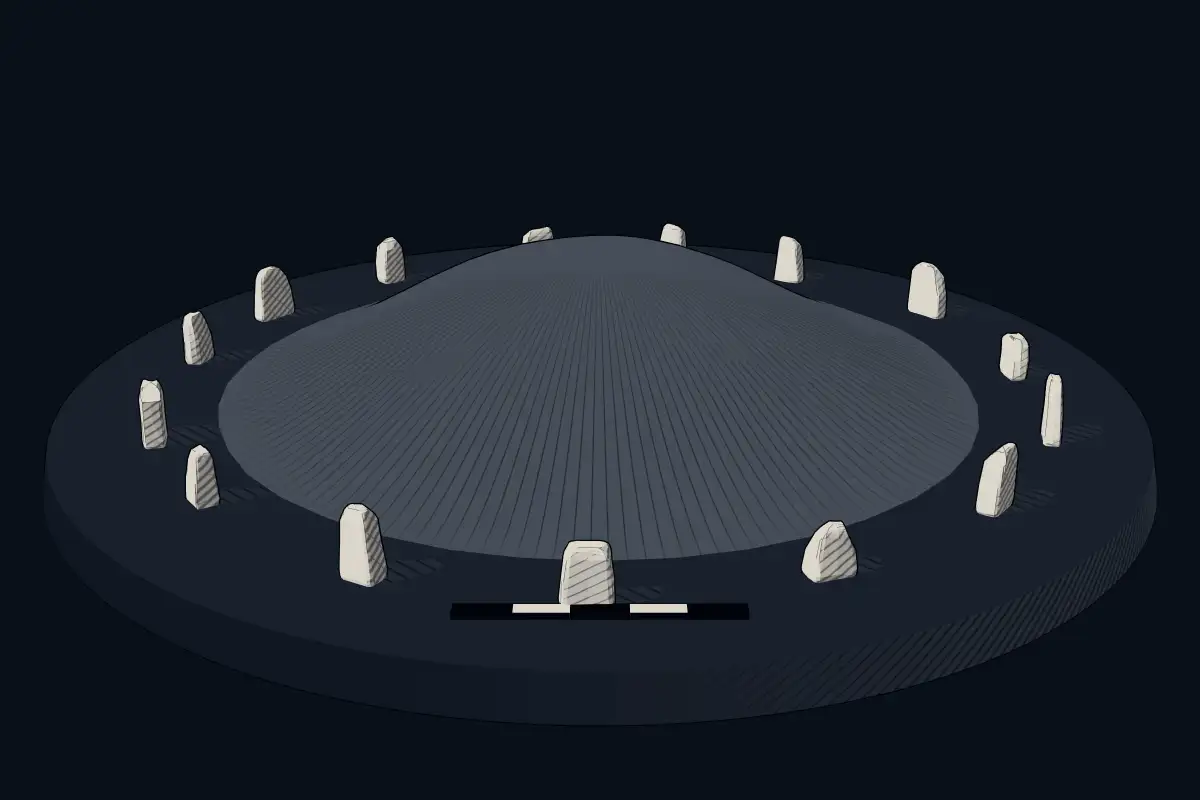
An interpretive reconstruction of the monument, standing on the real ground at its exact point, under the sun for that place and season. Drag to look around it.
The reconstruction is ours, not a survey: it shows what a monument of this type looks like, at the size the record gives for this one.
Lore
Evidence & Lore
What the sources actually support — and, kept apart, what has been claimed.
What the evidence supports
Dates
Est. 250–650 CEHow this date was established: Type comparisonTypical range for megalithic mounds in Japan; this site has not been dated itself. Japanese kofun burial mounds were mainly constructed between the middle of the 3rd century and the early 7th century AD.Source for this date
Where it stands
Japan
The pin marks the monument itself — its exact point.
- Coordinates
- 34°51′58″ N, 135°38′09″ EFor a GPS or map app: 34.86600, 135.63575
Access is as our sources describe it; we have not visited the site to check.
Nearby
The closest sites in the Atlas, by straight line.
 Hirugami Kurumazuka Kofun250–650 CE
 郡家車塚古墳250–650 CE
 Imashirozuka Kofun501–550 CE
 Maetsuka Kofun250–650 CE
 Makino Kurumazuka Kofun4000–1200 BCE
- Megalithic mound (tumulus with integral stones)Tsugeyama Kofun
- Megalithic mound (tumulus with integral stones)Banzan Kofun250–650 CE
 Ōda Chausuyama Kofun250–650 CE


Sources
Every record behind this page, with the link it came from.
2 sources behind this page
- 01Wikidata Q11450943wikidata.org
- 02Source for this dateen.wikipedia.org
Report a correctionWrong date, name, photograph or source? Tell us and it will be put right.
Around this place
The ten nearest sites, by compass
Credit
Text, licence and sources
Adapted from the Wikipedia article "安満宮山古墳" (Japanese), licensed CC BY-SA 4.0; authors are listed in the page history. Reused under CC BY-SA 4.0. Read on Wikipedia · Edit history and authors
- Wikipedia (Japanese): 安満宮山古墳CC BY-SA 4.0
- Wikidata Q11450943CC0