Menhir (standing stone)The Bronze Age
Sassi Ritti
DatedEst. 2800–1800 BCE
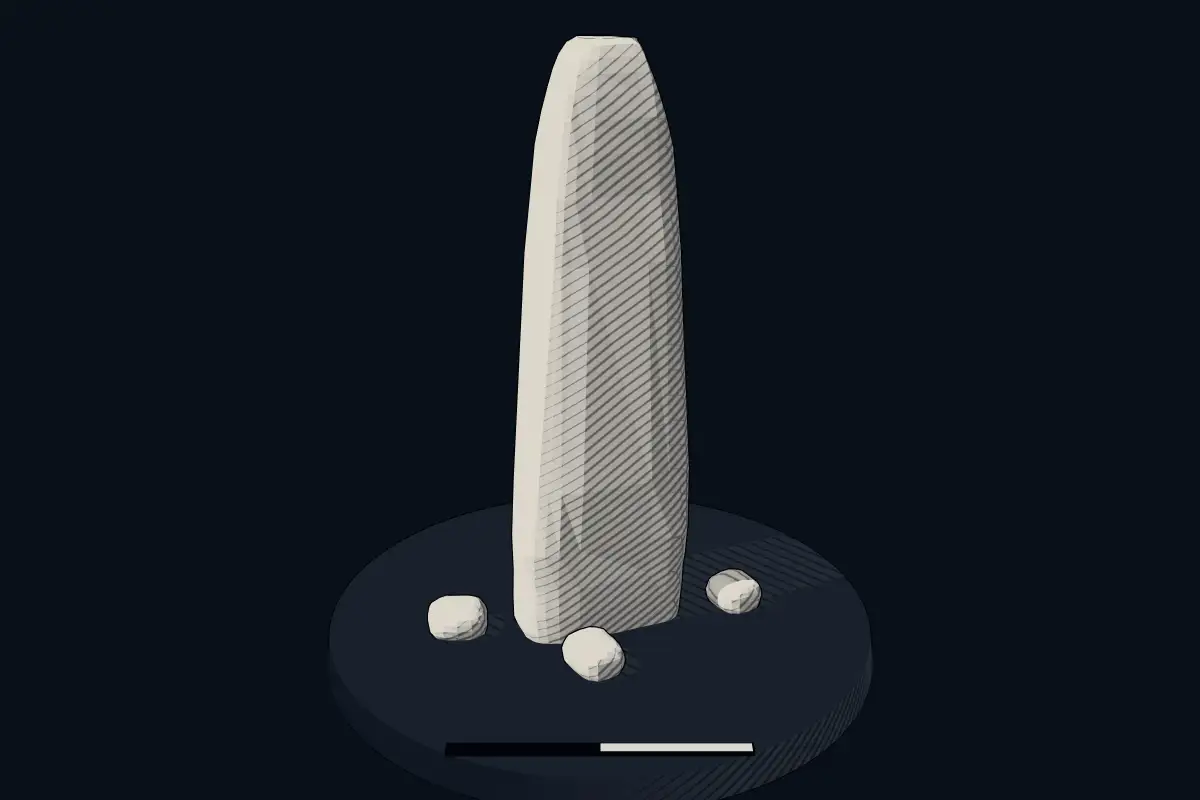
No licensed photograph yetWe have no photograph we may publish for this site, so the interpretive 3D view leads instead.
Overview
About this site
Overview
Sassi Ritti is a megalithic complex on the island of Elba, Italy, at an altitude of 327 m, not far from the village of San Piero in Campo and from the Villanovan necropolis of Spino. Four aniconic menhirs, which give the site its name, originally formed a typical alignment of monoliths oriented north-south.
The alignment is thought to be linked to a solar cult comparable to the so-called filarate (rows of stones) of Corsica and Sardinia. It is dated by typology to between 2800 and 1800 BCE.
Read on Wikipedia1 min readCC BY-SA 4.0
Where it sits in time
The site's dated range, placed against world reference points.
The scale is logarithmic: each step to the left is about ten times older than the last.
Article
Sassi Ritti
DescriptionSources for this section
- Wikipedia (Italian): Sassi RittiCC BY-SA 4.0
Sources for this section
- Wikipedia (Italian): Sassi RittiCC BY-SA 4.0
The four menhirs are aniconic, that is, they carry no carved figures. Their north-south alignment is probably connected with a solar cult.
Burials and tools of Sardinian obsidian from Monte Arci were found near the site in the past.
FindsSources for this section
- Wikipedia (Italian): Sassi RittiCC BY-SA 4.0
Sources for this section
- Wikipedia (Italian): Sassi RittiCC BY-SA 4.0
Burials and tools of Sardinian obsidian from Monte Arci were found near the site in the past.
SettingSources for this section
- Wikipedia (Italian): Sassi RittiCC BY-SA 4.0
Sources for this section
- Wikipedia (Italian): Sassi RittiCC BY-SA 4.0
Not far from the archaeological site, at the locality of Moncione, stands a stone hut built for agricultural use by Mamiliano Martorella around 1930. Beside it is a large water mill (Mulino di Moncione), enlarged after 1890 by the local landowner Pompeo Battaglini.
ContextSources for this section
- Wikipedia (Italian): Sassi RittiCC BY-SA 4.0
Sources for this section
- Wikipedia (Italian): Sassi RittiCC BY-SA 4.0
Outside the Atlantic fringe, menhirs also occur across central and southern Europe. Italy has its most famous menhirs in Sardinia, where at least 332 standing stones can be seen.
Tradition and region
About this kind of monument
Central and southern European menhirs
Outside the Atlantic fringe, menhirs also occur across central and southern Europe. In the Czech Republic there are about 40 real menhirs and dozens of stones that could also be menhirs, and others have been erected recently. The largest real menhir is Kamenný pastýř, the "stony shepherd", near Klobuky, 3.3 metres high; the Czech menhirs are probably the last outcrop of a tradition that ran across northern Germany. Some of the Czech stones in the Atlas may be natural boulders.
Italy has its most famous menhirs in Sardinia, where at least 332 standing stones can be seen. They include elaborate "statue-menhirs" that show a human face at the top and gendered symbols on the flat front; over a hundred of this standardised type have been found, mostly around the village of Laconi. In the Sardinian language they are called perdas fittas or perdas lungas. In Switzerland, in the canton of Vaud, several menhirs form linear patterns at Clendy in Yverdon-les-Bains, and date back to the third millennium BCE.
A statue menhir is a carved standing stone of the later European Neolithic, in which a slab or pillar has a stylised human figure cut into it, sometimes with hints of clothing or weapons. They are most commonly found in southern and western France, Catalonia, Corsica, Sardinia, Italy and the Alps.
Menhirs are usually difficult to date, and those without excavation can only be given a broad range. A stone's present position is not always its original one.
When visiting, check whether a stone stands in its original position and look for signs of shaping.
Paraphrased from Wikipedia: Menhir, Wikipedia: List of menhirs, Wikipedia: Statue menhir · CC BY-SA 4.0
See it in 3D
An interpretive reconstruction of the monument, standing on the real ground at its exact point, under the sun for that place and season. Drag to look around it.
The reconstruction is ours, not a survey: it shows what a monument of this type looks like, at the size the record gives for this one.
Lore
Evidence & Lore
What the sources actually support — and, kept apart, what has been claimed.
What the evidence supports
Dates
Est. 2800–1800 BCEHow this date was established: Type comparisonTypical range for menhirs in Italy; this site has not been dated itself. Standing stones are associated with the Beaker people of the European late Neolithic and early Bronze Age c. 2800-1800 BC.Source for this date
Where it stands
Italy
The pin marks the monument itself — its exact point.
- Coordinates
- 42°44′49″ N, 10°11′47″ EFor a GPS or map app: 42.74694, 10.19649
Access is as our sources describe it; we have not visited the site to check.
Nearby
The closest sites in the Atlas, by straight line.
 Tomb of the Chariots
- Stone row (alignment)Pinzu a Virgine stone row3300–2500 BCE
 Piève statue menhirs4800–2500 BCE
 Monte Revincu dolmen4000–3000 BCE
 Santa Maria statue menhir4500–1500 BCE
- Megalithic mound (tumulus with integral stones)Mucellena Etruscan tumulus
- DolmenDolmen Tres Pitta4000–3000 BCE
 Tumulo del Principe etrusco


Sources
Every record behind this page, with the link it came from.
2 sources behind this page
- 01Wikidata Q3950680wikidata.org
- 02Source for this dateen.wikipedia.org
Report a correctionWrong date, name, photograph or source? Tell us and it will be put right.
Around this place
The ten nearest sites, by compass
- Tomb of the Chariots37 km NE
- Pinzu a Virgine stone row68 km W
- Piève statue menhirs77 km W
- Monte Revincu dolmen77 km W
- Santa Maria statue menhir85 km SW
- Mucellena Etruscan tumulus104 km NE
- Dolmen Tres Pitta108 km SW
- Tumulo del Principe etrusco111 km N
- Castaldu statue menhir126 km SW
- Pacciunituli dolmen142 km SW
Credit
Text, licence and sources
Adapted from the Wikipedia article "Sassi Ritti" (Italian), licensed CC BY-SA 4.0; authors are listed in the page history. Reused under CC BY-SA 4.0. Read on Wikipedia · Edit history and authors
- Wikipedia (Italian): Sassi RittiCC BY-SA 4.0
- Wikidata Q3950680CC0