
Overview
About this site
What the sources say
Il nuraghe Melas o Fumiu è un nuraghe complesso situato nel comune di Guspini, nel Medio Campidano.
Article in ItalianRead on Wikipedia4 min readCC BY-SA 4.0
Where it sits in time
The site's dated range, placed against world reference points.
The scale is logarithmic: each step to the left is about ten times older than the last.
The full article
Nuraghe Melas: the whole story
In briefSources for this section
- Wikipedia (Italian): Nuraghe MelasCC BY-SA 4.0
Sources for this section
- Wikipedia (Italian): Nuraghe MelasCC BY-SA 4.0
Nuraghe Melas, also called Fumiu, is a complex nuraghe in the municipality of Guspini in Sardinia’s Medio Campidano. It stands on a hill of just under 100 metres, surrounded by Mediterranean scrub. The site is about 2 km in a straight line from Saurecci and about 7 km from the inhabited centre. It can be seen from the ss 126 road between Guspini and San Nicolò d'Arcidano.
The monument consists of several nuraghi of varying sizes. Its entrances include an opening facing the sirocco-levante and another, 2 metres high, that appears above ground like a window. A gallery opens in the wall of the second entrance and leads to upper levels or a terrace. Regular, carefully built stairways are present, along with niches in the main chamber measuring 1.60 metres deep and 2.30 metres wide.
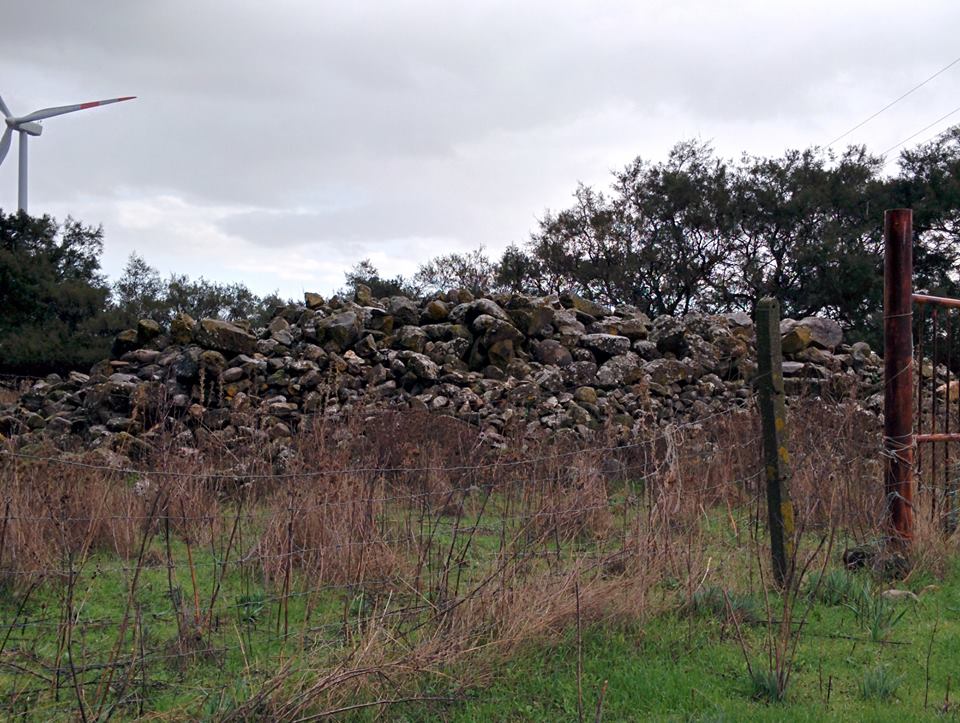
Basalt blocks occur through most of the structure, especially in the lintel of the main entrance. Large stones, nearly perpendicular walls, and the use of cement and clay are distinctive features described by Vittorio Angius. The upper chamber has been completely destroyed, while dense Mediterranean vegetation now makes the structure difficult to interpret. Its position provides broad views over the Campidano plain, particularly northward toward Monte Arci.
Nuraghe Melas is dated by typological estimate to 1900 BCE to 730 BCE. Monuments of this kind in Sardinia are usually truncated conical towers with a tholos-like internal vault; more than 7,000 have been found, and archaeologists believe there were originally more than 10,000. Nearby prehistoric sites include Uraddili, the menhir Genna Prunas, Pozzo sacro Sa Mitza de Nieddinu, Domus de janas di Bruncu Maddeus, and Bruncu 'e s'Orcu.
No English Wikipedia article exists for it; the full text below is the Italian article "Nuraghe Melas", shown in the original language.
Summary in EnglishSources for this section
- Wikipedia (Italian): Nuraghe MelasCC BY-SA 4.0
Sources for this section
- Wikipedia (Italian): Nuraghe MelasCC BY-SA 4.0
Nuraghe Melas is a nuraghe in Guspini, Italy. A typological estimate: 1900 BCE to 730 BCE. No English Wikipedia article exists for it; the full text below is the Italian article "Nuraghe Melas", shown in the original language.
Contesto ambientale e collocazione geograficaSources for this section
- Wikipedia (Italian): Nuraghe MelasCC BY-SA 4.0
Sources for this section
- Wikipedia (Italian): Nuraghe MelasCC BY-SA 4.0
Il nuraghe Melas è stato realizzato sulla sommità di una collina alta poco meno di 100 metri circa, immerso nella macchia mediterranea che domina l'intera area archeologica. Il nuraghe dista circa 2 km in linea d'aria dalla fortezza nuragica di Saurecci e circa 7 km dal centro abitato. Il sito archeologico è visibile percorrendo la strada ss 126 che collega Guspini a San Nicolò d'Arcidano tra la località Tupa Crebu e la località Corti Arrubia.
Nei pressi del sito sono presenti ulteriori monumenti preistorici relativi al periodo prenuragico e nuragico: il nuraghe Uraddili, il menhir Genna Prunas e il Pozzo sacro Sa Mitza de Nieddinu ad est della fortezza, mentre a nord si trovano la Domus de janas di Bruncu Maddeus e il nuraghe Bruncu 'e s'Orcu.
DescrizioneSources for this section
- Wikipedia (Italian): Nuraghe MelasCC BY-SA 4.0
Sources for this section
- Wikipedia (Italian): Nuraghe MelasCC BY-SA 4.0
Vittorio Angius lo chiama Fumìu e lo descrive così: «.. È un tal disegno, del quale non si
possa dar un’idea senza averlo delineato». Proseguendo con la descrizione asserisce che ci siano più nuraghi che lo compongono di dimensioni variabili sottolineando che: «.. il norace Fumiu... presenta alcune particolarità. Sopra la porta aperta incontro al sirocco-levante è uno spiraglio, e non lungi da questa è una seconda porta aperta al sirocco e alta metri 2, che però essendo alta sul suolo pare una finestra: in un suo fianco è aperta la galleria nello spessore del muro per andar ne’ piani superiori o nella terrazza.» Con chiaro riferimento alla presenza di scale, vedasi la galleria fotografica. Queste presentano un andamento regolare e una struttura ben definita e curata. Dopo aver descritto le nicchie presenti nella camera principale e : «.. profondi metri 1,60, larghi 2,30.» sottolinea un aspetto fondamentale della costruzione nel suo insieme: «.. In questa costruzione furono usate pietre molto maggiori che nelle altre due suddescritte, le mura son quasi a perpendicolo, e si usarono i cementi e l’argilla».
La sua posizione, come quella di tutti i nuraghe è fortemente strategica. La vista sulla sommità del mastio centrale permetteva di guardare all'intera piana del Campidano con particolare attenzione alla zona nord e al Monte Arci. La sua struttura oggigiorno è di difficile interpretazione a causa della macchia mediterranea che lo sovrasta. I blocchi di roccia basaltica sono presenti in quasi tutta la struttura, con particolare attenzione all'architrave dell'ingresso principale.
La camera al piano superiore risulta completamente distrutta.
Voci correlateSources for this section
- Wikipedia (Italian): Nuraghe MelasCC BY-SA 4.0
Sources for this section
- Wikipedia (Italian): Nuraghe MelasCC BY-SA 4.0
Guspini
Nuraghe Saurecci
Nuraghe Fenu
Civiltà nuragica
Nuraghe
Altri progettiSources for this section
- Wikipedia (Italian): Nuraghe MelasCC BY-SA 4.0
Sources for this section
- Wikipedia (Italian): Nuraghe MelasCC BY-SA 4.0
Wikimedia Commons contiene immagini o altri file su nuraghe Melas
How this page was madeSources for this section
- Wikipedia (Italian): Nuraghe MelasCC BY-SA 4.0
Sources for this section
- Wikipedia (Italian): Nuraghe MelasCC BY-SA 4.0
The summary at the top of this page was written by MiniMax-M3 (2026-11-07) from the cited Wikipedia article “Nuraghe Melas”, translated from Italian. The numbers in it were checked automatically against the source text. The rest of the page is the article itself, the structured records and computed distances.
Tradition and region
About this kind of monument
Sardinian nuraghi
The nuraghe is the main type of ancient megalithic building in Sardinia, and it has become the symbol of the island and of its Nuragic civilization. They were built during the Nuragic Age, between 1900 and 730 BCE. More than 7,000 have been found, and archaeologists believe that originally there were more than 10,000. A nuraghe has the outer shape of a truncated conical tower, rather like a medieval tower, with a tholos-like vault inside.
The finest is Su Nuraxi at Barumini, a UNESCO World Heritage Site since 1997. Its oldest part is a central tower with three superposed chambers, 18.6 metres high, built of basalt blocks between the seventeenth and thirteenth centuries BCE. In the Late Bronze Age four corner towers joined by a curtain wall were added, and a village grew around it, inhabited from the thirteenth to the sixth century BCE. Scholars consider it the most impressive expression of the Nuragic civilization.
There is no consensus on what the nuraghi were for: rulers' residences, military strongholds, meeting halls, temples and ordinary dwellings have all been proposed. The Nuragic civilization lasted from the eighteenth century BCE until the Iron Age or the beginning of Roman colonisation in 238 BCE, and building of nuraghi had stopped by the twelfth or eleventh century BCE. Its origins are disputed: the traditional theory of Giovanni Lilliu, from 1966, saw migrants related to the Beaker culture, while others argue for local development. Even the word nuraghe has an uncertain and disputed etymology.
Many nuraghi have never been excavated, and their dates are inferred from their form.
When visiting, look for the stone courses, the entrance corridor, and the village of huts that often surrounds the tower.
Paraphrased from Wikipedia: Nuraghe, Wikipedia: Nuragic civilization, Wikipedia: Su Nuraxi · CC BY-SA 4.0
Photographs
7 photographs, each with its author and licence
More photographs
Lore
Evidence & Lore
What the sources actually support — and, kept apart, what has been claimed.
What the evidence supports
Dates
Est. 1900–730 BCEHow this date was established: Type comparisonTypical range for nuraghes in Italy; this site has not been dated itself. The nuraghe is the main type of ancient megalithic edifice of Sardinia developed during the Nuragic Age between 1900 and 730 BC.Source for this date
Where it stands
Italy
The pin marks the monument itself — its exact point.
- Coordinates
- 39°36′30″ N, 8°39′08″ EFor a GPS or map app: 39.60832, 8.65213
Access is as our sources describe it; we have not visited the site to check.
Nearby
The closest sites in the Atlas, by straight line.




Sources
Every record behind this page, with the link it came from.
2 sources behind this page
- 01Wikidata Q47491991wikidata.org
- 02Source for this dateen.wikipedia.org
Image files
- Panoramica del Nuraghe Melas con sullo sfondo il Monte Arci e poco più sotto il colle Sa Zeppara.jpgPrc90CC BY-SA 4.0
- Il nuraghe Melas o nuraghe Fumiu.jpgPrc90CC BY-SA 4.0
- Ingresso laterale che porta alle scale.jpgPrc90CC BY-SA 4.0
- In dettaglio la finestrella di scarico sopra l'architrave.jpgPrc90CC BY-SA 4.0
- In Dettaglio le scale che portano alla sommità del torre centrale.jpgPrc90CC BY-SA 4.0
- La nicchia interna.jpgPrc90CC BY-SA 4.0
- Architrave possente del nuraghe Melas.jpgPrc90CC BY-SA 4.0
Report a correctionWrong date, name, photograph or source? Tell us and it will be put right.
Around this place
The ten nearest sites, by compass
Credit
Text, licence and sources
Text from the Wikipedia article "Nuraghe Melas" (Italian), licensed CC BY-SA 4.0; authors are listed in the page history. Reused under CC BY-SA 4.0. Read on Wikipedia · Edit history and authors
- Wikipedia (Italian): Nuraghe MelasCC BY-SA 4.0
- Wikidata Q47491991CC0