
Menhir di Genna Prunas
DatedEst. 2800–1800 BCE
Photo Prc90 · CC BY 3.0Source file on Wikimedia Commons
Overview
About this site
What the sources say
Il menhir di Genna Prunas è un monumento preistorico situato nel comune di Guspini, lungo la SS126 all'altezza del chilometro 99, in un terreno agricolo presso casa Usai.
Article in ItalianRead on Wikipedia2 min readCC BY-SA 4.0
Where it sits in time
The site's dated range, placed against world reference points.
The scale is logarithmic: each step to the left is about ten times older than the last.
The full article
Menhir di Genna Prunas: the whole story
In briefSources for this section
- Wikipedia (Italian): Menhir Genna PrunasCC BY-SA 4.0
Sources for this section
- Wikipedia (Italian): Menhir Genna PrunasCC BY-SA 4.0
Menhir di Genna Prunas is a prehistoric standing stone in the comune of Guspini, Italy, along the SS126 at the height of kilometer 99. It stands in agricultural land near casa Usai.
The stone reaches a maximum height of about 1,70 metres. Its base is fairly stout, with a width of 60 cm, while its upper end becomes much more rounded. What distinguishes it from other menhirs is the presence of thirty coppelle cut into its basaltic surface, covering all four sides of the monument.
The menhir is dated to the Ozieri culture of the IV millennium BCE. It represents the Dea Madre. Its estimated date is 2800 BCE to 1800 BCE, based on typological comparison.
Menhirs occur beyond the Atlantic fringe across central and southern Europe, though Sardinia holds Italy's most famous examples, with at least 332 standing stones. These include elaborate statue-menhirs showing a human face at the top and gendered symbols on the flat front; more than a hundred of this standardised type have been found, mostly around the village of Laconi. In the Sardinian language they are called perdas fittas or perdas lungas.
No English Wikipedia article exists for it; the full text below is the Italian article "Menhir Genna Prunas", shown in the original language.
Summary in EnglishSources for this section
- Wikipedia (Italian): Menhir Genna PrunasCC BY-SA 4.0
Sources for this section
- Wikipedia (Italian): Menhir Genna PrunasCC BY-SA 4.0
Menhir di Genna Prunas is a menhir (standing stone) in Guspini, Italy. A typological estimate: 2800 BCE to 1800 BCE. No English Wikipedia article exists for it; the full text below is the Italian article "Menhir Genna Prunas", shown in the original language.
DescrizioneSources for this section
- Wikipedia (Italian): Menhir Genna PrunasCC BY-SA 4.0
Sources for this section
- Wikipedia (Italian): Menhir Genna PrunasCC BY-SA 4.0
Il menhir è datato alla cultura di Ozieri (IV millennio a.C.) e rappresenta la Dea Madre.
Raggiunge un'altezza max di circa 1,70 metri e presenta una forma abbastanza tozza alla base con una larghezza di 60 cm per poi assumere nell'estremità una forma molto più arrotondata.
Rispetto agli altri menhir ha la peculiarità di essere interessato dalla presenza di trenta coppelle realizzate sulla superficie basaltica, che ricoprono i quattro lati del monumento.
Altri progettiSources for this section
- Wikipedia (Italian): Menhir Genna PrunasCC BY-SA 4.0
Sources for this section
- Wikipedia (Italian): Menhir Genna PrunasCC BY-SA 4.0
Wikimedia Commons contiene immagini o altri file del menhir di Genna Prunas
How this page was madeSources for this section
- Wikipedia (Italian): Menhir Genna PrunasCC BY-SA 4.0
Sources for this section
- Wikipedia (Italian): Menhir Genna PrunasCC BY-SA 4.0
The summary at the top of this page was written by MiniMax-M3 (2026-11-08) from the cited Wikipedia article “Menhir Genna Prunas”, translated from Italian. The numbers in it were checked automatically against the source text. The rest of the page is the article itself, the structured records and computed distances.
Tradition and region
About this kind of monument
Central and southern European menhirs
Outside the Atlantic fringe, menhirs also occur across central and southern Europe. In the Czech Republic there are about 40 real menhirs and dozens of stones that could also be menhirs, and others have been erected recently. The largest real menhir is Kamenný pastýř, the "stony shepherd", near Klobuky, 3.3 metres high; the Czech menhirs are probably the last outcrop of a tradition that ran across northern Germany. Some of the Czech stones in the Atlas may be natural boulders.
Italy has its most famous menhirs in Sardinia, where at least 332 standing stones can be seen. They include elaborate "statue-menhirs" that show a human face at the top and gendered symbols on the flat front; over a hundred of this standardised type have been found, mostly around the village of Laconi. In the Sardinian language they are called perdas fittas or perdas lungas. In Switzerland, in the canton of Vaud, several menhirs form linear patterns at Clendy in Yverdon-les-Bains, and date back to the third millennium BCE.
A statue menhir is a carved standing stone of the later European Neolithic, in which a slab or pillar has a stylised human figure cut into it, sometimes with hints of clothing or weapons. They are most commonly found in southern and western France, Catalonia, Corsica, Sardinia, Italy and the Alps.
Menhirs are usually difficult to date, and those without excavation can only be given a broad range. A stone's present position is not always its original one.
When visiting, check whether a stone stands in its original position and look for signs of shaping.
Paraphrased from Wikipedia: Menhir, Wikipedia: List of menhirs, Wikipedia: Statue menhir · CC BY-SA 4.0
See it in 3D
An interpretive reconstruction of the monument, standing on the real ground at its exact point, under the sun for that place and season. Drag to look around it.
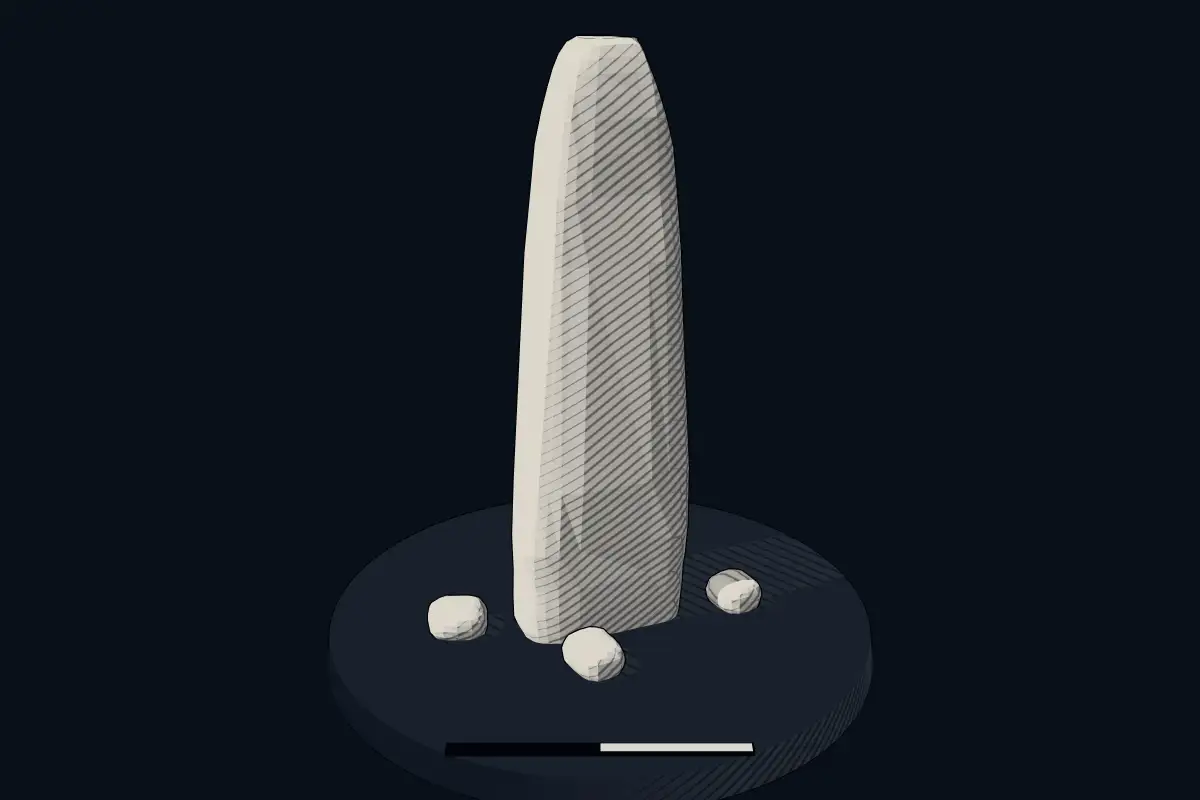
The reconstruction is ours, not a survey: it shows what a monument of this type looks like, at the size the record gives for this one.
Photographs
4 photographs, each with its author and licence
More photographs
Lore
Evidence & Lore
What the sources actually support — and, kept apart, what has been claimed.
What the evidence supports
Dates
Est. 2800–1800 BCEHow this date was established: Type comparisonTypical range for menhirs in Italy; this site has not been dated itself. Standing stones are associated with the Beaker people of the European late Neolithic and early Bronze Age c. 2800-1800 BC.Source for this date
Where it stands
Italy
The pin marks the monument itself — its exact point.
- Coordinates
- 39°35′50″ N, 8°39′40″ EFor a GPS or map app: 39.59719, 8.66100
Access is as our sources describe it; we have not visited the site to check.
Nearby
The closest sites in the Atlas, by straight line.


Sources
Every record behind this page, with the link it came from.
2 sources behind this page
- 01Wikidata Q20009232wikidata.org
- 02Source for this dateen.wikipedia.org
Image files
Report a correctionWrong date, name, photograph or source? Tell us and it will be put right.
Around this place
The ten nearest sites, by compass
Credit
Text, licence and sources
Text from the Wikipedia article "Menhir Genna Prunas" (Italian), licensed CC BY-SA 4.0; authors are listed in the page history. Reused under CC BY-SA 4.0. Read on Wikipedia · Edit history and authors
- Wikipedia (Italian): Menhir Genna PrunasCC BY-SA 4.0
- Wikidata Q20009232CC0