Ipogeo De Beaumont Bonelli Bellacicco
Photo Dr. Marcello Bellacicco · CC BY-SA 3.0Source file on Wikimedia Commons
Overview
About this site
Overview
The Ipogeo De Beaumont Bonelli Bellacicco is a hypogeum in Taranto, Italy, in the Borgo Antico at Corso Vittorio Emanuele 39. It is described as an exceptional structure that records the history of Taranto from geological time, about 65 million years ago, through Greek, Byzantine and medieval traces to the 18th century.
It lies 14 m below the street and extends over 700 m² on three levels.
Read on Wikipedia1 min readCC BY-SA 4.0
Article
Ipogeo De Beaumont Bonelli Bellacicco
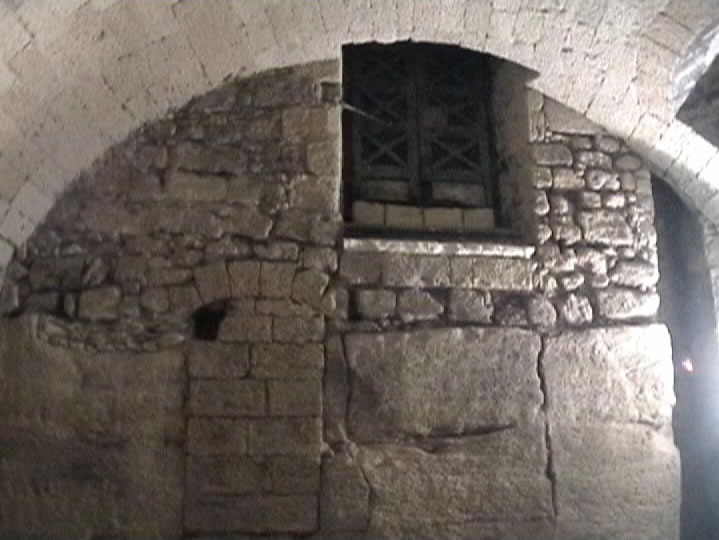
The outer walls date from the Byzantine period, while the wall facing the sea is probably of ancient Greek origin.
DescriptionSources for this section
Sources for this section
Inside the hypogeum, fossil remains of mussels are found in the limestone rock. The outer walls date from the Byzantine period, while the wall facing the sea is probably of ancient Greek origin. The hypogeum has an exit at sea level giving direct access to the seafront promenade of the Borgo Antico.
Later historySources for this section
Sources for this section
The residence of the Marquise De Beaumont and her husband, Prince Bonelli, was later built on this structure. The present owner, Marcello Bellacicco, carried out a restoration that returned its frescoes to the walls and its former splendour to the ceiling.
VisitingSources for this section
Sources for this section
The hypogeum and the building above it are cultural assets of Taranto and are open to visitors free of charge.
Tradition and region
About this kind of monument
Domus de janas of Sardinia
Domus de janas, Sardinian for "houses of the fairies" or, alternatively, "houses of witches", are a type of pre-Nuragic rock-cut chamber tomb found in Sardinia. The names are folklore: later people imagined the small carved rooms as dwellings of fairies or witches. In fact they are tombs, with several chambers quarried out by the people of the San Ciriaco through Ozieri cultures and later groups, in a layout that resembles a house.
They were built mostly between 3400 and 2700 BCE, and so date to the Late Neolithic, the Chalcolithic and the early Bronze Age, including the Bell Beaker period. At Anghelu Ruju near Alghero a necropolis of them has 38 tombs. Other large sites are Montessu near Villaperuccio and Sant'Andrea Priu at Bonorva. Many more are found throughout the island, with the exception of Gallura, where the dead were usually buried in megalithic circles such as those of Li Muri.
The internal chambers vary in shape, from that of a rounded hut with a conical or triangular ceiling. The walls are often decorated with reliefs or etchings of spirals, zig-zags and bull's horns, and some neolithic murals are arguably the oldest known examples of egg tempera painting. Carved or painted false doors appear in about 20 tombs, mostly in the north-west, among them some at Anghelu Ruju, which are datable to between about 3200 and 1600 BCE; the earliest predate false doors in Egyptian tombs.
The Atlas sometimes files these tombs as chambered cairns, but they are the same Sardinian type, and this article applies to them.
When visiting, look for carving on the ceilings and walls, and note that tombs were reused over many centuries.
Paraphrased from Wikipedia: Domus de janas, Wikipedia: Nuragic civilization, Wikipedia: Nuraghe · CC BY-SA 4.0
Photographs
1 photograph, each with its author and licence
Where it stands
Italy
The pin marks the monument itself — its exact point.
- Coordinates
- 40°28′29″ N, 17°13′47″ EFor a GPS or map app: 40.47480, 17.22970
Access is as our sources describe it; we have not visited the site to check.
Nearby
The closest sites in the Atlas, by straight line.


Sources
Every record behind this page, with the link it came from.
1 source behind this page
- 01Wikidata Q650717wikidata.org
Image files
- Ipogeo De Beaumont Taranto1.jpgDr. Marcello BellaciccoCC BY-SA 3.0
Report a correctionWrong date, name, photograph or source? Tell us and it will be put right.
Around this place
The ten nearest sites, by compass
Credit
Text, licence and sources
Adapted from the Wikipedia article "Ipogeo De Beaumont Bonelli Bellacicco" (German), licensed CC BY-SA 4.0; authors are listed in the page history. Reused under CC BY-SA 4.0. Read on Wikipedia · Edit history and authors