Steinkiste von Ballymaclare
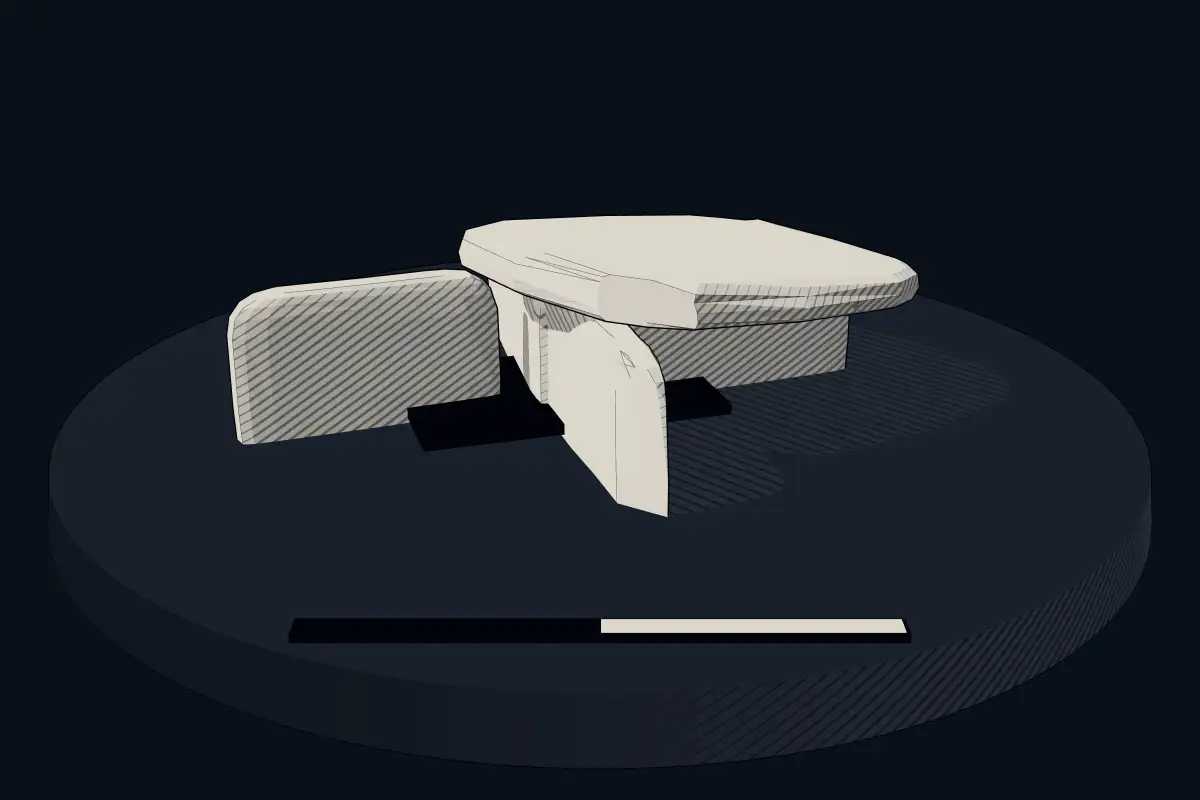
No licensed photograph yetWe have no photograph we may publish for this site, so the interpretive 3D view leads instead.
Overview
About this site
Overview
The cist of Ballymaclare (Steinkiste von Ballymaclare) lies in the townland of Ballymaclare (Irish Baile Mharclaí), on the north-eastern side of Slieve Coiltia, close to the R734 road, south of the town of New Ross in County Wexford, Ireland. The county is otherwise poor in megaliths, for reasons of available resources.
The cist has a chamber of about 2.0 m × 1.0 m, covered by a greenstone slab about 3.3 m long.
Read on Wikipedia2 min readCC BY-SA 4.0
Article
Steinkiste von Ballymaclare
The cist lay within a stone mound surrounded by a ring-shaped ditch of about 10 m in diameter.
DescriptionSources for this section
- Wikipedia (German): Steinkiste von BallymaclareCC BY-SA 4.0
Sources for this section
- Wikipedia (German): Steinkiste von BallymaclareCC BY-SA 4.0
The cist is oriented north-east to south-west. It has an approximately rectangular chamber of about 2.0 m × 1.0 m, covered by a greenstone slab about 3.3 m long, 1.2 m wide and 0.3 m thick. The capstone is supported by five supporting stones that form the chamber walls. Two flat slabs make up the paved floor.
The cist lay within a stone mound surrounded by a ring-shaped ditch of about 10 m in diameter.
FindsSources for this section
- Wikipedia (German): Steinkiste von BallymaclareCC BY-SA 4.0
Sources for this section
- Wikipedia (German): Steinkiste von BallymaclareCC BY-SA 4.0
Inside the cist two complete vessels were found, both now lost. One contained a human skull and the other cremated bone.
Later historySources for this section
- Wikipedia (German): Steinkiste von BallymaclareCC BY-SA 4.0
Sources for this section
- Wikipedia (German): Steinkiste von BallymaclareCC BY-SA 4.0
In 1938 stones were removed from the stone heap that covered the cist during the building of the nearby school at Aclare.
ContextSources for this section
- Wikipedia (German): Steinkiste von BallymaclareCC BY-SA 4.0
Sources for this section
- Wikipedia (German): Steinkiste von BallymaclareCC BY-SA 4.0
In Britain and Ireland a cist is a small stone-built coffin-like box used to hold the dead, and it is one of the commonest finds in prehistoric graves. A cist may once have been covered by a cairn or a long barrow.
Tradition and region
About this kind of monument
British and Irish cists
In Britain and Ireland a cist is a small stone-built coffin-like box used to hold the dead, and it is one of the commonest finds in prehistoric graves. A cist may once have been covered by a cairn or a long barrow, and several are sometimes found together in the same cairn or barrow. Ornaments found in excavated cists point to the wealth or prominence of the person buried. The centre of a round barrow, which in Britain was mostly built between 2200 and 1100 BCE, may hold a stone cist or a cut grave, and the burial may be an inhumation or a cremation placed in a vessel.
The Bell Beaker phenomenon, which reached Britain and Ireland in the late Neolithic, brought individual burials, often under tumuli and with weapons, in place of the collective burials of the earlier Neolithic. Cists of this period are therefore often single graves. The Food Vessel culture of the Early Bronze Age used slab cists, and some of their stones carry cup and ring marks.
Kilmartin Glen in Argyll is the richest area, with numerous cists among its prehistoric monuments, including a linear cemetery of five burial cairns that runs for more than three miles. Several of its cairns and many natural rocks are decorated with cup and ring marks. More than 800 ancient monuments lie within ten kilometres of the village, 150 of them prehistoric.
The Atlas's cists are dated by their position in a barrow, by the pottery or ornaments found with the burial, and by radiocarbon dating of surviving bone. Where none is known, it gives a broad Neolithic to Bronze Age range.
When visiting, look for the slabs set on edge around a pit, and for the cap stone that may have fallen aside.
Paraphrased from Wikipedia: Cist, Wikipedia: Round barrow, Wikipedia: Kilmartin Glen, Wikipedia: Bell Beaker culture · CC BY-SA 4.0
From the article
Dated moments in the story
- 1938
1938 wurden beim Bau der nahe gelegenen Schule bei Aclare Steine aus dem Steinhaufen entfernt, der die Kiste bedeckte.
Source
See it in 3D
An interpretive reconstruction of the monument, standing on the real ground at its exact point, under the sun for that place and season. Drag to look around it.
The reconstruction is ours, not a survey: it shows what a monument of this type looks like, at the size the record gives for this one.
Where it stands
Ireland
The pin marks the monument itself — its exact point.
- Coordinates
- 52°20′38″ N, 6°54′32″ WFor a GPS or map app: 52.34397, -6.90886
Access is as our sources describe it; we have not visited the site to check.
Nearby
The closest sites in the Atlas, by straight line.
- Portal tomb (portal dolmen)Portal Tomb von Newbawn4000–3000 BCE
- MegalithRobinstown Great3300–2900 BCE
- Menhir (standing stone)Standing stone2800–1800 BCE
 Three Friars
- MegalithBallygunnertemple3300–2900 BCE
- Entrance graveEntrance Grave von Harristown
 Ballindud Portal Tomb4000–3000 BCE
 Barnastick2800–1800 BCE


Sources
Every record behind this page, with the link it came from.
1 source behind this page
- 01Wikidata Q20182975wikidata.org
Report a correctionWrong date, name, photograph or source? Tell us and it will be put right.
Around this place
The ten nearest sites, by compass
Credit
Text, licence and sources
Adapted from the Wikipedia article "Steinkiste von Ballymaclare" (German), licensed CC BY-SA 4.0; authors are listed in the page history. Reused under CC BY-SA 4.0. Read on Wikipedia · Edit history and authors