
Ballindud Portal Tomb
Also known asBallindud Cromlech
DatedEst. 4000–3000 BCE
Photo Wanfried-Dublin · CC BY-SA 4.0Source file on Wikimedia Commons
Overview
About this site
Overview
Ballindud Portal Tomb (Irish: Tuama Baile an Dodaigh), also recorded as Ballindud Cromlech, is a portal tomb in County Waterford, Ireland. It was built in the Neolithic, and a typological estimate places it between 4000 and 3000 BCE.
The tomb has not been excavated by archaeologists.
Read on Wikipedia1 min readCC BY-SA 4.0
Where it sits in time
The site's dated range, placed against world reference points.
The scale is logarithmic: each step to the left is about ten times older than the last.
Article
Ballindud Portal Tomb
DescriptionSources for this section
- Wikipedia (Irish): Tuama Baile an DodaighCC BY-SA 4.0
Sources for this section
- Wikipedia (Irish): Tuama Baile an DodaighCC BY-SA 4.0
Ballindud is a portal tomb (Irish: tuama ursanach) in County Waterford. It dates to the Neolithic period. Archaeologists have not excavated it.
Some were covered by a mound of earth or smaller stones which has since eroded away, leaving the stone skeleton.
ContextSources for this section
- Wikipedia (Irish): Tuama Baile an DodaighCC BY-SA 4.0
Sources for this section
- Wikipedia (Irish): Tuama Baile an DodaighCC BY-SA 4.0
A portal tomb, or portal dolmen, is the Irish and British version of the dolmen: a single-chamber megalithic tomb with two or more upright stones framing a portal at the front and a large capstone. In the Irish classification of megalithic tombs set out by Seán Ó Nualláin and Rúaidhrí de Valera in 1961, portal dolmens are one of four categories, alongside court cairns, wedge-shaped gallery graves and passage tombs.
Most portal tombs date from the Neolithic, between 4000 and 3000 BCE. Some were covered by a mound of earth or smaller stones which has since eroded away, leaving the stone skeleton.
Tradition and region
About this kind of monument
Portal tombs
A portal tomb, or portal dolmen, is the Irish and British version of the dolmen: a single-chamber megalithic tomb with two or more upright stones framing a "portal" at the front and a large capstone. In the Irish classification of megalithic tombs set out by Seán Ó Nualláin and Rúaidhrí de Valera in 1961, portal dolmens are one of four categories, alongside court cairns, wedge-shaped gallery graves and passage tombs.
Most portal tombs date from the Neolithic, between 4000 and 3000 BCE, and some were covered by a mound of earth or smaller stones which has since eroded away, leaving the stone skeleton. Ireland has about 172 dolmens, of which the best known is Poulnabrone in the Burren, with estimates between 3800 and 3200 BCE. Excavation under Poulnabrone found the remains of about 33 people, adults and children, along with stone and bone objects.
In Wales and Cornwall the form is the cromlech or quoit. Pentre Ifan in Pembrokeshire is the largest and best-preserved Neolithic dolmen in Wales. The names of Irish portal tombs often reflect old tradition: Brownshill, near Carlow, has a capstone reputed to be the heaviest in Europe, estimated at 150 tonnes, and Proleek in County Louth is the subject of a legend of a Scottish giant who carried it there.
Dating rests on the few excavated tombs, and most are dated by comparison.
When visiting, look for the capstone and for the portal stones at the front.
Paraphrased from Wikipedia: Portal dolmen, Wikipedia: Dolmen, Wikipedia: Passage grave, Wikipedia: Poulnabrone dolmen, Wikipedia: Pentre Ifan, Wikipedia: Brownshill Dolmen, Wikipedia: Proleek Dolmen · CC BY-SA 4.0
From the article
Dated moments in the story
- 2021
Eolas breise as Béarla faoi Baile an Dodaigh Curtha i gcartlann 2021-08-20 ar an Wayback Machine
Source
See it in 3D
An interpretive reconstruction of the monument, standing on the real ground at its exact point, under the sun for that place and season. Drag to look around it.
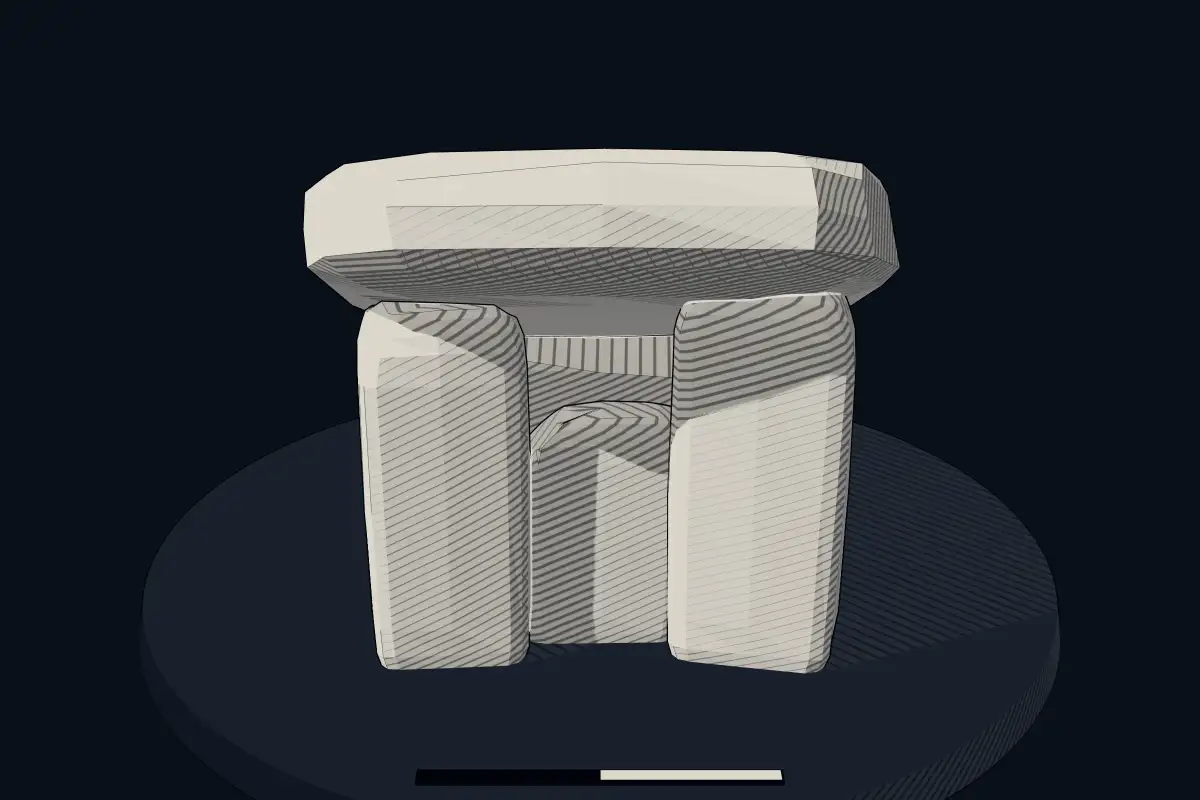
The reconstruction is ours, not a survey: it shows what a monument of this type looks like, at the size the record gives for this one.
Photographs
1 photograph, each with its author and licence
Lore
Evidence & Lore
What the sources actually support — and, kept apart, what has been claimed.
What the evidence supports
Dates
Est. 4000–3000 BCEHow this date was established: Type comparisonTypical range for portal tombs in Ireland; this site has not been dated itself. Irish portal tombs are dolmens and most date from the Late Neolithic period (4000-3000 BCE).Source for this date
Where it stands
Ireland
The pin marks the monument itself — its exact point.
- Coordinates
- 52°13′40″ N, 7°07′10″ WFor a GPS or map app: 52.22769, -7.11933
Access is as our sources describe it; we have not visited the site to check.
Nearby
The closest sites in the Atlas, by straight line.


Sources
Every record behind this page, with the link it came from.
2 sources behind this page
- 01Wikidata Q60846580wikidata.org
- 02Source for this dateen.wikipedia.org
Image files
- Ballindud Dolmen.jpgWanfried-DublinCC BY-SA 4.0
Report a correctionWrong date, name, photograph or source? Tell us and it will be put right.
Around this place
The ten nearest sites, by compass
Credit
Text, licence and sources
Adapted from the Wikipedia article "Tuama Baile an Dodaigh" (Irish), licensed CC BY-SA 4.0; authors are listed in the page history. Reused under CC BY-SA 4.0. Read on Wikipedia · Edit history and authors
- Wikipedia (Irish): Tuama Baile an DodaighCC BY-SA 4.0
- Wikidata Q60846580CC0