Passage Tomb von Carn
DatedEst. 3400–2900 BCE
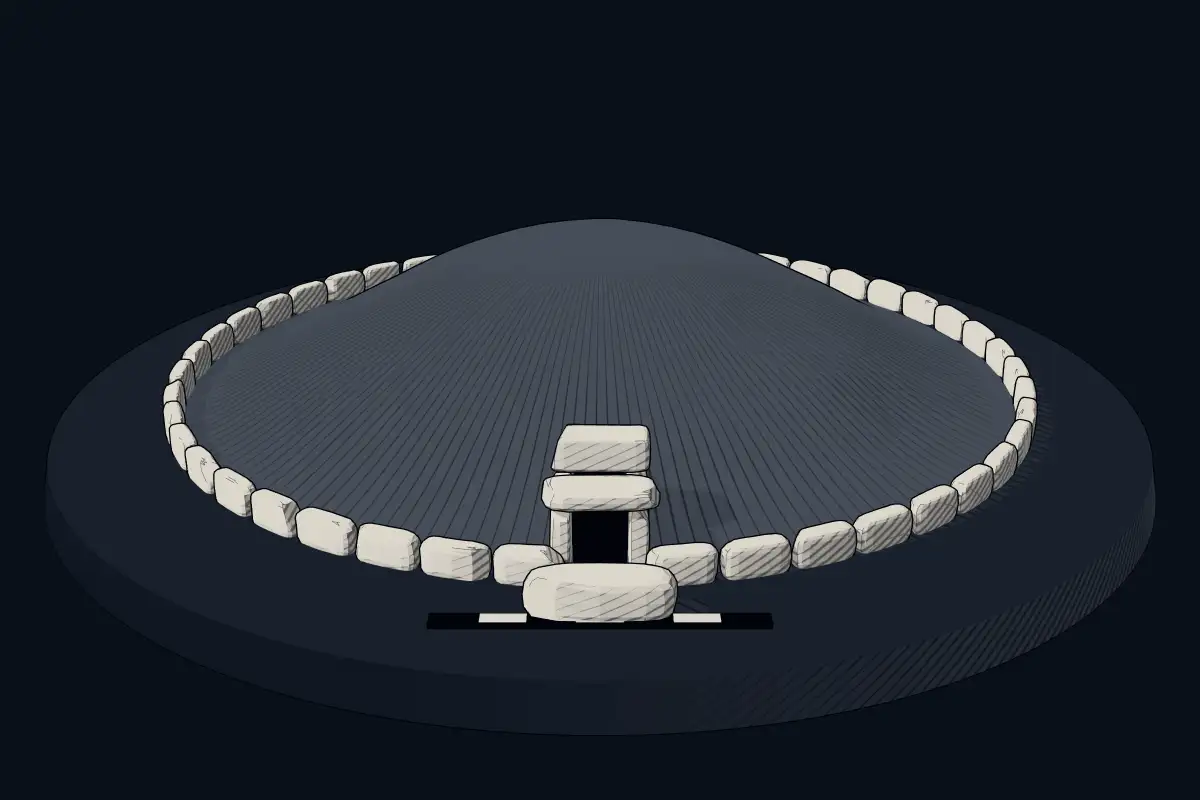
No licensed photograph yetWe have no photograph we may publish for this site, so the interpretive 3D view leads instead.
Overview
About this site
Overview
The passage tomb of Carn lies in the townland of Carn (Irish Carn Dalláin), on a ridge in the north of County Cavan, Ireland. The catalogue estimates, by type, a date of 3400 to 2900 BCE.
The monument has not been excavated. What is known of its interior comes from an account of a destructive opening, and damage since then makes a firm identification difficult.
Read on Wikipedia2 min readCC BY-SA 4.0
Where it sits in time
The site's dated range, placed against world reference points.
The scale is logarithmic: each step to the left is about ten times older than the last.
Article
Passage Tomb von Carn
The associated cairn, once about three metres high, has collapsed heavily and is crossed by field boundaries.
DescriptionSources for this section
- Wikipedia (German): Passage Tomb von CarnCC BY-SA 4.0
Sources for this section
- Wikipedia (German): Passage Tomb von CarnCC BY-SA 4.0
The associated cairn, once about three metres high, has collapsed heavily and is crossed by field boundaries. What it consists of internally is speculation.
Research historySources for this section
- Wikipedia (German): Passage Tomb von CarnCC BY-SA 4.0
Sources for this section
- Wikipedia (German): Passage Tomb von CarnCC BY-SA 4.0
Information on the interior does not come from an excavation but from a report of an opening that destroyed part of the monument. In 1739 an author named Richardson recorded details of discoveries apparently made about 25 years earlier. He described a passage leading to three inner chambers, and reported that several urns, five skulls and a quantity of burnt bones were recovered.
Richardson also mentioned a square stone enclosure, about 18 metres across, to the south, and four small round areas on the slope, each ringed with large stones, which he described as ancient burial places. These features could not be located later, so it remains open whether they were removed or have decayed.
InterpretationSources for this section
- Wikipedia (German): Passage Tomb von CarnCC BY-SA 4.0
Sources for this section
- Wikipedia (German): Passage Tomb von CarnCC BY-SA 4.0
The finds Richardson described fit the passage tomb type and suggest that the monument was one. However, the damage caused by the opening and later disturbance makes a definite diagnosis difficult.
ContextSources for this section
- Wikipedia (German): Passage Tomb von CarnCC BY-SA 4.0
Sources for this section
- Wikipedia (German): Passage Tomb von CarnCC BY-SA 4.0
A passage tomb is a burial chamber covered in earth or stone, with a narrow access passage made of large stones. The type is found along the Atlantic seaboard of Europe, and in Ireland and Britain passage tombs often lie in large clusters, called cemeteries. Ireland has four great ones, Brú na Bóinne, Loughcrew, Carrowkeel and Carrowmore. Most were built in the fourth millennium BCE.
Tradition and region
About this kind of monument
Irish and British passage tombs
A passage tomb is a burial chamber covered in earth or stone, with a narrow access passage made of large stones. The type is found along the Atlantic seaboard of Europe, and in Ireland and Britain passage tombs often lie in large clusters, called cemeteries. Ireland has four great ones, known as the "big four": Brú na Bóinne in the Boyne Valley, Loughcrew, Carrowkeel and Carrowmore, each with its own character. Most were built in the fourth millennium BCE.
The Boyne Valley is the heart of the tradition. Brú na Bóinne in County Meath comprises at least ninety monuments, dominated by Newgrange, Knowth and Dowth, built in the 32nd century BCE. Newgrange, built around 3100 BCE, is older than Stonehenge and the Egyptian pyramids. It has a façade of white quartz cobbles ringed by engraved kerbstones, and is aligned so that the rising sun on the winter solstice shines through a "roofbox" above the entrance and floods the inner chamber. Knowth, a large passage tomb surrounded by 17 smaller ones, holds the largest assemblage of megalithic art in Europe and is ringed by 127 kerbstones. Dowth has mostly been left as a ruin, with a crater from an 1847 excavation.
Across the Irish Sea, Bryn Celli Ddu on Anglesey is considered one of the finest passage tombs in Wales. Visitors can go through its stone passage into the chamber, and the site was once a henge with a stone circle; it may have been used to mark the summer solstice. Barclodiad y Gawres, "the giantess's apronful", on the same island is a cruciform passage grave with decorated stones.
When visiting, look at the kerbstones for carved spirals and lozenges, at the direction of the passage, and at the quartz and other stones that came from far away.
Paraphrased from Wikipedia: Passage grave, Wikipedia: Newgrange, Wikipedia: Knowth, Wikipedia: Brú na Bóinne, Wikipedia: Dowth, Wikipedia: Bryn Celli Ddu, Wikipedia: Barclodiad y Gawres, Wikipedia: Loughcrew, Wikipedia: Carrowmore · CC BY-SA 4.0
From the article
Dated moments in the story
- 1739
1739 hielt ein Autor namens Richardson Einzelheiten über Auffindungen fest, die scheinbar etwa 25 Jahre zuvor gemacht wurden.
Source
Lore
Evidence & Lore
What the sources actually support — and, kept apart, what has been claimed.
What the evidence supports
Dates
Est. 3400–2900 BCEHow this date was established: Type comparisonTypical range for passage tombs in Ireland; this site has not been dated itself. The passage grave of Newgrange in Ireland belongs to the megalithic constructions of c. 3400 BC.Source for this date
Where it stands
Ireland
The pin marks the monument itself — its exact point.
- Coordinates
- 54°04′22″ N, 7°32′49″ WFor a GPS or map app: 54.07265, -7.54690
Access is as our sources describe it; we have not visited the site to check.
Nearby
The closest sites in the Atlas, by straight line.
 Court Tomb von Doon3750–2900 BCE
- Wedge tombKilnavert Wedge Tomb2500–2000 BCE
- Megalithic complexDerryragh Megalithen
 Gartnanoul Court Tomb3750–2900 BCE
- Portal tomb (portal dolmen)Portal Tomb von Aghavas4000–3000 BCE
 Finn McCool's Fingers4500–1200 BCE
- MegalithPortal Tomb von Carrickclevan3300–2900 BCE
- Wedge tombWedge Tomb von Greenan


Sources
Every record behind this page, with the link it came from.
2 sources behind this page
- 01Wikidata Q141445708wikidata.org
- 02Source for this dateen.wikipedia.org
Report a correctionWrong date, name, photograph or source? Tell us and it will be put right.
Around this place
The ten nearest sites, by compass
- Court Tomb von Doon5.9 km NW
- Kilnavert Wedge Tomb6.8 km W
- Derryragh Megalithen7.7 km W
- Gartnanoul Court Tomb7.8 km SE
- Portal Tomb von Aghavas17 km SW
- Finn McCool's Fingers18 km E
- Portal Tomb von Carrickclevan18 km S
- Wedge Tomb von Greenan20 km NW
- Leagaun Standing Stone21 km NE
- portal tomb of Drumhawnagh22 km S
Credit
Text, licence and sources
Adapted from the Wikipedia article "Passage Tomb von Carn" (German), licensed CC BY-SA 4.0; authors are listed in the page history. Reused under CC BY-SA 4.0. Read on Wikipedia · Edit history and authors
- Wikipedia (German): Passage Tomb von CarnCC BY-SA 4.0
- Wikidata Q141445708CC0