
Megalithic mound (tumulus with integral stones)
Lismacrory Mounds
DatedEst. 3700–2900 BCE
Photo Derek Ryan Bawn · CC BY-SA 4.0Source file on Wikimedia Commons

Overview
About this site
What the sources say
Lismacrory Mounds are a group of prehistoric mounds forming a National Monument in County Tipperary, Ireland. They are 2.2 km (1.4 mi) north of Ballingarry, North Tipperary, 10 km (6.3 mi) southeast of Lough Derg.
There are about 20 mounds, or cairns, in the area. They were originally assumed to be burial sites, but are now thought to be piles of stones discarded from fulachtaí fia. Other structures identified in the area include ringforts, dwellings and enclosure sites.
Read on Wikipedia2 min readCC BY-SA 4.0
Where it sits in time
The site's dated range, placed against world reference points.
The scale is logarithmic: each step to the left is about ten times older than the last.
The full article
Lismacrory Mounds: the whole story
In briefSources for this section
- Wikipedia (English): Lismacrory MoundsCC BY-SA 4.0
Sources for this section
- Wikipedia (English): Lismacrory MoundsCC BY-SA 4.0
Lismacrory Mounds are a group of prehistoric mounds forming a National Monument in County Tipperary, Ireland. The site lies 2.2 km (1.4 mi) north of Ballingarry, North Tipperary, and 10 km (6.3 mi) southeast of Lough Derg. About 20 mounds, or cairns, occur in the area.
The mounds were originally assumed to be burial sites, but they are now thought to be piles of stones discarded from fulachtaí fia. Other identified structures around them include ringforts, dwellings and enclosure sites. The surviving monuments are described as a group of prehistoric mounds rather than as a single cairn.
The Lismacrory Mounds are dated by typological estimate to 3700 BCE to 2900 BCE. This dating is an estimate based on the monument type. The wider group of monuments shows that prehistoric cairns were accompanied by ringforts, dwellings and enclosed areas.
Ireland’s hilltop cairns are among its most conspicuous monuments. Many great cairns are Neolithic passage tombs built around 3000 BCE, while many others have never been excavated. Folklore often surrounds such monuments, although the surviving background specifically discusses Heapstown Cairn and Queen Maeve's Cairn rather than Lismacrory Mounds.
How this page was madeSources for this section
- Wikipedia (English): Lismacrory MoundsCC BY-SA 4.0
Sources for this section
- Wikipedia (English): Lismacrory MoundsCC BY-SA 4.0
The summary at the top of this page was written by MiniMax-M3 (2026-11-08) from the cited Wikipedia article “Lismacrory Mounds”. The numbers in it were checked automatically against the source text. The rest of the page is the article itself, the structured records and computed distances.
Tradition and region
About this kind of monument
Irish cairns and barrows
Ireland's hilltop cairns are among its most conspicuous monuments. Many of the great cairns are Neolithic passage tombs, built around 3000 BCE on hilltops: Heapstown Cairn in County Sligo is believed to cover a passage tomb and sits near the Carrowkeel cemetery, and Queen Maeve's Cairn on the summit of Knocknarea, about 55 metres across and 10 metres high, is the largest cairn in Ireland outside Brú na Bóinne. The latter has not been excavated, but its flat top and kerbstones are typical of a passage tomb.
Many cairns have not been excavated, and the large ones are dated by comparison with excavated passage tombs.
Folklore is rich. Medieval tales say that Heapstown Cairn is Carn Ochtriallach, built when the Fomorians filled a well of healing with stones in the story of the Second Battle of Moytura, and another tale makes it the burial mound of the prince Ailill. Knocknarea is Miosgán Meadhbha, Meadhbh's heap. In Ireland it is traditional to carry a stone up from the bottom of a hill to add to a cairn, and a Scottish Gaelic blessing says "I'll put a stone on your cairn". These are traditions, not evidence of who is buried.
When visiting, look for cairns on summits, for kerbstones at the base, and for the dip left by antiquarian digging. Visitor erosion of Maeve's Cairn has caused concern, so please keep to the paths.
Paraphrased from Wikipedia: Cairn, Wikipedia: Heapstown Cairn, Wikipedia: Knocknarea, Wikipedia: Mound of the Hostages, Wikipedia: Tumulus · CC BY-SA 4.0
See it in 3D
An interpretive reconstruction of the monument, standing on the real ground at its exact point, under the sun for that place and season. Drag to look around it.
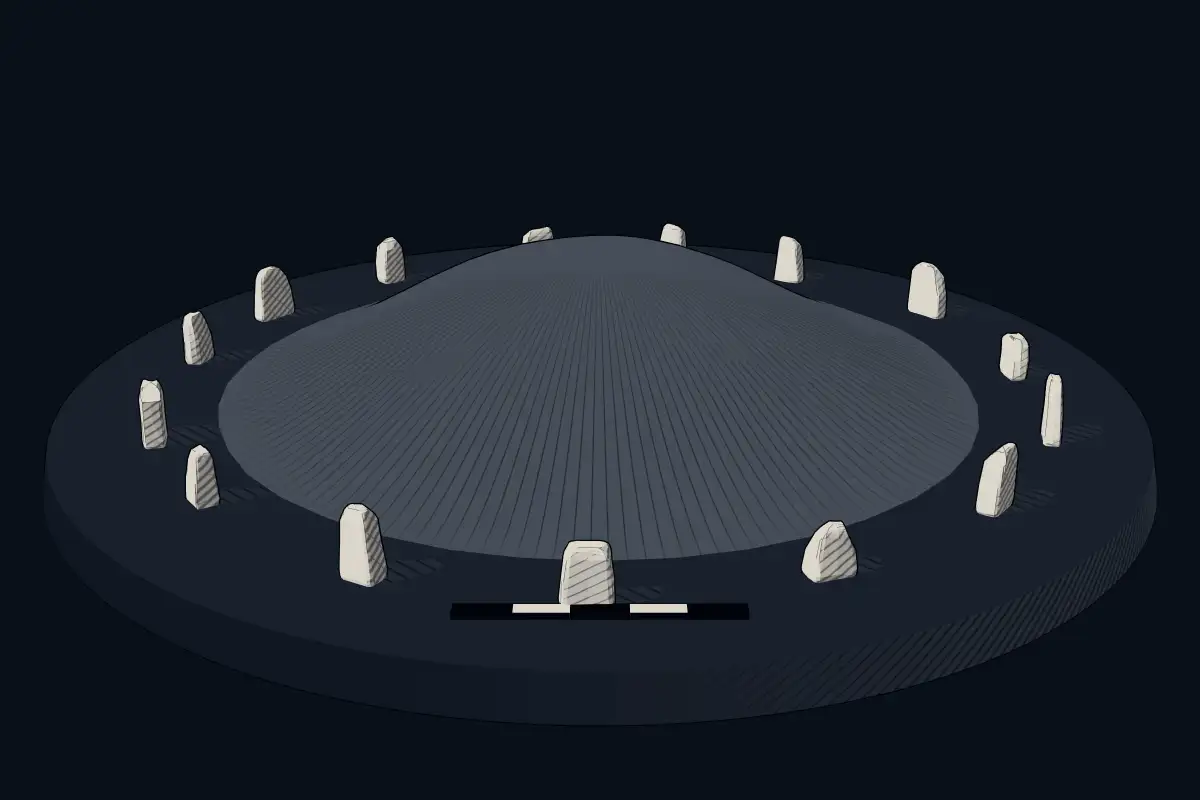
The reconstruction is ours, not a survey: it shows what a monument of this type looks like, at the size the record gives for this one.
Photographs
1 photograph, each with its author and licence
Lore
Evidence & Lore
What the sources actually support — and, kept apart, what has been claimed.
What the evidence supports
Dates
Est. 3700–2900 BCEHow this date was established: Type comparisonTypical range for megalithic mounds in Ireland; this site has not been dated itself. Megalithic construction in Ireland is placed at c. 3700 BC (Knockiveagh) and c. 3400 BC at Newgrange; court cairns continued to be built and enlarged until 2900 BC.Source for this date
Where it stands
Ireland
The pin marks the monument itself — its exact point.
- Coordinates
- 53°02′16″ N, 8°01′54″ WFor a GPS or map app: 53.03778, -8.03167
Access is as our sources describe it; we have not visited the site to check.
Nearby
The closest sites in the Atlas, by straight line.
- DolmenAshleypark Burial Mound3400–3300 BCE
- Menhir (standing stone)Timoney Stones4500–800 BCE
 Graves of the Leinstermen2800–1800 BCE
- Stone circleSteinkreis von Moanmore East3300–2500 BCE
- DolmenWedge Tomb von Knockcurraghbola Commons4000–3000 BCE
- DolmenKnockcurraghbola Crowlands I und II4000–3000 BCE
- Wedge tombLoughbrack wedge tomb2500–2000 BCE
- Wedge tombBaurnadomeeny2500–2000 BCE

Sources
Every record behind this page, with the link it came from.
3 sources behind this page
- 01Wikidata Q28233013wikidata.org
- 02Source for this dateen.wikipedia.org
- 03Wikipedia: Lismacrory Moundsen.wikipedia.org
Image files
- Lismacrory Mound 2.jpgDerek Ryan BawnCC BY-SA 4.0
Report a correctionWrong date, name, photograph or source? Tell us and it will be put right.
Lore, kept apart
Legends and claims
These are stories and claims reported by the sources. They are not evidence, and they never stand in for the dating above.
- Tradition
Ireland’s hilltop cairns are among its most conspicuous monuments.
Ireland’s hilltop cairns are among its most conspicuous monuments. Many great cairns are Neolithic passage tombs built around 3000 BCE, while many others have never been excavated. Folklore often surrounds such monuments, although the surviving background specifically discusses Heapstown Cairn and Queen Maeve's Cairn rather than Lismacrory Mounds.
Source
Around this place
The ten nearest sites, by compass
- Ashleypark Burial Mound16 km SW
- Timoney Stones26 km SE
- Graves of the Leinstermen32 km SW
- Steinkreis von Moanmore East37 km NW
- Wedge Tomb von Knockcurraghbola Commons38 km S
- Knockcurraghbola Crowlands I und II39 km S
- Loughbrack wedge tomb40 km S
- Baurnadomeeny41 km S
- Bayswell Leacht41 km SE
- Meehambee Dolmen42 km N
Credit
Text, licence and sources
Text from the Wikipedia article "Lismacrory Mounds" (English), licensed CC BY-SA 4.0; authors are listed in the page history. Reused under CC BY-SA 4.0. Read on Wikipedia · Edit history and authors
- Wikipedia (English): Lismacrory MoundsCC BY-SA 4.0
- Wikidata Q28233013CC0