
Lia Fáil
Also known asStone of Destiny · Lia Fail
DatedEst. 2800–1800 BCE
Photo August Schwerdfeger · CC BY 4.0Source file on Wikimedia Commons

Overview
About this site
What the sources say
The Fál (Irish: [fˠaːlˠ]) or Lia Fáil (Irish: [ˌl̠ʲiə ˈfˠaːlʲ]; "Stone of Fál") is a stone at the Inauguration Mound (Irish: an Forrad) on the Hill of Tara in County Meath, Ireland, which served as the coronation stone for the King of Tara and hence High King of Ireland. It is also known as the Stone of Destiny or Speaking Stone. According to legend, all of the kings of Ireland were crowned on the stone up to Muirchertach mac Ercae, c. 500 AD.
Read on Wikipedia7 min readCC BY-SA 4.0
Where it sits in time
The site's dated range, placed against world reference points.
The scale is logarithmic: each step to the left is about ten times older than the last.
The full article
Lia Fáil: the whole story
In briefSources for this section
- Wikipedia (English): Lia FáilCC BY-SA 4.0
Sources for this section
- Wikipedia (English): Lia FáilCC BY-SA 4.0
The Fál or Lia Fáil, meaning Stone of Fál, is a stone at the Inauguration Mound on the Hill of Tara in County Meath, Ireland. It served as the coronation stone for the King of Tara and hence High King of Ireland. It is also known as the Stone of Destiny or Speaking Stone. According to legend, all of the kings of Ireland were crowned on the stone up to Muirchertach mac Ercae, c. 500 AD. Archibald Geikie noted resemblances to the calcareous red sandstone of which the Stone of Scone is composed, but the stones are not currently believed to have come from connected quarry sites. It has also been identified as a whitish granitoid.
Several conflicting legends describe how the stone came to Ireland. The Lebor Gabala, dating to the eleventh century, states that it was brought in antiquity by the semi-divine Tuatha Dé Danann from the city of Falias, together with three other treasures: the Sword of Light, the Spear of Lugh and the Dagda's Cauldron. Some Scottish chroniclers, such as John of Fordun and Hector Boece, treat it as the same as the Stone of Scone in Scotland, saying it left Tara in AD 500 when the High King Murtagh MacEirc loaned it to his great-uncle Fergus for his coronation in Scotland.
The historian William Forbes Skene remarked that while the Scottish legend brings the stone at Scone from Ireland, the Irish legend brings the stone at Tara from Scotland. The Dindsenchas reports that the Lia Fáil would roar in the presence of a false king pretending to hold dominion in Ireland.
The stone was thought to be magical. When the rightful High King of Ireland put his feet on it, it was said to roar in joy, and it was credited with the power to rejuvenate the king and give him a long reign. According to Lebor Gabála Érenn, Cúchulainn split it with his sword when it failed to cry out under his protégé Lugaid Riab nDerg. From then on it never cried out again, except under Conn of the Hundred Battles and, according to legend, at the coronation of Brian Boru in 1002.
The stone was originally called Fál, a word of obscure meaning. From it the Tuatha Dé Danann named Ireland Inis Fáil, island of Fál, and the stone in turn was named Lia Fáil, Standing Stone of Ireland. The name lives on in Fianna Fáil, the name of a major political party in the republic. In recent years the stone has been vandalised: damaged by a hammer in 11 places in June 2012, covered by green and red paint over at least 50% of its surface in May 2014, and spray painted with the word Fake in February 2023.
SettingSources for this section
- Wikipedia (English): Lia FáilCC BY-SA 4.0
Sources for this section
- Wikipedia (English): Lia FáilCC BY-SA 4.0
Archibald Geikie noted resemblances to the calcareous red sandstone of which the Stone of Scone is composed; it is not currently believed the stones originated from connected quarry sites. It has also been identified as a whitish granitoid.
Folklore and legendsSources for this section
- Wikipedia (English): Lia FáilCC BY-SA 4.0
Sources for this section
- Wikipedia (English): Lia FáilCC BY-SA 4.0
There are several different, and conflicting, legends in Irish mythology describing how the Lia Fáil is said to have been brought to Ireland. The Lebor Gabala, dating to the eleventh century, states that it was brought in antiquity by the semi-divine race known as the Tuatha Dé Danann. The Tuatha Dé Danann had travelled to the "Northern Isles" where they learned many skills and magic in its four cities Falias, Gorias, Murias and Findias. From there they travelled to Ireland bringing with them a treasure from each city – the four legendary treasures of Ireland. From Falias came the Lia Fáil. The other three treasures are the Claíomh Solais or Sword of Light, the Sleá Bua or Spear of Lugh and the Coire Dagdae or The Dagda's Cauldron.
Some Scottish chroniclers, such as John of Fordun and Hector Boece from the thirteenth century, treat the Lia Fáil the same as the Stone of Scone in Scotland. According to this account, the Lia Fáil left Tara in AD 500 when the High King of Ireland Murtagh MacEirc loaned it to his great-uncle, Fergus (later known as Fergus the Great) for the latter's coronation in Scotland. Fergus's sub-kingdom, Dalriada, had by this time expanded to include the north-east part of Ulster and parts of western Scotland. Not long after Fergus's coronation in Scotland, he and his inner circle were caught in a freak storm off the County Antrim coast in which all perished. The stone remained in Scotland, which is why Murtagh MacEirc is recorded in history as the last Irish King to be crowned on it.
However, historian William Forbes Skene commented: "It is somewhat remarkable that while the Scottish legend brings the stone at Scone from Ireland, the Irish legend brings the stone at Tara from Scotland."
The Dindsenchas, recording a tradition from early Irish literature and echoing ancient legends, reports that Lia Fáil would roar in the presence of a false king pretending to hold dominion in Ireland.
Mythical powersSources for this section
- Wikipedia (English): Lia FáilCC BY-SA 4.0
Sources for this section
- Wikipedia (English): Lia FáilCC BY-SA 4.0
The Lia Fáil was thought to be magical: when the rightful High King of Ireland put his feet on it, the stone was said to roar in joy. The stone is also credited with the power to rejuvenate the king and also to endow him with a long reign. According to Lebor Gabála Érenn, Cúchulainn split it with his sword when it failed to cry out under his protégé, Lugaid Riab nDerg — from then on it never cried out again, except under Conn of the Hundred Battles and according to legend, at the coronation of Brian Boru in 1002.
Inis FáilSources for this section
- Wikipedia (English): Lia FáilCC BY-SA 4.0
Sources for this section
- Wikipedia (English): Lia FáilCC BY-SA 4.0
The stone was originally called Fál, a word of obscure meaning; the Dictionary of the Irish Language distinguishes this word from five homonyms in Old Irish and Middle Irish, whose meanings cluster respectively around "barrier", "chieftain", "abundance", "learning", and "valley". It is from this stone the Tuatha Dé Danann metonymically named Ireland Inis Fáil ("island of Fál"), and from this Fál became an ancient name for Ireland. The stone in turn by reverse metonymy was named Lia Fáil "[Standing] Stone of Ireland". Inisfail appears as a synonym for Erin in some Irish romantic and nationalist poetry in English in the nineteenth and early twentieth centuries; Aubrey Thomas de Vere's 1863 poem Inisfail is an example.
The fianna [warrior-band] of the Fenian Cycle, though usually simply "the Fianna", was sometimes poetically called Fianna Fáil "Fianna of Ireland". Hence Fianna Fáil was a sobriquet for modern Irish nationalist militias; for the Irish Volunteers it was an Irish-language alternative to Óglaigh na hÉireann, and the initials "FF" used on their cap badge have been retained on that of the current Irish Army. In Amhrán na bhFiann ["The Soldier's Song"], the republic's national anthem, the opening "Soldiers are We" is translated "Sinne Fianna Fáil". For similar reasons, Fianna Fáil is the name of a major political party in the republic. The identification of the Lia Fáil with the Scottish "Stone of Destiny" has fostered the idea that "Fá[i]l" means "[of] Destiny", and hence Fianna Fáil is rendered "Soldiers of Destiny".
VandalismSources for this section
- Wikipedia (English): Lia FáilCC BY-SA 4.0
Sources for this section
- Wikipedia (English): Lia FáilCC BY-SA 4.0
Sometime in June 2012, the stone was damaged by a hammer in 11 places. It was vandalised again in May 2014 when green and red paint was poured on the stone covering at least 50% of its surface.
The stone was vandalised again c. 6–7 February 2023 when the word "Fake" was spray painted on the stone.
How this page was madeSources for this section
- Wikipedia (English): Lia FáilCC BY-SA 4.0
Sources for this section
- Wikipedia (English): Lia FáilCC BY-SA 4.0
The summary at the top of this page was written by Claude Sonnet 5.5 (2026-11-06) from the cited Wikipedia article “Lia Fáil”. The numbers in it were checked automatically against the source text. The rest of the page is the article itself, the structured records and computed distances.
Tradition and region
About this kind of monument
Irish standing stones
Ireland is rich in menhirs, standing stones that are usually located in farmers' fields and heavily worn by the weather and by livestock. Menhirs are found across Europe, Africa and Asia, with a concentration in Western Europe, notably in Ireland, Great Britain and Brittany. Theories concerning their purpose remain speculative, with hypotheses including rituals, territorial markers and elements of an ideological system. Standing stones are usually difficult to date, because they were set up in many different periods of prehistory.
One Irish stone is well dated by its art. The Turoe Stone, a 1.2-metre granite boulder in the village of Bullaun, County Galway, probably dates to about 100 BCE to 100 CE. The top half is covered with a continuous abstract curvilinear design in the La Tène Celtic style, similar to the Castlestrange Stone in County Roscommon. It is National Monument number 327. For centuries the stone was a curiosity at a lios, a "fairy fort", some 3 kilometres away, before it was moved to Turoe Farm; in 2025 it was moved temporarily for conservation. The "fairy fort" name is a folk tradition.
Ogham, the early medieval alphabet of Ireland, was cut on the edges of some standing stones. In Ireland it is traditional to carry a stone up from the bottom of a hill and add it to the cairn at the top.
The Atlas treats isolated Irish stones as undated unless there is excavation or art to show their age.
When visiting, look at the surface for carving.
Paraphrased from Wikipedia: Menhir, Wikipedia: Turoe Stone, Wikipedia: List of menhirs, Wikipedia: Ogham · CC BY-SA 4.0
From the article
Dated moments in the story
- 500 CE
According to legend, all of the kings of Ireland were crowned on the stone up to Muirchertach mac Ercae, c. 500 AD.
Source - 1002
According to Lebor Gabála Érenn, Cúchulainn split it with his sword when it failed to cry out under his protégé, Lugaid Riab nDerg — from then on it never cried out again, except under Conn of the Hundred Battles and according to legend, at the coronation of Brian Boru in 1002.
Source - 1863
Inisfail appears as a synonym for Erin in some Irish romantic and nationalist poetry in English in the nineteenth and early twentieth centuries; Aubrey Thomas de Vere's 1863 poem Inisfail is an example.
Source - 2012
Sometime in June 2012, the stone was damaged by a hammer in 11 places.
Source - 2014
It was vandalised again in May 2014 when green and red paint was poured on the stone covering at least 50% of its surface.
Source - 2023
The stone was vandalised again c. 6–7 February 2023 when the word "Fake" was spray painted on the stone.
Source
See it in 3D
An interpretive reconstruction of the monument, standing on the real ground at its exact point, under the sun for that place and season. Drag to look around it.
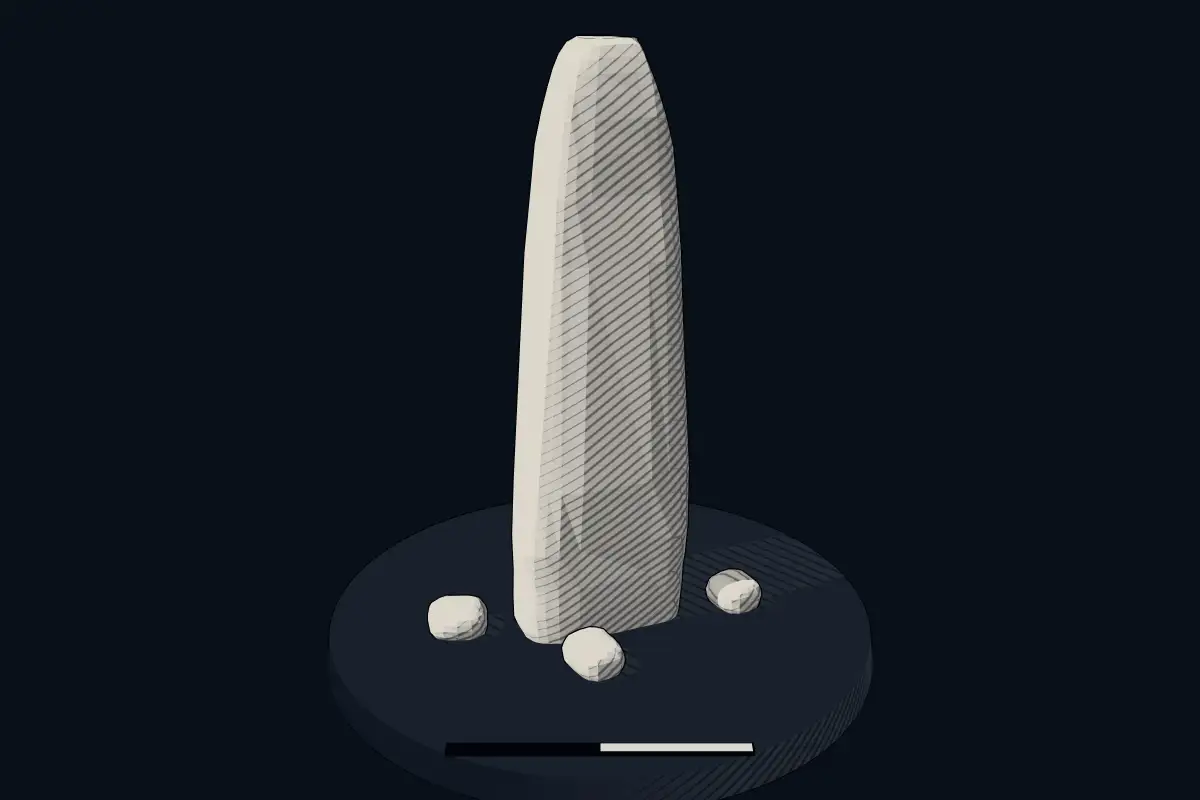
The reconstruction is ours, not a survey: it shows what a monument of this type looks like, at the size the record gives for this one.
Photographs
8 photographs, each with its author and licence
More photographs
Lore
Evidence & Lore
What the sources actually support — and, kept apart, what has been claimed.
What the evidence supports
Dates
Est. 2800–1800 BCEHow this date was established: Type comparisonTypical range for menhirs in Ireland; this site has not been dated itself. Standing stones are associated with the Beaker people of the European late Neolithic and early Bronze Age c. 2800-1800 BC.Source for this date
Where it stands
Ireland
The pin marks the monument itself — its exact point.
- Coordinates
- 53°34′43″ N, 6°36′44″ WFor a GPS or map app: 53.57863, -6.61214
Access is as our sources describe it; we have not visited the site to check.
Nearby
The closest sites in the Atlas, by straight line.
 Mound of the Hostages3400–2900 BCE
- Megalithic mound (tumulus with integral stones)Alexander Reid mound3700–2900 BCE
- Passage tomb (passage grave)Ardmulchan Passage Tomb3400–2900 BCE
 Newgrange3150–3050 BCE
 Knowth3250–3150 BCE
 Dowth3200–2900 BCE
- Megalithic mound (tumulus with integral stones)Dowth Mound3700–2900 BCE
 Fourknocks Passage Tomb3000–2500 BCE


Sources
Every record behind this page, with the link it came from.
3 sources behind this page
- 01Wikidata Q687578wikidata.org
- 02Source for this dateen.wikipedia.org
- 03Wikipedia: Lia Fáilen.wikipedia.org
Image files
- Stone of Destiny 2018-07-24.jpgAugust SchwerdfegerCC BY 4.0
- Stone of Destiny Tara.JPGAlanna MilbourneCC BY-SA 4.0
- Stone Of Destiny - Hill of Tara.JPGIanfhunterCC BY 4.0
- Tara hill.JPGCooKeeNCC BY-SA 4.0
- The Municipal District of Ashbourne - Hill of Tara - 2025-10-24 19-54-29 017.jpgOlliebailieCC BY-SA 4.0
- Lia Fail.jpgJohnJDuncanCC BY-SA 4.0
- County Meath - Hill of Tara - 20130629155641.jpgKevForkanCC BY-SA 4.0
- County Meath - Hill of Tara - 20130629160408.jpgKevForkanCC BY-SA 4.0


Report a correctionWrong date, name, photograph or source? Tell us and it will be put right.
Lore, kept apart
Legends and claims
These are stories and claims reported by the sources. They are not evidence, and they never stand in for the dating above.
- Tradition
There are several different, and conflicting, legends in Irish mythology describing how the Lia Fáil is said to have been brought to Ireland.
There are several different, and conflicting, legends in Irish mythology describing how the Lia Fáil is said to have been brought to Ireland. The Lebor Gabala, dating to the eleventh century, states that it was brought in antiquity by the semi-divine race known as the Tuatha Dé Danann. The Tuatha Dé Danann had travelled to the "Northern Isles" where they learned many skills and magic in its four cities Falias, Gorias, Murias and Findias. From there they travelled to Ireland bringing with them a treasure from each city – the four legendary treasures of Ireland. From Falias came the Lia Fáil. The other three treasures are the Claíomh Solais or Sword of Light, the Sleá Bua or Spear of Lugh and the Coire Dagdae or The Dagda's Cauldron. Some Scottish chroniclers, such as John of Fordun and Hector Boece from the thirteenth century, treat the Lia Fáil the same as the Stone of Scone in Scotland. According to this account, the Lia Fáil left Tara in AD 500 when the High King of Ireland Murtagh MacEirc loaned it to his great-uncle, Fergus (later known as Fergus the Great) for the latter's coronation in Scotland. Fergus's sub-kingdom, Dalriada, had by this time expanded to include the north-east part of Ulster and parts of western Scotland. Not long after Fergus's coronation in Scotland, he and his inner circle were caught in a freak storm off the County Antrim coast in which all perished. The stone remained in Scotland, which is why Murtagh MacEirc is recorded in history as the last Irish King to be crowned on it. However, historian William Forbes Skene commented: "It is somewhat remarkable that while the Scottish legend brings the stone at Scone from Ireland, the Irish legend brings the stone at Tara from Scotland." The Dindsenchas, recording a tradition from early Irish literature and echoing ancient legends, reports that Lia Fáil would roar in the presence of a false king pretending to hold dominion in Ireland.
Source - Tradition
The Fál or Lia Fáil, meaning Stone of Fál, is a stone at the Inauguration Mound on the Hill of Tara in County Meath, Ireland.
The Fál or Lia Fáil, meaning Stone of Fál, is a stone at the Inauguration Mound on the Hill of Tara in County Meath, Ireland. It served as the coronation stone for the King of Tara and hence High King of Ireland. It is also known as the Stone of Destiny or Speaking Stone. According to legend, all of the kings of Ireland were crowned on the stone up to Muirchertach mac Ercae, c. 500 AD. Archibald Geikie noted resemblances to the calcareous red sandstone of which the Stone of Scone is composed, but the stones are not currently believed to have come from connected quarry sites. It has also been identified as a whitish granitoid.
Source - Tradition
Several conflicting legends describe how the stone came to Ireland.
Several conflicting legends describe how the stone came to Ireland. The Lebor Gabala, dating to the eleventh century, states that it was brought in antiquity by the semi-divine Tuatha Dé Danann from the city of Falias, together with three other treasures: the Sword of Light, the Spear of Lugh and the Dagda's Cauldron. Some Scottish chroniclers, such as John of Fordun and Hector Boece, treat it as the same as the Stone of Scone in Scotland, saying it left Tara in AD 500 when the High King Murtagh MacEirc loaned it to his great-uncle Fergus for his coronation in Scotland.
Source - Tradition
The historian William Forbes Skene remarked that while the Scottish legend brings the stone at Scone from Ireland, the Irish legend brings the stone at Tara from Scotland.
The historian William Forbes Skene remarked that while the Scottish legend brings the stone at Scone from Ireland, the Irish legend brings the stone at Tara from Scotland. The Dindsenchas reports that the Lia Fáil would roar in the presence of a false king pretending to hold dominion in Ireland.
Source - Tradition
The stone was thought to be magical.
The stone was thought to be magical. When the rightful High King of Ireland put his feet on it, it was said to roar in joy, and it was credited with the power to rejuvenate the king and give him a long reign. According to Lebor Gabála Érenn, Cúchulainn split it with his sword when it failed to cry out under his protégé Lugaid Riab nDerg. From then on it never cried out again, except under Conn of the Hundred Battles and, according to legend, at the coronation of Brian Boru in 1002.
Source - Tradition
The Fál (Irish: [fˠaːlˠ]) or Lia Fáil (Irish: [ˌl̠ʲiə ˈfˠaːlʲ]; "Stone of Fál") is a stone at the Inauguration Mound (Irish: an Forrad) on the Hill of Tara in County Meath, Ireland, which served as the coronation stone for the King of Tara
The Fál (Irish: [fˠaːlˠ]) or Lia Fáil (Irish: [ˌl̠ʲiə ˈfˠaːlʲ]; "Stone of Fál") is a stone at the Inauguration Mound (Irish: an Forrad) on the Hill of Tara in County Meath, Ireland, which served as the coronation stone for the King of Tara and hence High King of Ireland. It is also known as the Stone of Destiny or Speaking Stone. According to legend, all of the kings of Ireland were crowned on the stone up to Muirchertach mac Ercae, c. 500 AD.
Source
Around this place
The ten nearest sites, by compass
Credit
Text, licence and sources
Text from the Wikipedia article "Lia Fáil" (English), licensed CC BY-SA 4.0; authors are listed in the page history. Reused under CC BY-SA 4.0. Read on Wikipedia · Edit history and authors
- Wikipedia (English): Lia FáilCC BY-SA 4.0
- Wikidata Q687578CC0