
Megalithic mound (tumulus with integral stones)
Soros
Also known asTomb at Marathonas · Tumulus of Marathon · Marathon tumuli
Datedc. 540–440 BCE
Photo Tomisti · CC BY-SA 4.0Source file on Wikimedia Commons
Overview
About this site
What the sources say
There are two tumuli at Marathon, Greece. One is a burial mound (Greek τύμβος, tymbos, tomb), or "Soros" that houses the ashes of 192 Athenians who fell during the Battle of Marathon in 490 BC. The other houses the inhumed bodies of the Plataeans who fell during that same battle. The burial mound dominates the plain of Marathon, where the eponymous battle took place, along with the tumulus of the Plataeans, and a victory column erected by the Athenians to commemorate their victory over Darius' Persian expedition. The tumulus is encompassed in a park today.
Read on Wikipedia5 min readCC BY-SA 4.0
Where it sits in time
The site's dated range, placed against world reference points.
The scale is logarithmic: each step to the left is about ten times older than the last.
The full article
Soros: the whole story
In briefSources for this section
- Wikipedia (English): Marathon tumuliCC BY-SA 4.0
Sources for this section
- Wikipedia (English): Marathon tumuliCC BY-SA 4.0
There are two tumuli at Marathon, Greece. One, the Soros, is a burial mound that houses the ashes of 192 Athenians who fell during the Battle of Marathon in 490 BC. The other houses the inhumed bodies of the Plataeans who fell in the same battle. The burial mound dominates the plain of Marathon, together with the tumulus of the Plataeans and a victory column erected by the Athenians to commemorate their victory over Darius' Persian expedition. The tumulus is encompassed in a park today.
The battle took place on September 12, or possibly August 12, 490 BCE. Athens and its ally Plataea, some 11,000 hoplites in total, attacked a Persian expeditionary force of some 25,000 infantry and 1,000 cavalry, with 100,000 armed sailors as reserves. The Athenians attacked down a hillside onto the coastal plain and, using the momentum of their tightly packed, heavily armoured formation, routed the less disciplined Persian flanks. Herodotus claims the Greeks counted 6,400 dead Persians, and states that the Athenians lost 192 men and the Plataeans 11.
Both tumuli are fairly standard, with hemispherical shapes, and the dead were interred in the hole left by the excavation of the dirt piled on top. They are unusual because such monumental burial had been out of style in central Greece since the seventh century. The Athenians normally buried their war dead in the Kerameikos cemetery, with a stele or marker vase. Some scholars have suggested that raising the tumuli was a deliberate attempt to evoke Homer, given the similarities with the burial practices of the mythical heroes in the Iliad.
The Athenian Tumulus stands around 40 feet (12 m) tall and was excavated in 1884 by Dimitrios Philios and again in 1890 and 1891 by Valerios Stais. The Plataean Tumulus is smaller, at around 10 feet (3.0 m), and was identified and excavated in 1970 by Prof. Marinatos, then the Greek Inspector General of Antiquities. A large layer of ash and charred bone was found in the Athenian Tumulus, while multiple bodies were found inhumed in the Plataean Tumulus.
The victory column has since collapsed and been replaced by a modern replica that matches the original in height and general mass.
The Battle of Marathon took place on September 12, or possibly August 12, 490 BCE at the plain of Marathon.
Battle of MarathonSources for this section
- Wikipedia (English): Marathon tumuliCC BY-SA 4.0
Sources for this section
- Wikipedia (English): Marathon tumuliCC BY-SA 4.0
The Battle of Marathon took place on September 12, or possibly August 12, 490 BCE at the plain of Marathon. Athens and its ally Plataea, some 11,000 hoplites in total, attacked a Persian expeditionary force of some 25,000 infantry and 1,000 cavalry, with 100,000 armed sailors acting as reserves. The Athenian forces attacked down a hillside onto the coastal plain, and using the momentum of their tightly packed, heavily armored formation routed the less disciplined Persian flanks, which were unused to fighting heavily armored troops. The subsequent rout left the Persian center exposed and as a result the Persians suffered high casualties as their command structure fell into disarray and as soldiers scrambled onto their ships. Herodotus claims that the Greeks counted 6,400 dead Persians on the field, but could make no account for those who fled into the swamps off to the north of the battlefield. Herodotus states that the Athenians lost 192 men in the battle and the Plataeans lost 11.
DescriptionSources for this section
- Wikipedia (English): Marathon tumuliCC BY-SA 4.0
Sources for this section
- Wikipedia (English): Marathon tumuliCC BY-SA 4.0
There are three monuments of the plain of Marathon, the Athenian Tumulus, the Plataean Tumulus, and a victory column erected by the Athenians. Both tumuli are fairly standard with hemispherical shapes and with the dead interred within the hole left by the excavation of the dirt that would be piled on top of them. The tumuli are unusual, however, because such monumental burial practices had been out of style in central Greece since the seventh century. The Athenians normally buried their war dead in the Kerameikos cemetery, with a stele or marker vase to show the location of the deceased. However, some scholars have suggested that the raising of the tumuli was a deliberate attempt to evoke Homer by the Athenians and their allies. This concept is based on the similarities between the structure and interment method used with the tumuli, and the description of the burial practices used by and for their mythical heroes in the Iliad.
The Athenian Tumulus stands around 40 feet (12 m) tall and was excavated in 1884 by Dimitrios Philios and then again in 1890 and 1891 by Valerios Stais. The Plataean Tumulus is smaller at around 10 feet (3.0 m), and was identified and excavated in 1970 by Prof. Marinatos, who was the Greek Inspector General of Antiquities at that time. A large layer of ash and charred bone was found in the Athenian Tumulus while multiple bodies were found inhumed in the Plataean Tumulus. The Victory Column has since collapsed and been replaced with a modern replica which matches the original both in height and in general mass.
How this page was madeSources for this section
- Wikipedia (English): Marathon tumuliCC BY-SA 4.0
Sources for this section
- Wikipedia (English): Marathon tumuliCC BY-SA 4.0
The summary at the top of this page was written by Claude Sonnet 5.5 (2026-11-06) from the cited Wikipedia article “Marathon tumuli”. The numbers in it were checked automatically against the source text. The rest of the page is the article itself, the structured records and computed distances.
Tradition and region
About this kind of monument
Greek tumuli and Macedonian burial mounds
Burial mounds in Greece are of several ages. At Marathon, the Soros is the burial mound of the Athenians who fell in the battle of 490 BCE, which holds the ashes of 192 of them; the Plataeans who fought alongside them were buried in a second, smaller tumulus nearby. The Athenian mound stands about 12 metres high and was excavated in 1884 by Dimitrios Philios and again in 1890 and 1891 by Valerios Stais; the Plataean mound, about 3 metres high, was identified and excavated in 1970. A large layer of ash and charred bone was found in the Athenian tumulus, while the Plataeans were inhumed. Such monumental burial had been out of fashion in central Greece since the seventh century BCE, so the choice at Marathon was unusual.
In the north, the Macedonians raised enormous tumuli over rich chamber tombs. At Vergina, the site of ancient Aigai, the Greek archaeologist Manolis Andronikos became convinced that the hill called the Great Tumulus concealed the tombs of the Macedonian kings, and in 1977 he found four buried tombs, two of them never looted. The Kasta Tomb near Amphipolis, also called the Amphipolis Tomb, is the largest ancient tumulus ever discovered in Greece. It dates to the last quarter of the fourth century BCE and has a perimeter wall; its inner tomb was found in 2012 and entered in August 2014, and the remains of five people were recovered. Early public speculation that it was meant for Alexander the Great is only a guess.
Dating combines the historical record, as at Marathon, with the architecture and objects inside the tombs.
When visiting Marathon, climb the Soros and look back across the plain towards the sea, as the battle's participants would have seen it.
Paraphrased from Wikipedia: Marathon tumuli, Wikipedia: Kasta Tomb, Wikipedia: Vergina, Wikipedia: Tumulus · CC BY-SA 4.0
From the article
Dated moments in the story
- 490 BCE
One is a burial mound (Greek τύμβος, tymbos, tomb), or "Soros" that houses the ashes of 192 Athenians who fell during the Battle of Marathon in 490 BC.
Source - 490 BCE
The Battle of Marathon took place on September 12, or possibly August 12, 490 BCE at the plain of Marathon.
Source - 1884
The Athenian Tumulus stands around 40 feet (12 m) tall and was excavated in 1884 by Dimitrios Philios and then again in 1890 and 1891 by Valerios Stais.
Source - 1970
The Plataean Tumulus is smaller at around 10 feet (3.0 m), and was identified and excavated in 1970 by Prof.
Source
See it in 3D
An interpretive reconstruction of the monument, standing on the real ground at its exact point, under the sun for that place and season. Drag to look around it.
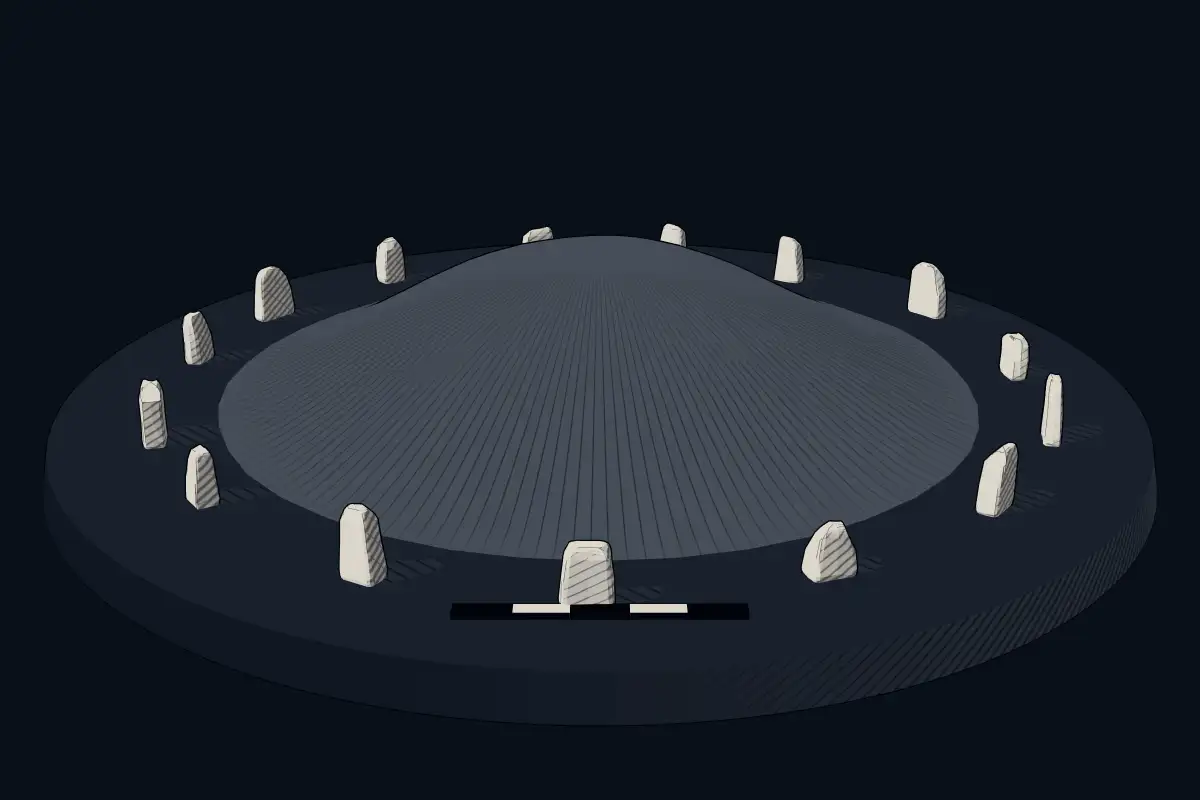
The reconstruction is ours, not a survey: it shows what a monument of this type looks like, at the size the record gives for this one.
Photographs
8 photographs, each with its author and licence
More photographs
Lore
Evidence & Lore
What the sources actually support — and, kept apart, what has been claimed.
What the evidence supports
Dates
540–440 BCEHow this date was established: Historical sourcesThe date derives from the recorded battle in which the buried Athenians died. The source gives one year, so it is shown as a 100-year window (D-08).Source for this date
Measured facts
- Burial contents
- Ashes of 192 AtheniansSource: Burial contents
- Associated battle
- Battle of MarathonSource: Associated battle
- Nearby mound
- A tumulus containing the bodies of fallen PlataeansSource: Nearby mound
- Present setting
- Encompassed in a parkSource: Present setting
- Heritage designation
- archaeological site in GreeceSource: Heritage designation
Where it stands
Greece
The pin marks the monument itself — its exact point.
- Coordinates
- 38°07′05″ N, 23°58′42″ EFor a GPS or map app: 38.11797, 23.97833
Access is as our sources describe it; we have not visited the site to check.
Nearby
The closest sites in the Atlas, by straight line.


Sources
Every record behind this page, with the link it came from.
2 sources behind this page
- 01Wikidata Q17276497wikidata.org
- 02Wikipedia (en)en.wikipedia.org
Image files
- Marathon Tomb of the Athenians 1.jpgTomistiCC BY-SA 4.0
- Tumulus (tomb) in Marathon.jpgamanderson2CC BY 2.0
- The mound at Marathon - DPLA - 72ca40df7d5a0f950828a28ed8eb2440 (page 1).jpgCatsimpoolas, NicholasPublic domain
- The burial mound of the Athenians at Marathon on Januray 15, 2019.jpgGeorge E. KoronaiosCC0
- The tumulus (tomb) of the Athenians at Marathon.jpgGeorge E. KoronaiosCC0
- Τύμβος Αθηναίων στο Μαραθώνα-1.jpgGeorge FournarisCC BY-SA 4.0
- TYMVOS MARATHONA.jpgKAMINSKA JOANNACC BY-SA 4.0
- Marathon Tomb of the Athenians 2.jpgTomistiCC BY-SA 4.0
Report a correctionWrong date, name, photograph or source? Tell us and it will be put right.
Around this place
The ten nearest sites, by compass
Credit
Text, licence and sources
Text from the Wikipedia article "Marathon tumuli" (English), licensed CC BY-SA 4.0; authors are listed in the page history. Reused under CC BY-SA 4.0. Read on Wikipedia · Edit history and authors
- Wikipedia (English): Marathon tumuliCC BY-SA 4.0
- Wikidata Q17276497CC0