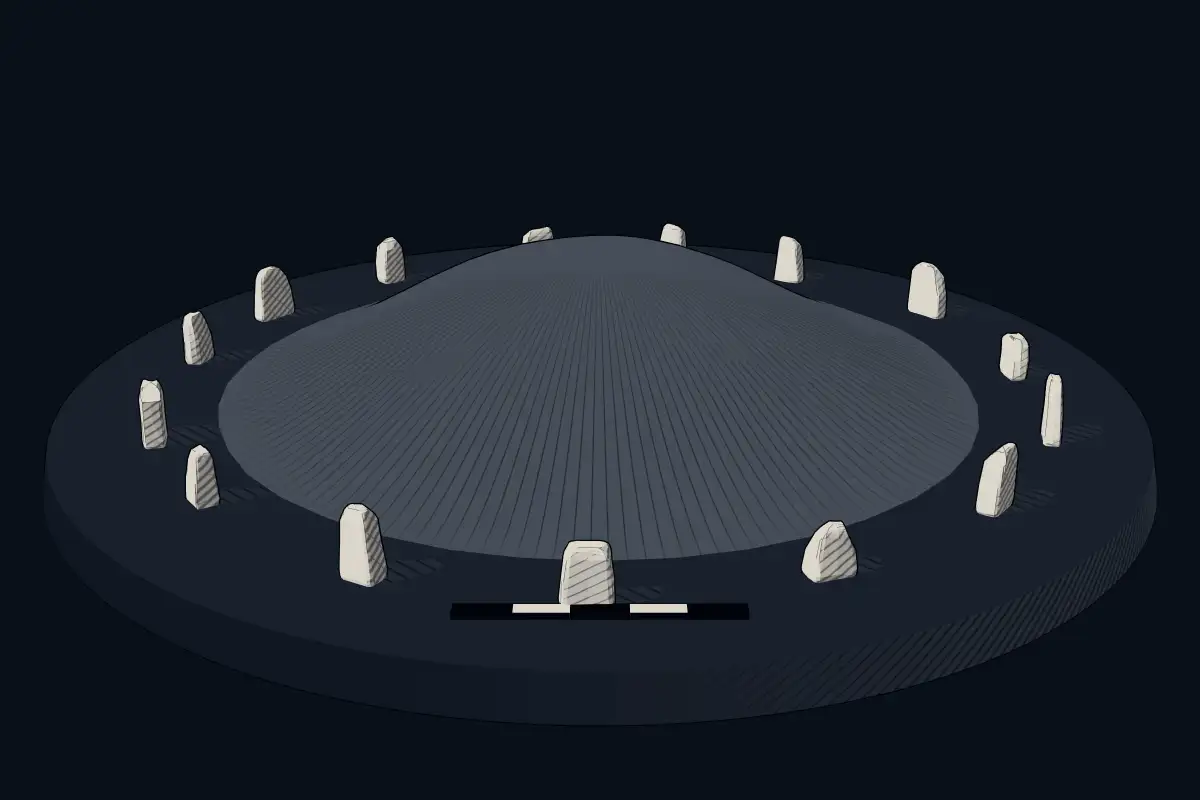
Megalithic mound (tumulus with integral stones)
Salamis sea-battle tumulus
No licensed photograph yetWe have no photograph we may publish for this site, so the interpretive 3D view leads instead.
Overview
About this site
What the sources say
Salamis sea-battle tumulus is a megalithic mound recorded in Salamina Municipality, Greece. The catalogue places it at 37.9469° N, 23.5511° E and links it to Wikidata item Q111709040.
Built from structured records, not from an articleSources and licences
The full article
About Salamis sea-battle tumulus
This kind of monument hereSources for this section
- en.wikipedia.orgCC BY-SA 4.0
- en.wikipedia.orgCC BY-SA 4.0
- en.wikipedia.orgCC BY-SA 4.0
- en.wikipedia.orgCC BY-SA 4.0
Sources for this section
- en.wikipedia.orgCC BY-SA 4.0
- en.wikipedia.orgCC BY-SA 4.0
- en.wikipedia.orgCC BY-SA 4.0
- en.wikipedia.orgCC BY-SA 4.0
Burial mounds in Greece are of several ages. At Marathon, the Soros is the burial mound of the Athenians who fell in the battle of 490 BCE, which holds the ashes of 192 of them; the Plataeans who fought alongside them were buried in a second, smaller tumulus nearby. The Athenian mound stands about 12 metres high and was excavated in 1884 by Dimitrios Philios and again in 1890 and 1891 by Valerios Stais; the Plataean mound, about 3 metres high, was identified and excavated in 1970. A large layer of ash and charred bone was found in the Athenian tumulus, while the Plataeans were inhumed. Such monumental burial had been out of fashion in central Greece since the seventh century BCE, so the choice at Marathon was unusual. Further down this page, About this kind of monument gives the whole of “Greek tumuli and Macedonian burial mounds”.
Dating
No date has been recorded for this site, and the Atlas does not guess one. Where a regional range exists for this kind of monument it is given in the notes on this page, as background and not as a date for this site.
Landscape and neighbours
No other catalogued site lies within 10 km of it. The nearest is Athena Promachos, 15.6 km to the east. It is one of 1 megalithic mound records among the 1 sites catalogued in Salamina Municipality, Greece.
The nearest neighbours in the catalogue are Athena Promachos (15.6 km east, monolithic statue); Tumulus of the Plataeans (40.0 km north-east, megalithic mound); Soros (42.0 km north-east, megalithic mound); Pyramid of Ligourio (58.6 km south-west, other / unclassified). The catalogue is assembled from open records and is not complete, so unrecorded monuments may lie closer.
Records and protectionSources for this section
Sources for this section
Wikidata lists the site with the heritage status archaeological site in Greece. The open records for it are Wikidata (Q111709040), where corrections and further identifiers can be added. Many such sites stand on private land; check local access rules and respect the monument and its surroundings.
How this page was madeSources for this section
Sources for this section
Nothing on this page was written by an AI model: it is assembled by program from Wikidata (CC0), the heritage register named above and the regional article “Greek tumuli and Macedonian burial mounds”, written for the Atlas from the Wikipedia articles it cites (CC BY-SA 4.0), with distances and counts calculated from the catalogue coordinates.
Tradition and region
About this kind of monument
Greek tumuli and Macedonian burial mounds
Burial mounds in Greece are of several ages. At Marathon, the Soros is the burial mound of the Athenians who fell in the battle of 490 BCE, which holds the ashes of 192 of them; the Plataeans who fought alongside them were buried in a second, smaller tumulus nearby. The Athenian mound stands about 12 metres high and was excavated in 1884 by Dimitrios Philios and again in 1890 and 1891 by Valerios Stais; the Plataean mound, about 3 metres high, was identified and excavated in 1970. A large layer of ash and charred bone was found in the Athenian tumulus, while the Plataeans were inhumed. Such monumental burial had been out of fashion in central Greece since the seventh century BCE, so the choice at Marathon was unusual.
In the north, the Macedonians raised enormous tumuli over rich chamber tombs. At Vergina, the site of ancient Aigai, the Greek archaeologist Manolis Andronikos became convinced that the hill called the Great Tumulus concealed the tombs of the Macedonian kings, and in 1977 he found four buried tombs, two of them never looted. The Kasta Tomb near Amphipolis, also called the Amphipolis Tomb, is the largest ancient tumulus ever discovered in Greece. It dates to the last quarter of the fourth century BCE and has a perimeter wall; its inner tomb was found in 2012 and entered in August 2014, and the remains of five people were recovered. Early public speculation that it was meant for Alexander the Great is only a guess.
Dating combines the historical record, as at Marathon, with the architecture and objects inside the tombs.
When visiting Marathon, climb the Soros and look back across the plain towards the sea, as the battle's participants would have seen it.
Paraphrased from Wikipedia: Marathon tumuli, Wikipedia: Kasta Tomb, Wikipedia: Vergina, Wikipedia: Tumulus · CC BY-SA 4.0
See it in 3D
An interpretive reconstruction of the monument, standing on the real ground at its exact point, under the sun for that place and season. Drag to look around it.
The reconstruction is ours, not a survey: it shows what a monument of this type looks like, at the size the record gives for this one.
Where it stands
Greece
The pin marks the monument itself — its exact point.
- Coordinates
- 37°56′49″ N, 23°33′04″ EFor a GPS or map app: 37.94690, 23.55110
Access is as our sources describe it; we have not visited the site to check.
Nearby
The closest sites in the Atlas, by straight line.


Sources
Every record behind this page, with the link it came from.
1 source behind this page
- 01Wikidata Q111709040wikidata.org
Report a correctionWrong date, name, photograph or source? Tell us and it will be put right.
Around this place
The ten nearest sites, by compass
Credit
Text, licence and sources
This page is assembled from open records (Wikidata, CC0; OpenStreetMap, ODbL) and a tradition article paraphrasing Wikipedia (CC BY-SA 4.0). No article exists for this site, and nothing here is written by a model.
- Wikidata Q111709040CC0
- en.wikipedia.orgCC BY-SA 4.0
- en.wikipedia.orgCC BY-SA 4.0
- en.wikipedia.orgCC BY-SA 4.0
- en.wikipedia.orgCC BY-SA 4.0