
Watch Stone
Also known asThe Watchstone · Watch Stone (Orkney)
DatedEst. 2800–1800 BCE
Photo Robert Eva · CC BY-SA 2.0Source file on Wikimedia Commons

Overview
About this site
Overview
The Watch Stone (also the Watchstone) is a standing stone on Mainland, Orkney, Scotland. It stands in Stenness, north-west of the Stones of Stenness, at the southern end of the Bridge of Brodgar, close to where the Loch of Stenness and the Loch of Harray meet.
It is more than 5.6 metres high and is one of the most imposing standing stones in Orkney. It was once one of a pair of stones.
Read on Wikipedia2 min readCC BY-SA 4.0
Where it sits in time
The site's dated range, placed against world reference points.
The scale is logarithmic: each step to the left is about ten times older than the last.
Article
Watch Stone
It was one of a pair of stones, which were either outliers of the Stones of Stenness circle or a gateway-like entrance to the Ness of Brodgar.
DescriptionSources for this section
- Wikipedia (German): WatchstoneCC BY-SA 4.0
Sources for this section
- Wikipedia (German): WatchstoneCC BY-SA 4.0
The stone stands close to the place where the Loch of Stenness meets the Loch of Harray. It was one of a pair of stones, which were either outliers of the Stones of Stenness circle or a gateway-like entrance to the Ness of Brodgar.
Research historySources for this section
- Wikipedia (German): WatchstoneCC BY-SA 4.0
Sources for this section
- Wikipedia (German): WatchstoneCC BY-SA 4.0
In 1842 James Wilson, in A voyage round the coasts of Scotland and the isles, still described a large watch stone standing on each side of the southern end of the bridge leading to the northern promontory. By 1875 Walter Hugh Patton drew only one stone.
The stump of the second stone was dug out in 1930 from a bank at the roadside. It was 0.9 m high, 1.45 m wide and very thin, and lay about 13.0 metres south-west of the Watch Stone at the edge of the Loch of Stenness.
InterpretationSources for this section
- Wikipedia (German): WatchstoneCC BY-SA 4.0
Sources for this section
- Wikipedia (German): WatchstoneCC BY-SA 4.0
The discovery of the stump led to the theory that the two stones were remains of the south-eastern section of a large stone circle, the rest of which disappeared when the level of the loch rose. It has also long been assumed that the megaliths once formed part of a stone-flanked ceremonial route between the Ring of Brodgar and the Stones of Stenness.
The Odin Stone, the Comet Stone and two unnamed stones in front of the House of Lochview are said to have been part of this processional way. Geophysical surveys on the Ness of Brodgar, however, have found no evidence of a path.
ContextSources for this section
- Wikipedia (German): WatchstoneCC BY-SA 4.0
Sources for this section
- Wikipedia (German): WatchstoneCC BY-SA 4.0
Britain and Ireland are rich in standing stones. They were put up in many periods of prehistory as part of the wider megalithic cultures, and any single stone may be Neolithic, Bronze Age or later, so they are usually difficult to date. Theories about their purpose remain speculative: rituals, territorial markers, or markers in a system of belief.
Tradition and region
About this kind of monument
British and Irish standing stones
Britain and Ireland are rich in standing stones; the Atlas records many hundreds. Together with Brittany they hold about 50,000 examples across the Atlantic fringe of Europe, and many stand singly in fields. In Ireland they are usually in farmers' fields and are heavily worn by weather and by livestock rubbing against them. The stones are usually difficult to date. They were put up in many periods of prehistory as part of the wider megalithic cultures, and any single stone may be Neolithic, Bronze Age or later. Theories about their purpose remain speculative: rituals, territorial markers, or markers in a system of belief.
Some stand in groups. The Calanais Stones on the Isle of Lewis, built around 2750 BCE, form a circle with a tall central monolith and several rows extending outwards in a cross-shaped plan, on a ridge overlooking Loch Roag. The Rollright Stones in Oxfordshire include the King's Men, the King Stone and the Whispering Knights, three monuments built in the Neolithic and Bronze Age.
Folklore: the names of the Rollright Stones come from stories told since the early modern period; legend holds that the King Stone comes alive at the stroke of midnight. At Calanais one tradition says the stones were giants who would not convert to Christianity, and in the seventeenth century the people of Lewis called them fir bhrèige, "false men". Another legend says that on midsummer morning an entity known as the Shining One walks the length of the avenue. These are traditions, not memories of the builders.
The Atlas treats isolated stones as undated unless they have been excavated.
When visiting, look at how a stone stands in relation to the landscape and to any nearby monument.
Paraphrased from Wikipedia: Menhir, Wikipedia: Callanish Stones, Wikipedia: Rollright Stones, Wikipedia: List of menhirs · CC BY-SA 4.0
From the article
Dated moments in the story
- 1842
James Wilson schrieb in: A voyage round the coasts of Scotland and the isles noch 1842: „Beiderseits des südlichen Endes der Brücke, die zum nördlichen Vorgebirge führt, steht ein großer Wachpostenstein ...“.
Source - 1875
1875 zeichnete Walter Hugh Patton nur noch einen Stein.
Source - 1930
Der Stumpf des zweiten Steins wurde 1930 in einem Wall am Straßenrand ausgegraben.
Source
See it in 3D
An interpretive reconstruction of the monument, standing on the real ground at its exact point, under the sun for that place and season. Drag to look around it.
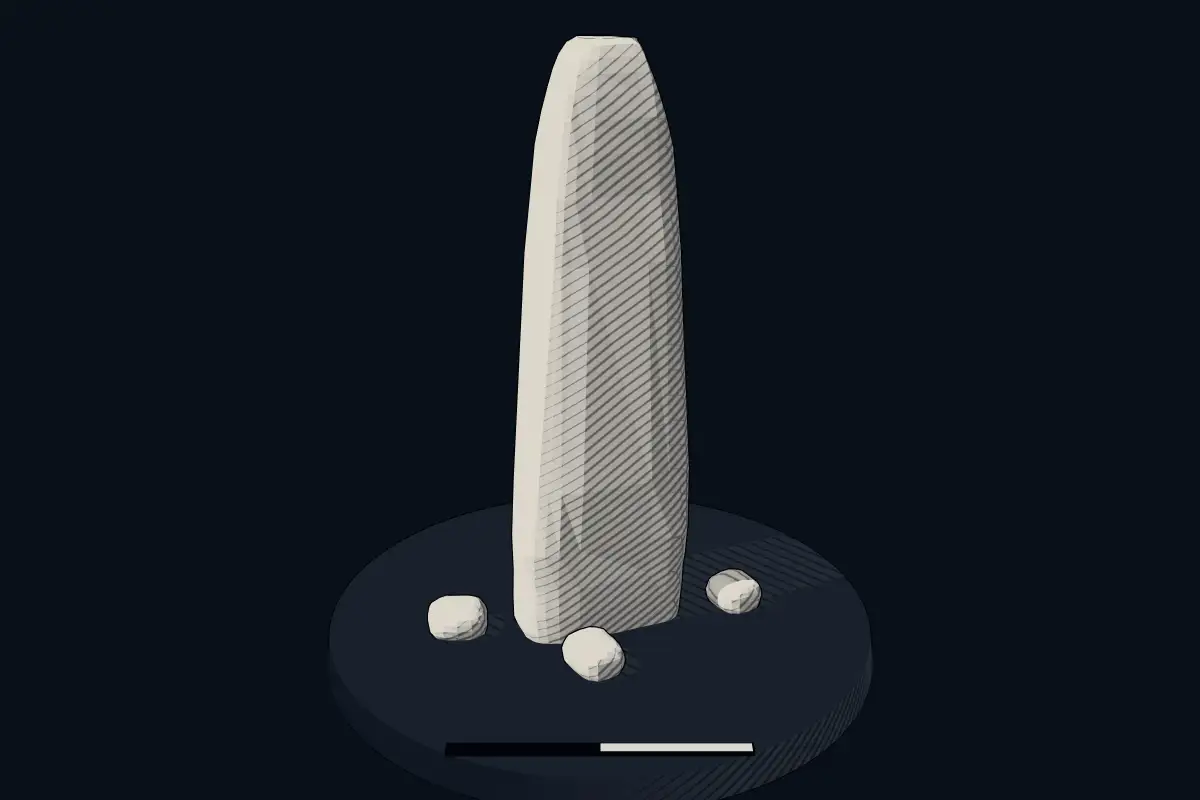
The reconstruction is ours, not a survey: it shows what a monument of this type looks like, at the size the record gives for this one.
Photographs
8 photographs, each with its author and licence
More photographs


Lore
Evidence & Lore
What the sources actually support — and, kept apart, what has been claimed.
What the evidence supports
Dates
Est. 2800–1800 BCEHow this date was established: Type comparisonTypical range for menhirs in United Kingdom; this site has not been dated itself. Standing stones are associated with the Beaker people of the European late Neolithic and early Bronze Age c. 2800-1800 BC.Source for this date
Where it stands
United Kingdom
The pin marks the monument itself — its exact point.
- Coordinates
- 58°59′43″ N, 3°12′37″ WFor a GPS or map app: 58.99517, -3.21036
Access is as our sources describe it; we have not visited the site to check.
Nearby
The closest sites in the Atlas, by straight line.
 Odin Stone2800–1800 BCE
 Stones of Stenness2390–2170 BCE
 Lochview, standing stones and cairn SE of4000–800 BCE
- Cyclopean masonryBig Howe, broch 260m WNW of Stenness Church390 BCE–200 CE
 Ness of Brodgar2365–2235 BCE
 Barnhouse Stone, standing stone2800–1800 BCE
 Comet Stone2800–1800 BCE
- Chambered cairnFresh Knowe4000–2500 BCE


Sources
Every record behind this page, with the link it came from.
2 sources behind this page
- 01Wikidata Q2248726wikidata.org
- 02Source for this dateen.wikipedia.org
Image files
- The Watch Stone - geograph.org.uk - 5922930.jpgRobert EvaCC BY-SA 2.0
- Stenness Watchstone 2017-05-23 - 2.jpgAugust SchwerdfegerCC BY 4.0
- The Watch Stone, Stenness, Orkney - geograph.org.uk - 1280036.jpgwill craigCC BY-SA 2.0
- 0490 Bridge of Brodgar - Stennes watch stone E.jpgVirtual-PanoCC BY-SA 4.0
- The Watch Stone - geograph.org.uk - 6891383.jpgGordon HattonCC BY-SA 2.0
- Stenness Watchstone 2017-05-23 - 1.jpgAugust SchwerdfegerCC BY 4.0
- 0491 Bridge of Brodgar - Stennes watch stone SE.jpgVirtual-PanoCC BY-SA 4.0
- Orkney Watch Stone 01.jpgPaulT (Gunther Tschuch)CC BY-SA 4.0
Report a correctionWrong date, name, photograph or source? Tell us and it will be put right.
Around this place
The ten nearest sites, by compass
Credit
Text, licence and sources
Adapted from the Wikipedia article "Watchstone" (German), licensed CC BY-SA 4.0; authors are listed in the page history. Reused under CC BY-SA 4.0. Read on Wikipedia · Edit history and authors
- Wikipedia (German): WatchstoneCC BY-SA 4.0
- Wikidata Q2248726CC0