
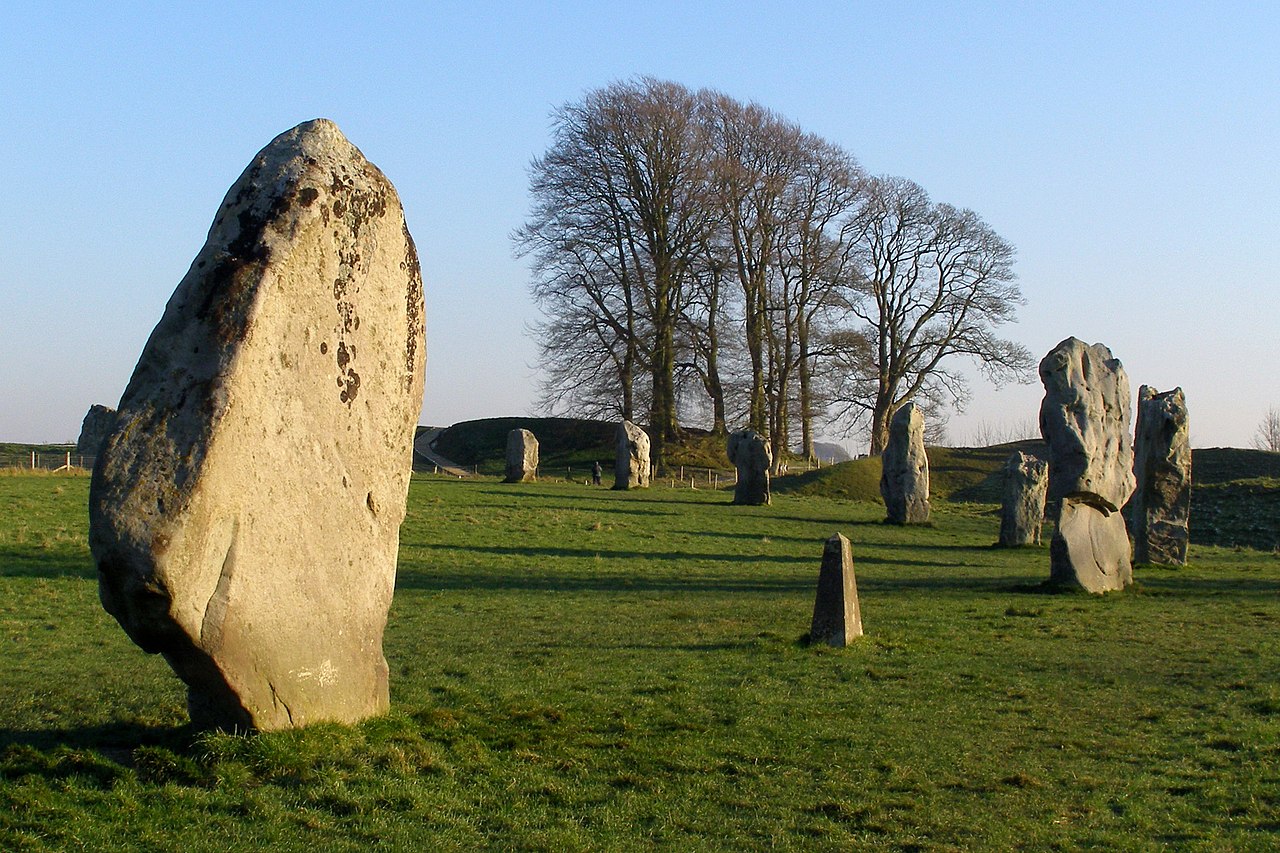
Stone 9
Also known asST9 · Avebury Stone 9 · Barber stone
DatedEst. 4000–2400 BCE
Photo JimChampion · CC BY-SA 3.0Source file on Wikimedia Commons
Overview
About this site
Overview
Stone 9 is a megalith in Wiltshire, United Kingdom. It is also known as ST9, Avebury Stone 9, Barber stone, Barber Surgeon Stone. It lies at 51.4271° N, 1.8546° W.
Catalogue recordSources and licences
Where it sits in time
The site's dated range, placed against world reference points.
The scale is logarithmic: each step to the left is about ten times older than the last.
Article
Stone 9
ContextSources for this section
- en.wikipedia.orgCC BY-SA 4.0
- en.wikipedia.orgCC BY-SA 4.0
- en.wikipedia.orgCC BY-SA 4.0
- en.wikipedia.orgCC BY-SA 4.0
Sources for this section
- en.wikipedia.orgCC BY-SA 4.0
- en.wikipedia.orgCC BY-SA 4.0
- en.wikipedia.orgCC BY-SA 4.0
- en.wikipedia.orgCC BY-SA 4.0
Most of the "megalith" records for Britain in the Atlas come from the Scottish register of monuments, and many are not standing stones at all but carved rocks. Cup and ring marks are a form of prehistoric art found along the Atlantic seaboard of Europe, in Ireland, Wales, northern England, Scotland, Brittany, Portugal and Galicia. They consist of a concave depression no more than a few centimetres across, pecked into a rock surface and often surrounded by concentric circles; sometimes a linear channel, called a gutter, leads out from the middle. They occur as petroglyphs on natural boulders and outcrops, and also as an element of megalithic art on worked stones, such as the slab cists of the Food Vessel culture, some stone circles and passage graves, and the capstones at Newgrange. The regional background, “Prehistoric rock art and standing stones of Scotland”, is given below.
DatingSources for this section
- en.wikipedia.orgCC BY-SA 4.0
Sources for this section
- en.wikipedia.orgCC BY-SA 4.0
No scientific date has been published for this site. Monuments of this type in United Kingdom are generally dated 4000 BCE to 2400 BCE; the site itself may fall inside or outside that range.
Megalithic construction in England is placed at c. 4000 BC; the first henges in Britain appear c. 3000 BC and hundreds of smaller stone circles were built c. 2400 BC.
Setting
249 other recorded monuments lie within 10 km (80 within 1 km, 173 within 5 km), 77 of them of the same type. The site belongs to a dense concentration of monuments. In Wiltshire, United Kingdom, 2 of the 3 recorded monuments are of this type.
The nearest recorded monuments are Stone 8 (0.0 km east, megalith); Stone 10 (0.0 km north-west, megalith); Stone 7 (0.0 km east, megalith); Stone 6 (0.0 km east, megalith).
ProtectionSources for this section
Sources for this section
No heritage designation is recorded for the site.
Tradition and region
About this kind of monument
Prehistoric rock art and standing stones of Scotland
Most of the "megalith" records for Britain in the Atlas come from the Scottish register of monuments, and many are not standing stones at all but carved rocks. Cup and ring marks are a form of prehistoric art found along the Atlantic seaboard of Europe, in Ireland, Wales, northern England, Scotland, Brittany, Portugal and Galicia. They consist of a concave depression no more than a few centimetres across, pecked into a rock surface and often surrounded by concentric circles; sometimes a linear channel, called a gutter, leads out from the middle. They occur as petroglyphs on natural boulders and outcrops, and also as an element of megalithic art on worked stones, such as the slab cists of the Food Vessel culture, some stone circles and passage graves, and the capstones at Newgrange.
The richest area is Kilmartin Glen in Argyll, which has the most important concentration of Neolithic and Bronze Age remains in mainland Scotland. There are more than 800 ancient monuments within a ten-kilometre radius of the village, with 150 of them prehistoric, including standing stones, a henge, numerous cists and a linear cemetery of five burial cairns that runs over five kilometres. Several of the cairns, and many natural rocks, are decorated with cup and ring marks.
The meaning of the carvings is unknown. Megalithic art tends to be highly abstract, and its meaning is the subject of much debate. On natural outcrops the marks can be dated only broadly, so the Atlas gives a range from the Neolithic to the Bronze Age; on a worked stone of a dated monument they are at least as old as the monument.
When visiting, low light brings out the cups best. Please do not chalk or rub the carvings.
Paraphrased from Wikipedia: Cup and ring mark, Wikipedia: Kilmartin Glen, Wikipedia: Megalithic art, Wikipedia: Rock art · CC BY-SA 4.0
Photographs
1 photograph, each with its author and licence
Lore
Evidence & Lore
What the sources actually support — and, kept apart, what has been claimed.
What the evidence supports
Dates
Est. 4000–2400 BCEHow this date was established: Type comparisonTypical range for megaliths in United Kingdom; this site has not been dated itself. Megalithic construction in England is placed at c. 4000 BC; the first henges in Britain appear c. 3000 BC and hundreds of smaller stone circles were built c. 2400 BC.Source for this date
Where it stands
United Kingdom
The pin marks the monument itself — its exact point.
- Coordinates
- 51°25′38″ N, 1°51′17″ WFor a GPS or map app: 51.42713, -1.85460
Access is as our sources describe it; we have not visited the site to check.
Nearby
The closest sites in the Atlas, by straight line.




Sources
Every record behind this page, with the link it came from.
2 sources behind this page
- 01Wikidata Q130748742wikidata.org
- 02Source for this dateen.wikipedia.org
Image files
Report a correctionWrong date, name, photograph or source? Tell us and it will be put right.
Around this place
The ten nearest sites, by compass
Credit
Text, licence and sources
Compiled from open records (Wikidata, CC0; OpenStreetMap, ODbL) and a regional background article based on Wikipedia (CC BY-SA 4.0).
- Wikidata Q130748742CC0
- en.wikipedia.orgCC BY-SA 4.0
- en.wikipedia.orgCC BY-SA 4.0
- en.wikipedia.orgCC BY-SA 4.0
- en.wikipedia.orgCC BY-SA 4.0
- en.wikipedia.orgCC BY-SA 4.0