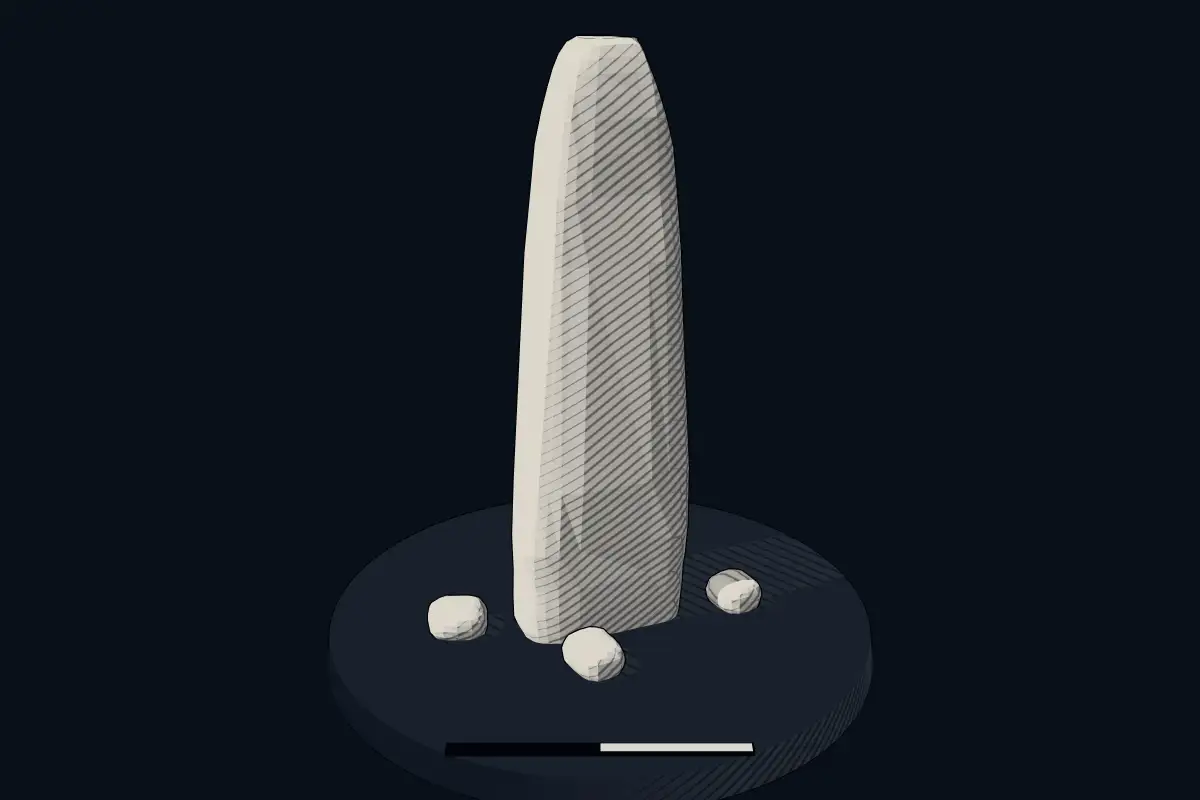
Dalgrambich Farm standing stones
DatedEst. 2800–1800 BCE
No licensed photograph yetWe have no photograph we may publish for this site, so the interpretive 3D view leads instead.
Overview
About this site
Overview
The Dalgrambich Farm standing stone is a single upright stone on the north side of the track from the grain mill at Kinrea to the house at Cantray, south of the village of Croy, in Strathnairn (the valley of the Nairn), east of Inverness in the Highlands of Scotland.
The stone is about 1.9 m high, 1.27 m wide and 0.55 m thick. The catalogue gives a typological estimate of 2800 to 1800 BCE.
Read on Wikipedia2 min readCC BY-SA 4.0
Where it sits in time
The site's dated range, placed against world reference points.
The scale is logarithmic: each step to the left is about ten times older than the last.
Article
Dalgrambich Farm standing stones
No other stones stand in its immediate vicinity, although several large stones lie at the edge of the field and on the southeast side of the track.
DescriptionSources for this section
- Wikipedia (German): Menhir von Dalgrambich FarmCC BY-SA 4.0
Sources for this section
- Wikipedia (German): Menhir von Dalgrambich FarmCC BY-SA 4.0
The stone stands at the south corner of a field. No other stones stand in its immediate vicinity, although several large stones lie at the edge of the field and on the southeast side of the track. These may have been part of the alleged Clava cairn or of a stone circle.
Research historySources for this section
- Wikipedia (German): Menhir von Dalgrambich FarmCC BY-SA 4.0
Sources for this section
- Wikipedia (German): Menhir von Dalgrambich FarmCC BY-SA 4.0
James E. Fraser regarded the stone as the last survivor of a Clava cairn. His account appears in Descriptive notes on the stone circles of Strathnairn and neighbourhood of Inverness, Proceedings of the Society of Antiquaries of Scotland, volume 18, 1883/1884, pages 328–362.
ContextSources for this section
- Wikipedia (German): Menhir von Dalgrambich FarmCC BY-SA 4.0
Sources for this section
- Wikipedia (German): Menhir von Dalgrambich FarmCC BY-SA 4.0
Britain and Ireland are rich in standing stones, many of which stand singly in fields. Such stones are usually difficult to date; any single stone may be Neolithic, Bronze Age or later. Theories about their purpose remain speculative and include rituals, territorial markers and markers in a system of belief.
Tradition and region
About this kind of monument
British and Irish standing stones
Britain and Ireland are rich in standing stones; the Atlas records many hundreds. Together with Brittany they hold about 50,000 examples across the Atlantic fringe of Europe, and many stand singly in fields. In Ireland they are usually in farmers' fields and are heavily worn by weather and by livestock rubbing against them. The stones are usually difficult to date. They were put up in many periods of prehistory as part of the wider megalithic cultures, and any single stone may be Neolithic, Bronze Age or later. Theories about their purpose remain speculative: rituals, territorial markers, or markers in a system of belief.
Some stand in groups. The Calanais Stones on the Isle of Lewis, built around 2750 BCE, form a circle with a tall central monolith and several rows extending outwards in a cross-shaped plan, on a ridge overlooking Loch Roag. The Rollright Stones in Oxfordshire include the King's Men, the King Stone and the Whispering Knights, three monuments built in the Neolithic and Bronze Age.
Folklore: the names of the Rollright Stones come from stories told since the early modern period; legend holds that the King Stone comes alive at the stroke of midnight. At Calanais one tradition says the stones were giants who would not convert to Christianity, and in the seventeenth century the people of Lewis called them fir bhrèige, "false men". Another legend says that on midsummer morning an entity known as the Shining One walks the length of the avenue. These are traditions, not memories of the builders.
The Atlas treats isolated stones as undated unless they have been excavated.
When visiting, look at how a stone stands in relation to the landscape and to any nearby monument.
Paraphrased from Wikipedia: Menhir, Wikipedia: Callanish Stones, Wikipedia: Rollright Stones, Wikipedia: List of menhirs · CC BY-SA 4.0
See it in 3D
An interpretive reconstruction of the monument, standing on the real ground at its exact point, under the sun for that place and season. Drag to look around it.
The reconstruction is ours, not a survey: it shows what a monument of this type looks like, at the size the record gives for this one.
Lore
Evidence & Lore
What the sources actually support — and, kept apart, what has been claimed.
What the evidence supports
Dates
Est. 2800–1800 BCEHow this date was established: Type comparisonTypical range for menhirs in United Kingdom; this site has not been dated itself. Standing stones are associated with the Beaker people of the European late Neolithic and early Bronze Age c. 2800-1800 BC.Source for this date
Where it stands
United Kingdom
The pin marks the monument itself — its exact point.
- Coordinates
- 57°29′54″ N, 4°01′08″ WFor a GPS or map app: 57.49837, -4.01900
Access is as our sources describe it; we have not visited the site to check.
Nearby
The closest sites in the Atlas, by straight line.
- Chambered cairnchambered cairn and stone circle 200m NE of Dalcross Castle4000–2500 BCE
 Balnuaran of Clava4000–2400 BCE
- Megalithic mound (tumulus with integral stones)mound 420m WNW of Ballaggan4000–800 BCE
- Megalithic mound (tumulus with integral stones)chambered cairn and standing stone 620m S of Culdoich4000–800 BCE
- Megalithic mound (tumulus with integral stones)cairn 1530m ESE of Rehiran Farm House4000–800 BCE
- Chambered cairnLittle Urchany4000–2500 BCE
- Megalithic mound (tumulus with integral stones)barrows 300m WNW of Allanfearn4000–800 BCE
- Megalithic mound (tumulus with integral stones)Hangman's Hill, cairn 380m E of Kinchyle4000–800 BCE

Sources
Every record behind this page, with the link it came from.
2 sources behind this page
- 01Wikidata Q65241065wikidata.org
- 02Source for this dateen.wikipedia.org
Report a correctionWrong date, name, photograph or source? Tell us and it will be put right.
Around this place
The ten nearest sites, by compass
- chambered cairn and stone circle 200m NE of Dalcross Castle1.7 km NW
- Balnuaran of Clava4.3 km SW
- mound 420m WNW of Ballaggan5.1 km SW
- chambered cairn and standing stone 620m S of Culdoich5.6 km SW
- cairn 1530m ESE of Rehiran Farm House5.7 km E
- Little Urchany7.7 km E
- barrows 300m WNW of Allanfearn7.8 km W
- Hangman's Hill, cairn 380m E of Kinchyle8.6 km NE
- enclosure 250m SW of Moor of Balnagowan8.6 km N
- ring cairn and stone circle 600m NNE of Mains of Daviot Farm8.7 km SW
Credit
Text, licence and sources
Adapted from the Wikipedia article "Menhir von Dalgrambich Farm" (German), licensed CC BY-SA 4.0; authors are listed in the page history. Reused under CC BY-SA 4.0. Read on Wikipedia · Edit history and authors