Bu Broch
Also known asBu · Navershaw · Naversough
Datedc. 615–425 BCE
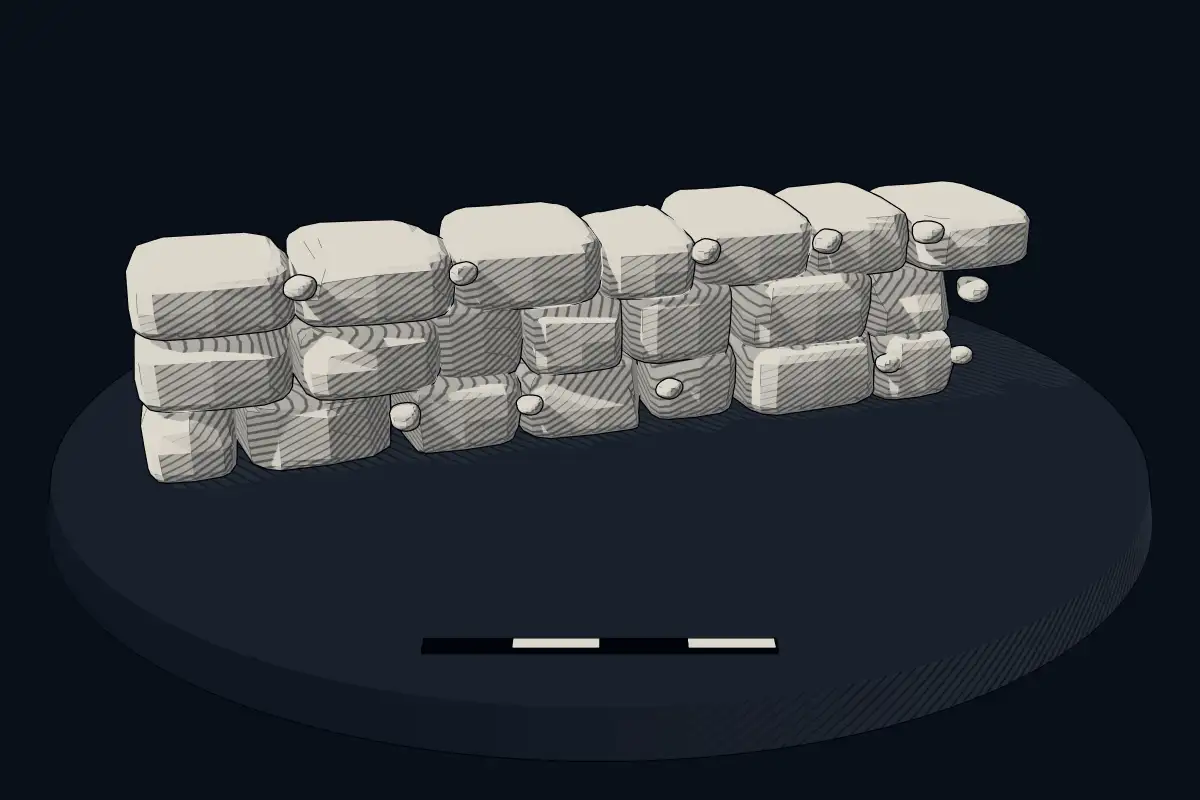
No licensed photograph yetWe have no photograph we may publish for this site, so the interpretive 3D view leads instead.
Overview
About this site
Overview
The Broch of Bu (also called Bu of Cairston Broch) is an Iron Age broch near Stromness on Mainland, Orkney, Scotland. Radiocarbon dates show that it was built in 600 BCE, much earlier than would have been expected for a structure of this kind.
Its excavation, together with that of the Broch of Howe on Orkney, has helped to clarify the origin of the Orcadian brochs better than the earlier excavations at Gurness and Midhowe.
Read on Wikipedia2 min readCC BY-SA 4.0
Where it sits in time
The site's dated range, placed against world reference points.
The scale is logarithmic: each step to the left is about ten times older than the last.
Article
Bu Broch
Towards the outside the interior was divided by radial slabs, which also helped to support the roof.
DescriptionSources for this section
- Wikipedia (German): Broch von BuCC BY-SA 4.0
Sources for this section
- Wikipedia (German): Broch von BuCC BY-SA 4.0
The excavation revealed a structure with an internal diameter of about 9.1 m. The wall was originally about 3.6 m thick and was later enlarged to 5.2 m. The entrance had no guard cell. The centre of the interior was occupied by a large hearth and a cooking place. Towards the outside the interior was divided by radial slabs, which also helped to support the roof. This arrangement corresponds in broad outline to that of roundhouses and wheelhouses.
DatingSources for this section
- Wikipedia (German): Broch von BuCC BY-SA 4.0
Sources for this section
- Wikipedia (German): Broch von BuCC BY-SA 4.0
The radiocarbon dates show that the broch was built in 600 BCE. Still earlier dates come from the roundhouse at Quanterness. This underlines the length of the period of architectural experimentation on Orkney. A development from roundhouse to broch is also supported by the excavation at Howe.
ContextSources for this section
- Wikipedia (German): Broch von BuCC BY-SA 4.0
Sources for this section
- Wikipedia (German): Broch von BuCC BY-SA 4.0
John W. Hedges identified 52 brochs on Orkney and analysed 80. Only a few have double-walled masonry. The entrances sometimes have door fastenings and guard cells. At least 10 Orkney brochs have their own water supply.
A broch is an Iron Age hollow-walled drystone tower found in Scotland, and Scotland holds more than 500 of them. Brochs belong to the class that Scottish archaeologists call complex Atlantic roundhouses. There are approximately 571 candidate sites, concentrated in northern Scotland, with the densest groups in Caithness, Sutherland and the Northern Isles.
Tradition and region
About this kind of monument
Scottish brochs
A broch is an Iron Age hollow-walled drystone tower found in Scotland, and Scotland holds more than 500 of them. Brochs belong to the class that Scottish archaeologists call "complex Atlantic roundhouses". There are approximately 571 candidate sites, concentrated in northern Scotland, with the densest groups in Caithness, Sutherland and the Northern Isles. The Atlas files them under "cyclopean masonry" because of the heavy drystone walls, but they are Scottish Iron Age buildings, unrelated to the Mycenaean walls that give that term its name.
The finest is the Broch of Mousa in Shetland, the tallest broch still standing and among the best-preserved prehistoric buildings in Europe; it is thought to have been built about 300 BCE. Midhowe Broch on Rousay in Orkney has an internal diameter of 9 metres within a wall 4.5 metres thick, which still stands more than 4 metres high. At the Broch of Gurness on Mainland Orkney, a village grew around a tower that probably once reached about 10 metres; settlement began between 500 and 200 BCE, and Robert Rendall found it in 1929.
Dating is not secure. Most brochs may have been built from about 300 BCE; a sheep bone at Old Scatness in Shetland dates to between 390 and 200 BCE. The old view that brochs were defensive refuges for people and their livestock has been challenged: it has been argued that they were the "stately homes" of their time, showing the status of important families, though there is no archaeological proof, and the purpose may have combined defensive, offensive and symbolic functions.
When visiting, look for the two skins of drystone wall with a stair or gallery between them, and for the settlement of smaller houses around the tower.
Paraphrased from Wikipedia: Broch, Wikipedia: Mousa Broch, Wikipedia: Dun Carloway, Wikipedia: Midhowe Broch, Wikipedia: Gurness Broch, Wikipedia: Cyclopean masonry · CC BY-SA 4.0
From the article
Dated moments in the story
- 600 BCE
Die Radiocarbon-Daten zeigen, dass der Broch 600 v. Chr. und somit viel früher, als es für eine derartige Struktur zu erwarten war, errichtet wurde.
Source
Lore
Evidence & Lore
What the sources actually support — and, kept apart, what has been claimed.
What the evidence supports
Dates
615–425 BCEHow this date was established: Radiocarbon dating4 radiocarbon dates in the p3k14c database (Bird et al. 2022, Scientific Data 9:27 (p3k14c radiocarbon database)) between 2440 and 2545 BP; the range shown is the middle half of the measurements; uncalibrated ages, shown as calendar years with the conventional BP + 1950 conversion.Source for this date
Where it stands
United Kingdom
The pin marks the monument itself — its exact point.
- Coordinates
- 58°57′55″ N, 3°16′17″ WFor a GPS or map app: 58.96516, -3.27148
Access is as our sources describe it; we have not visited the site to check.
Nearby
The closest sites in the Atlas, by straight line.



Sources
Every record behind this page, with the link it came from.
2 sources behind this page
- 01Wikidata Q923267wikidata.org
- 02Source for this datep3k14c.org
Report a correctionWrong date, name, photograph or source? Tell us and it will be put right.
Around this place
The ten nearest sites, by compass
Credit
Text, licence and sources
Adapted from the Wikipedia article "Broch von Bu" (German), licensed CC BY-SA 4.0; authors are listed in the page history. Reused under CC BY-SA 4.0. Read on Wikipedia · Edit history and authors
- Wikipedia (German): Broch von BuCC BY-SA 4.0
- Wikidata Q923267CC0