Ballmalloch,chambered cairn
DatedEst. 4000–2500 BCE
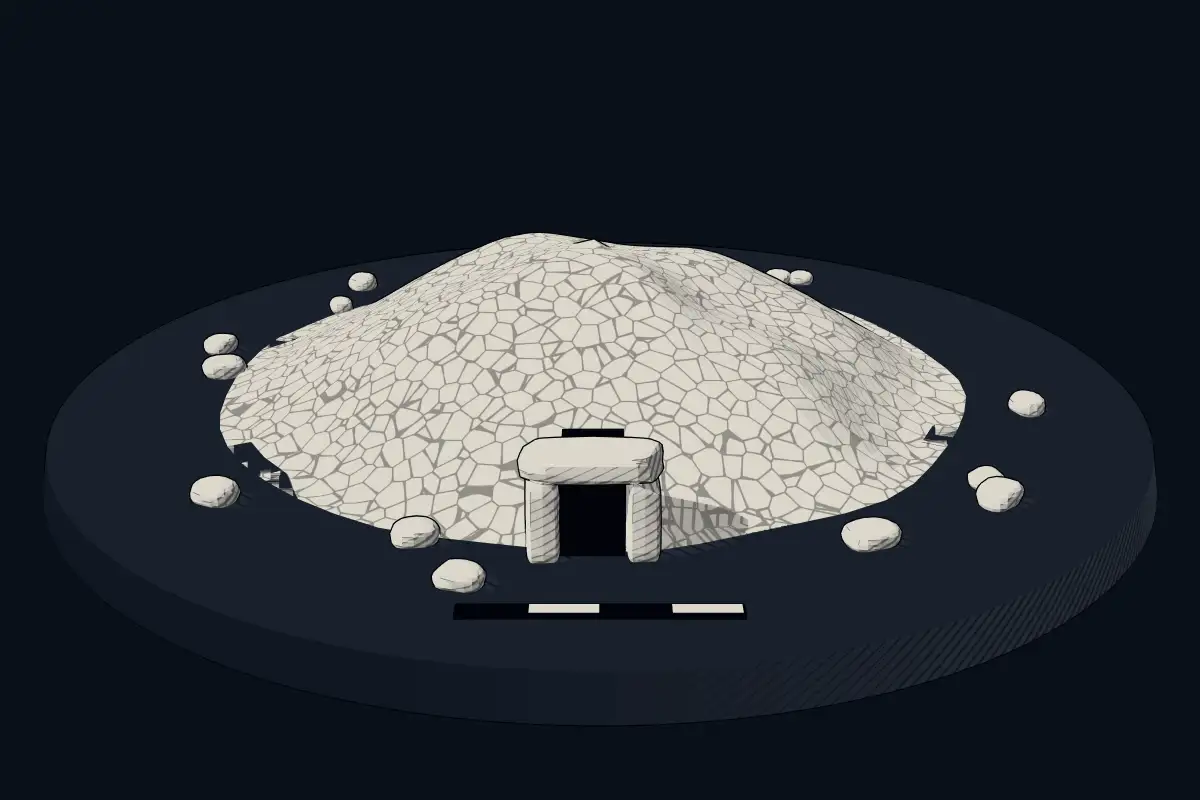
No licensed photograph yetWe have no photograph we may publish for this site, so the interpretive 3D view leads instead.
Overview
About this site
What the sources say
Ballmalloch,chambered cairn is a chambered cairn in South Ayrshire, United Kingdom. In open records it appears as Wikidata item Q56667032, mapped at 55.1247° N, 4.7243° W.
Built from structured records, not from an articleSources and licences
Where it sits in time
The site's dated range, placed against world reference points.
The scale is logarithmic: each step to the left is about ten times older than the last.
The full article
About Ballmalloch,chambered cairn
This kind of monument hereSources for this section
- en.wikipedia.orgCC BY-SA 4.0
- en.wikipedia.orgCC BY-SA 4.0
- en.wikipedia.orgCC BY-SA 4.0
- en.wikipedia.orgCC BY-SA 4.0
- en.wikipedia.orgCC BY-SA 4.0
- en.wikipedia.orgCC BY-SA 4.0
- en.wikipedia.orgCC BY-SA 4.0
Sources for this section
- en.wikipedia.orgCC BY-SA 4.0
- en.wikipedia.orgCC BY-SA 4.0
- en.wikipedia.orgCC BY-SA 4.0
- en.wikipedia.orgCC BY-SA 4.0
- en.wikipedia.orgCC BY-SA 4.0
- en.wikipedia.orgCC BY-SA 4.0
- en.wikipedia.orgCC BY-SA 4.0
Scotland, and above all Orkney and Caithness, has many Neolithic tombs. A chambered cairn is a stone mound over one or more burial chambers, entered by a passage. Maeshowe on Mainland Orkney was probably built around 2800 BCE, and gives its name to the Maeshowe type of cairn, which is limited to Orkney; its entrance passage is about 11 metres long, and sunlight enters it at the winter solstice and reaches the rear wall of the chamber. It is part of the Heart of Neolithic Orkney World Heritage Site. In the twelfth century Norse visitors broke in through the roof and left runic inscriptions inside. The full article, “Orkney, Caithness and Scottish chambered cairns”, follows below under About this kind of monument.
DatingSources for this section
- en.wikipedia.orgCC BY-SA 4.0
Sources for this section
- en.wikipedia.orgCC BY-SA 4.0
The Atlas shows 4000 BCE to 2500 BCE for this site, but that is a regional estimate for this kind of monument, not a date for this particular chambered cairn. No excavation, radiocarbon sample or other measurement is recorded for it, so the real age could fall anywhere within the range, or outside it.
The range rests on this regional background (source: the Wikipedia article “Chambered cairn”): Stone-chambered cairns appear in the early Neolithic (4000-3300 BC) and in the later Neolithic (3300-2500 BC) massive circular enclosures emerge.
Landscape and neighbours
The catalogue lists 1 other site within 1 km, 1 within 5 km and 4 within 10 km; 2 of them are also classed as chambered cairn. In South Ayrshire, United Kingdom, 2 of the 10 catalogued sites are classed as chambered cairn.
The nearest neighbours in the catalogue are Balmalloch (0.0 km north-east, megalith); Cairnderry, chambered cairn (6.9 km south-east, chambered cairn); Sheuchan's Cairn, chambered cairn, Highlandman's Rig (7.4 km east, chambered cairn); White Cairn,cairn 910m NNE of Bargrennan Cottage (9.5 km south-east, megalithic mound). The catalogue is assembled from open records and is not complete, so unrecorded monuments may lie closer.
Records and protectionSources for this section
Sources for this section
Heritage records attach the status scheduled monument to this site. The open records for it are Wikidata (Q56667032), where corrections and further identifiers can be added. Many such sites stand on private land; check local access rules and respect the monument and its surroundings.
How this page was madeSources for this section
Sources for this section
This page was built automatically from Wikidata (CC0), the heritage register named above and the regional article “Orkney, Caithness and Scottish chambered cairns”, written for the Atlas from the Wikipedia articles it cites (CC BY-SA 4.0), plus distances and counts computed from the catalogue coordinates. It contains no AI-written text.
Tradition and region
About this kind of monument
Orkney, Caithness and Scottish chambered cairns
Scotland, and above all Orkney and Caithness, has many Neolithic tombs. A chambered cairn is a stone mound over one or more burial chambers, entered by a passage. Maeshowe on Mainland Orkney was probably built around 2800 BCE, and gives its name to the Maeshowe type of cairn, which is limited to Orkney; its entrance passage is about 11 metres long, and sunlight enters it at the winter solstice and reaches the rear wall of the chamber. It is part of the Heart of Neolithic Orkney World Heritage Site. In the twelfth century Norse visitors broke in through the roof and left runic inscriptions inside.
Orkney also has the Quoyness cairn on Sanday, built about 3000 BCE and similar in design to Maeshowe, where the remains of several people were found in 1867. Unstan, on a promontory into the Loch of Stenness, is an atypical hybrid of the two main types of Orkney cairn and gave its name to Unstan ware, a type of pottery. The Tomb of the Eagles at Isbister on South Ronaldsay stands on a cliff edge.
On the mainland, the Grey Cairns of Camster in Caithness are two large chambered cairns dating to around 3000 BCE, among the oldest structures in Scotland, with central chambers reached by narrow passages. They were excavated and restored by Historic Environment Scotland and are open to the public.
Dating rests on radiocarbon dates from bone and on pottery, but many cairns were opened by antiquarians in the nineteenth century before records were kept. The Atlas gives a typological range of the fourth to third millennium BCE for most.
When visiting, check access in advance, since some cairns have narrow passages and others are open only at set times.
Paraphrased from Wikipedia: Chambered cairn, Wikipedia: Maes Howe, Wikipedia: Quoyness chambered cairn, Wikipedia: Unstan chambered cairn, Wikipedia: Isbister Chambered Cairn, Wikipedia: Midhowe Chambered Cairn, Wikipedia: Grey Cairns of Camster · CC BY-SA 4.0
Lore
Evidence & Lore
What the sources actually support — and, kept apart, what has been claimed.
What the evidence supports
Dates
Est. 4000–2500 BCEHow this date was established: Type comparisonTypical range for chambered cairns in United Kingdom; this site has not been dated itself. Stone-chambered cairns appear in the early Neolithic (4000-3300 BC) and in the later Neolithic (3300-2500 BC) massive circular enclosures emerge.Source for this date
Where it stands
United Kingdom
The pin marks the monument itself — its exact point.
- Coordinates
- 55°07′29″ N, 4°43′27″ WFor a GPS or map app: 55.12467, -4.72430
Access is as our sources describe it; we have not visited the site to check.
Nearby
The closest sites in the Atlas, by straight line.
- MegalithBalmalloch4000–2400 BCE
 Cairnderry, chambered cairn1540–1460 BCE
- Chambered cairnSheuchan's Cairn, chambered cairn, Highlandman's Rig4000–2500 BCE
- Megalithic mound (tumulus with integral stones)White Cairn,cairn 910m NNE of Bargrennan Cottage4000–800 BCE
 King's Cairn4000–2500 BCE
- Megalithic mound (tumulus with integral stones)cairn 110m WNW of Middle Bridge of Cree4000–800 BCE
 Bencallen Hill,chambered cairn4000–2500 BCE
- Megalithic mound (tumulus with integral stones)cairns 670m NNE of Miltonise4000–800 BCE


Sources
Every record behind this page, with the link it came from.
2 sources behind this page
- 01Wikidata Q56667032wikidata.org
- 02Source for this dateen.wikipedia.org
Report a correctionWrong date, name, photograph or source? Tell us and it will be put right.
Around this place
The ten nearest sites, by compass
- Balmalloch<0.1 km NE
- Cairnderry, chambered cairn6.9 km SE
- Sheuchan's Cairn, chambered cairn, Highlandman's Rig7.4 km E
- White Cairn,cairn 910m NNE of Bargrennan Cottage9.5 km SE
- King's Cairn11 km E
- cairn 110m WNW of Middle Bridge of Cree12 km SE
- Bencallen Hill,chambered cairn12 km NE
- cairns 670m NNE of Miltonise13 km SW
- Cairn Kenny13 km SW
- Cairn Kenny, chambered cairn13 km SW
Credit
Text, licence and sources
This page is assembled from open records (Wikidata, CC0; OpenStreetMap, ODbL) and a tradition article paraphrasing Wikipedia (CC BY-SA 4.0). No article exists for this site, and nothing here is written by a model.
- Wikidata Q56667032CC0
- en.wikipedia.orgCC BY-SA 4.0
- en.wikipedia.orgCC BY-SA 4.0
- en.wikipedia.orgCC BY-SA 4.0
- en.wikipedia.orgCC BY-SA 4.0
- en.wikipedia.orgCC BY-SA 4.0
- en.wikipedia.orgCC BY-SA 4.0
- en.wikipedia.orgCC BY-SA 4.0