
Altar Stone
Also known asStone 80
Datedc. 2600 BCE
Photo The Stones of Stonehenge · CC BY 4.0Source file on Wikimedia Commons

Overview
About this site
Overview
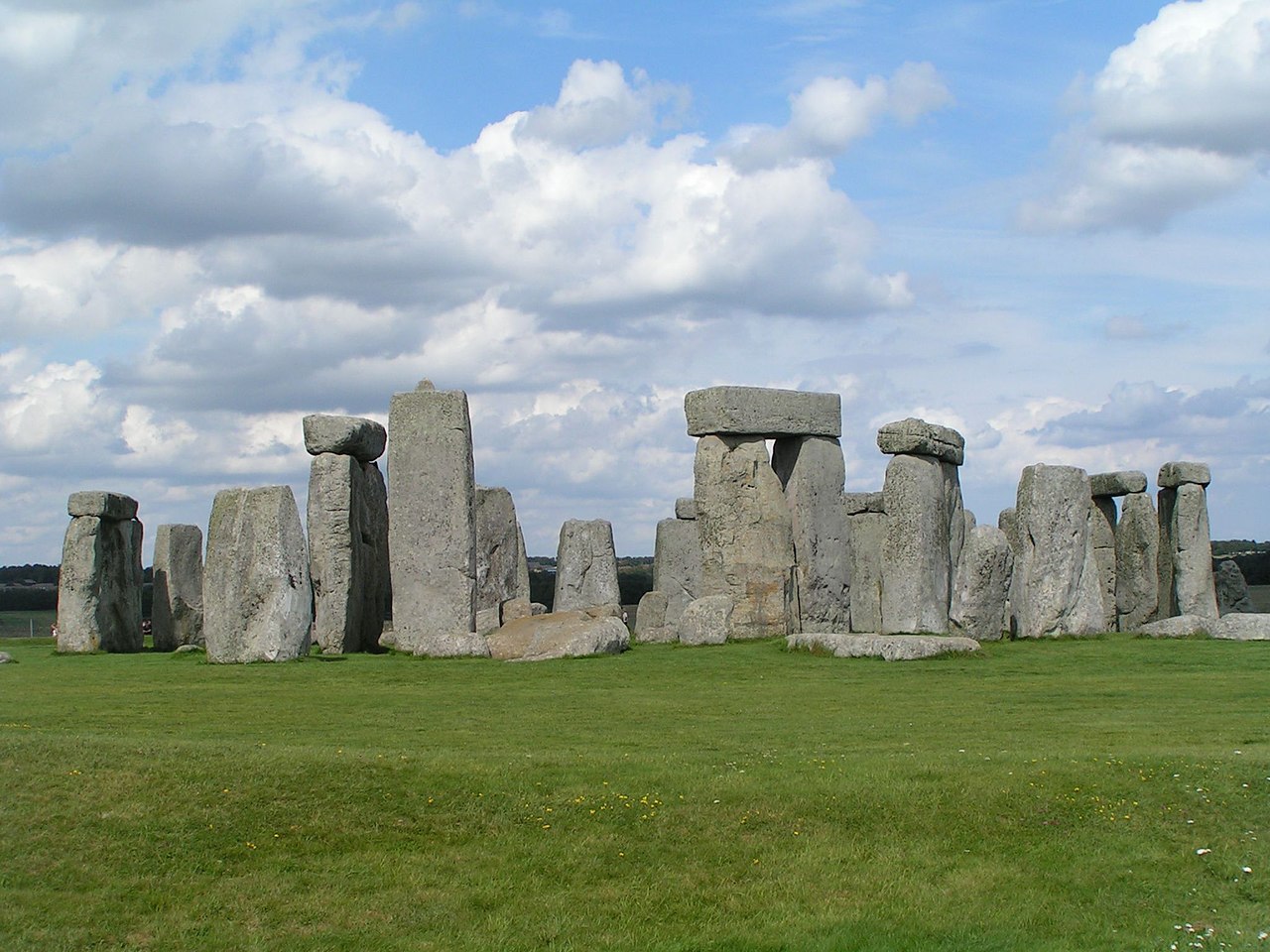
The Altar Stone is a recumbent central megalith at Stonehenge, England, dating to Stonehenge phase 3i, around 2600 BCE. It is identified as Stone 80 in scholarly articles.
It is made of a purplish-green micaceous sandstone. Research published in 2024 claims that its age fingerprint identifies it as coming from the Orcadian Basin in north-east Scotland.
Read on Wikipedia2 min readCC BY-SA 4.0
Where it sits in time
The site's dated range, placed against world reference points.
The scale is logarithmic: each step to the left is about ten times older than the last.
Article
Altar Stone
Stone 55, a sarsen megalith, lies on top of it perpendicularly and is thought to have fallen across it.
DescriptionSources for this section
- Wikipedia (English): Altar Stone (Stonehenge)CC BY-SA 4.0
Sources for this section
- Wikipedia (English): Altar Stone (Stonehenge)CC BY-SA 4.0
The Altar Stone measures 4.9 m long by 1 m wide by 0.5 m thick. Stone 55, a sarsen megalith, lies on top of it perpendicularly and is thought to have fallen across it. Some believe that the Altar Stone always was recumbent. It is sometimes classed as a bluestone because it does not have a local provenance.
SettingSources for this section
- Wikipedia (English): Altar Stone (Stonehenge)CC BY-SA 4.0
Sources for this section
- Wikipedia (English): Altar Stone (Stonehenge)CC BY-SA 4.0
The stone is a micaceous sandstone of purplish-green colour. It was thought to have originated from outcrops of the Senni Beds formation of the Old Red Sandstone in Wales, though this has not been fully established. Research published in 2024 claims to show that its age fingerprint identifies it as coming from the Orcadian Basin in north-east Scotland.
ExcavationsSources for this section
- Wikipedia (English): Altar Stone (Stonehenge)CC BY-SA 4.0
Sources for this section
- Wikipedia (English): Altar Stone (Stonehenge)CC BY-SA 4.0
Stone 80 was most recently excavated in the 1950s, but no written records of the excavation survive, and there are no samples available for examination that are established as having come from the monolith.
NameSources for this section
- Wikipedia (English): Altar Stone (Stonehenge)CC BY-SA 4.0
Sources for this section
- Wikipedia (English): Altar Stone (Stonehenge)CC BY-SA 4.0
The name probably comes from a 1620 comment by Inigo Jones, who wrote: whether it might be an Altar or no I leave to the judgment of others.
Tradition and region
About this kind of monument
Prehistoric rock art and standing stones of Scotland
Most of the "megalith" records for Britain in the Atlas come from the Scottish register of monuments, and many are not standing stones at all but carved rocks. Cup and ring marks are a form of prehistoric art found along the Atlantic seaboard of Europe, in Ireland, Wales, northern England, Scotland, Brittany, Portugal and Galicia. They consist of a concave depression no more than a few centimetres across, pecked into a rock surface and often surrounded by concentric circles; sometimes a linear channel, called a gutter, leads out from the middle. They occur as petroglyphs on natural boulders and outcrops, and also as an element of megalithic art on worked stones, such as the slab cists of the Food Vessel culture, some stone circles and passage graves, and the capstones at Newgrange.
The richest area is Kilmartin Glen in Argyll, which has the most important concentration of Neolithic and Bronze Age remains in mainland Scotland. There are more than 800 ancient monuments within a ten-kilometre radius of the village, with 150 of them prehistoric, including standing stones, a henge, numerous cists and a linear cemetery of five burial cairns that runs over five kilometres. Several of the cairns, and many natural rocks, are decorated with cup and ring marks.
The meaning of the carvings is unknown. Megalithic art tends to be highly abstract, and its meaning is the subject of much debate. On natural outcrops the marks can be dated only broadly, so the Atlas gives a range from the Neolithic to the Bronze Age; on a worked stone of a dated monument they are at least as old as the monument.
When visiting, low light brings out the cups best. Please do not chalk or rub the carvings.
Paraphrased from Wikipedia: Cup and ring mark, Wikipedia: Kilmartin Glen, Wikipedia: Megalithic art, Wikipedia: Rock art · CC BY-SA 4.0
From the article
Dated moments in the story
- 2600 BCE
The Altar Stone is a recumbent central megalith at Stonehenge in England, dating to Stonehenge phase 3i, around 2600 BCE.
Source - 1620
Its name probably comes from a 1620 comment by Inigo Jones who wrote: ‘... whether it might be an Altar or no I leave to the judgment of others’.
Source - 2024
Research published in 2024 claims to show that "the Altar Stone's age fingerprint identifies it as coming from the Orcadian Basin in north-east Scotland".
Source
Photographs
2 photographs, each with its author and licence
More photographs

Lore
Evidence & Lore
What the sources actually support — and, kept apart, what has been claimed.
What the evidence supports
Dates
Est. 4000–2400 BCEHow this date was established: Type comparisonTypical range for megaliths in United Kingdom; this site has not been dated itself. Megalithic construction in England is placed at c. 4000 BC; the first henges in Britain appear c. 3000 BC and hundreds of smaller stone circles were built c. 2400 BC.Source for this date
Where it stands
United Kingdom
The pin marks the monument itself — its exact point.
- Coordinates
- 51°10′44″ N, 1°49′34″ WFor a GPS or map app: 51.17880, -1.82623
Access is as our sources describe it; we have not visited the site to check.
Nearby
The closest sites in the Atlas, by straight line.
 Stonehenge3100–1600 BCE
- Menhir (standing stone)Station Stones2800–1800 BCE
 Stonehenge, Avebury and Associated Sites4500 BCE–600 CE
 Heel Stone3200–2500 BCE
- Megalithic mound (tumulus with integral stones)Bell barrow 100m east of Stonehenge immediately south of the A3444000–800 BCE
- Megalithic mound (tumulus with integral stones)Five bowl barrows forming the greater part of a round barrow cemetery 200m south west of Stonehenge on Stonehenge Down4000–800 BCE
- Megalithic mound (tumulus with integral stones)Bowl barrow 230m west of Stonehenge forming part of a round barrow cemetery on Stonehenge Down4000–800 BCE
- Megalithic mound (tumulus with integral stones)Disc barrow 220m south west of Stonehenge forming part of a round barrow cemetery on Stonehenge Down4000–800 BCE


Sources
Every record behind this page, with the link it came from.
3 sources behind this page
- 01Wikidata Q4736171wikidata.org
- 02Source for this dateen.wikipedia.org
- 03Wikipedia: Altar Stoneen.wikipedia.org
Image files
- Stonehenge-Altar-Stone P1110732.jpgThe Stones of StonehengeCC BY 4.0
- Past the Stones, Stonehenge - geograph.org.uk - 34294.jpgPam BrophyCC BY-SA 2.0
Report a correctionWrong date, name, photograph or source? Tell us and it will be put right.
Around this place
The ten nearest sites, by compass
- Stonehenge<0.1 km NE
- Station Stones<0.1 km NW
- Stonehenge, Avebury and Associated Sites<0.1 km E
- Heel Stone<0.1 km NE
- Bell barrow 100m east of Stonehenge immediately south of the A3440.2 km E
- Five bowl barrows forming the greater part of a round barrow cemetery 200m south west of Stonehenge on Stonehenge Down0.2 km W
- Bowl barrow 230m west of Stonehenge forming part of a round barrow cemetery on Stonehenge Down0.3 km W
- Disc barrow 220m south west of Stonehenge forming part of a round barrow cemetery on Stonehenge Down0.3 km SW
- Bowl barrow 300m WSW of Stonehenge, forming part of a round barrow cemetery on Stonehenge Down0.4 km W
- A twin bell barrow and a bell barrow forming the eastern part of The Cursus round barrow cemetery0.6 km N
Credit
Text, licence and sources
Adapted from the Wikipedia article "Altar Stone (Stonehenge)" (English), licensed CC BY-SA 4.0; authors are listed in the page history. Reused under CC BY-SA 4.0. Read on Wikipedia · Edit history and authors