
Pierre couverte de la Pagerie
DatedEst. 4000–3000 BCE
Photo Liberliger · CC BY-SA 4.0Source file on Wikimedia Commons
Overview
About this site
What the sources say
La Pierre couverte de la Pagerie est un dolmen situé à Gennes, dans le département français de Maine-et-Loire.
Article in FrenchRead on Wikipedia3 min readCC BY-SA 4.0
Where it sits in time
The site's dated range, placed against world reference points.
The scale is logarithmic: each step to the left is about ten times older than the last.
The full article
Pierre couverte de la Pagerie: the whole story
In briefSources for this section
Sources for this section
The Pierre couverte de la Pagerie is a dolmen at Gennes, in the French department of Maine-et-Loire. It is a monumental example of the angevin type with a portique, and it was classified as a historic monument in 1980.
The dolmen measures 10,5 m long and 5 m wide inside. Its chamber is bounded by a single chevet slab, two orthostats on the south side and one on the north. Two covering tables sit above it, one of them slanting down to the ground, while the portique still has its square covering table, tilted to the north. The entrance is framed by two slabs, and all the slabs are made of sandstone.
Excavations carried out in 1897 brought to light a skeleton inside the chamber without any accompanying objects. This burial may have taken place well after the monument was built, although three flint flakes kept at the musée d'Angers are associated with the site. One of the entrance pillars also bears a natural marking resembling the head of a bovine, together with a carved eye.
Dolmens of this kind in France generally belong to the Late Neolithic, about 4000 to 3000 BCE, although the dating given for the Pierre couverte de la Pagerie is a typological estimate for 4000 BCE to 3000 BCE. France holds some 4,500 dolmens spread across 60 departments, many of which were once covered by earth or smaller stones to form a mound.
No English Wikipedia article exists for it; the full text below is the French article "Pierre couverte de la Pagerie", shown in the original language.
Summary in EnglishSources for this section
Sources for this section
Pierre couverte de la Pagerie is a dolmen in Gennes-Val de Loire, France. Wikidata describes it as: dolmen in Gennes, France. A typological estimate: 4000 BCE to 3000 BCE. No English Wikipedia article exists for it; the full text below is the French article "Pierre couverte de la Pagerie", shown in the original language.
ProtectionSources for this section
Sources for this section
L'édifice est classé au titre des monuments historiques en 1980.
DescriptionSources for this section
Sources for this section
C'est un monumental dolmen de type angevin à portique. Il mesure 10,5 m de long pour 5 m de large en intérieur. La chambre est délimitée par une unique dalle de chevet, deux orthostates côté sud et un seul côté nord. Elle est recouverte de deux tables de couverture, dont une est inclinée jusqu'au sol. L'entrée est encadrée par deux dalles. Le portique dispose encore de sa table de couverture de forme carrée, inclinée au nord. Toutes les dalles sont en grès.
Un dessin naturel ressemblant à une tête de bovidé et un œil gravé sont visibles sur l'un des piliers d'entrée.
Lors des fouilles menées en 1897, un squelette fut retrouvé à l'intérieur de la chambre, sans aucun mobilier d'accompagnement. Il pourrait s'agir d'une inhumation bien postérieure à l'édification de l'édifice même si trois éclats de silex, conservés au musée d'Angers, sont associés à ce monument.
AnnexesSources for this section
Sources for this section
Bibliographie
: document utilisé comme source pour la rédaction de cet article.
Michel Gruet, Mégalithes en Anjou, Le Coudray-Macouard, Cheminements, 2005 (1re éd. 1967, actualisation de Charles-Tanguy Le Roux), 417 p. (ISBN 2-84478-397-X, lire en ligne), p. 127-129.
Articles connexes
Sites mégalithiques de Maine-et-Loire
Liste des monuments historiques de Maine-et-Loire
How this page was madeSources for this section
Sources for this section
The summary at the top of this page was written by MiniMax-M3 (2026-11-08) from the cited Wikipedia article “Pierre couverte de la Pagerie”, translated from French. The numbers in it were checked automatically against the source text. The rest of the page is the article itself, the structured records and computed distances.
Tradition and region
About this kind of monument
French dolmens
France is the dolmen country of Europe: the Dolmen de Bagneux at Saumur is the largest of some 4,500 dolmens scattered across 60 French departments, and one of the largest in Europe. A dolmen is a single-chamber megalithic tomb with two or more upright stones carrying a great capstone. Most date to the Late Neolithic, about 4000 to 3000 BCE, and many were covered with earth or smaller stones to form a mound.
Some of the oldest megalithic monuments in Europe are in western France. The Cairn of Barnenez in Finistère dates to the early Neolithic, around 4000 BCE, and with the Tumulus of Bougon and the Locmariaquer megaliths it is among the earliest megalithic monuments in Europe; it also has megalithic art. La Roche-aux-Fées near Essé in Ille-et-Vilaine is a covered corridor about 20 metres long, built of some 48 blocks, the heaviest around 45 tonnes, and divided into two chambers. It is thought to date from 3000 to 2500 BCE, and its entrance is aligned on sunrise at the winter solstice.
Folklore: the name of La Roche-aux-Fées, "the fairies' rock", comes from a legend that fairies placed the stones. Such stories are traditions about the monuments, not evidence of how they were built.
Because the Atlas draws on national inventories, its French records include many small and ruined dolmens, often reduced to a capstone resting on a few supports. Dates rest on the typology of the monument and, where a dolmen has been excavated, on radiocarbon dating of material from the chamber.
When visiting, look for the capstone and its supports, for the low rise of the old mound around the stones, and for the direction in which the entrance faces.
Paraphrased from Wikipedia: Dolmen, Wikipedia: Dolmen de Bagneux, Wikipedia: La Roche-aux-Fées, Wikipedia: Barnenez, Wikipedia: Carnac stones · CC BY-SA 4.0
From the article
Dated moments in the story
- 1897
Lors des fouilles menées en 1897, un squelette fut retrouvé à l'intérieur de la chambre, sans aucun mobilier d'accompagnement.
Source - 1967
1967, actualisation de Charles-Tanguy Le Roux), 417 p.
Source - 1980
L'édifice est classé au titre des monuments historiques en 1980.
Source - 2005
Michel Gruet, Mégalithes en Anjou, Le Coudray-Macouard, Cheminements, 2005 (1re éd.
Source
See it in 3D
An interpretive reconstruction of the monument, standing on the real ground at its exact point, under the sun for that place and season. Drag to look around it.
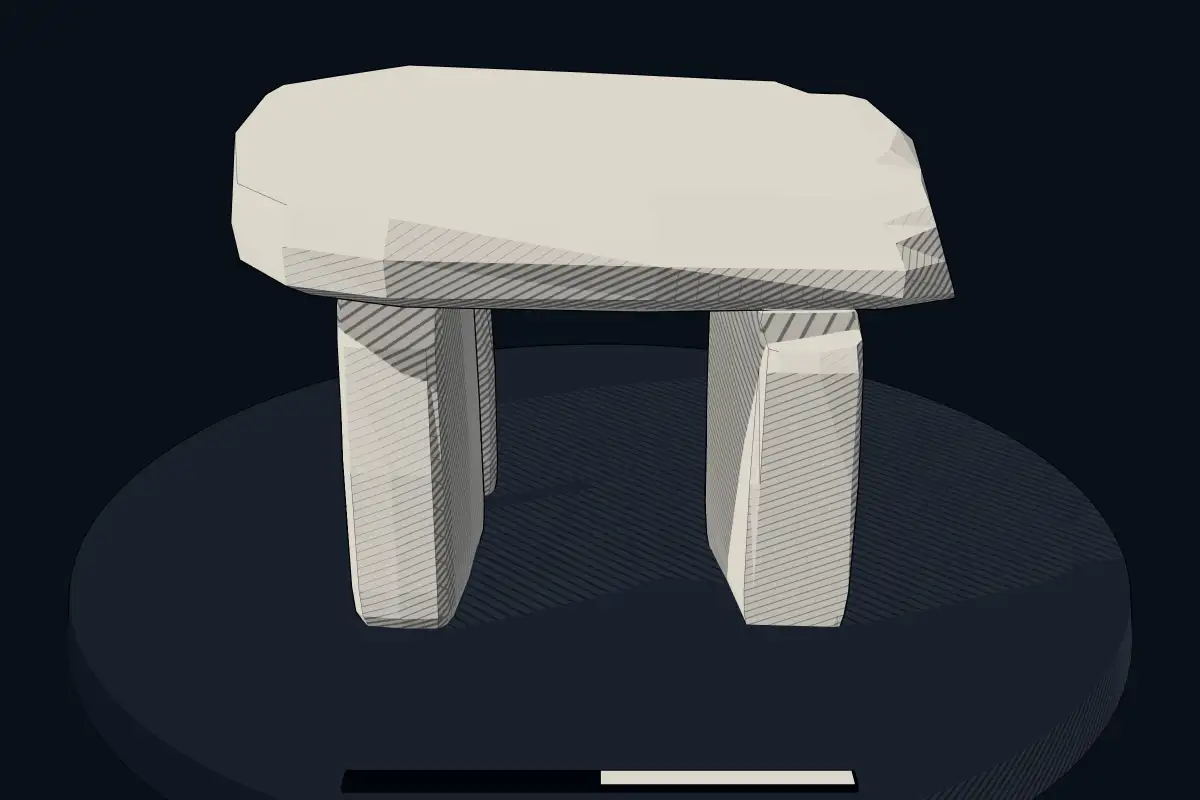
The reconstruction is ours, not a survey: it shows what a monument of this type looks like, at the size the record gives for this one.
Photographs
4 photographs, each with its author and licence
More photographs
Lore
Evidence & Lore
What the sources actually support — and, kept apart, what has been claimed.
What the evidence supports
Dates
Est. 4000–3000 BCEHow this date was established: Type comparisonTypical range for dolmens in France; this site has not been dated itself. Most dolmens date from the Late Neolithic period (4000-3000 BCE).Source for this date
Where it stands
France
The pin marks the monument itself — its exact point.
- Coordinates
- 47°20′22″ N, 0°15′23″ WFor a GPS or map app: 47.33940, -0.25631
Access is as our sources describe it; we have not visited the site to check.
Nearby
The closest sites in the Atlas, by straight line.


Sources
Every record behind this page, with the link it came from.
2 sources behind this page
- 01Wikidata Q3387404wikidata.org
- 02Source for this dateen.wikipedia.org
Image files
- Gennes pagerie 04.jpgLiberligerCC BY-SA 4.0
- Gennes pagerie 01.jpgLiberligerCC BY-SA 4.0
- Gennes pagerie 02.jpgLiberligerCC BY-SA 4.0
- Gennes pagerie 03.jpgLiberligerCC BY-SA 4.0
Report a correctionWrong date, name, photograph or source? Tell us and it will be put right.
Around this place
The ten nearest sites, by compass
- Pierre Longue du Bouchet0.6 km W
- Menhir du Moulin Hilaire0.8 km NE
- Dolmen de la Forêt1.4 km W
- dolmens des Varennes de Cumeray3.0 km NW
- Pierre couverte d'Avort3.4 km SW
- La Bajoulière dolmen4.5 km NW
- Pierre Couverte du Moulin de Piau6.9 km W
- Caillère dolmen8.3 km NW
- L’Étiau dolmen9.0 km NW
- Pierre Couverte de Saugré9.6 km S
Credit
Text, licence and sources
Text from the Wikipedia article "Pierre couverte de la Pagerie" (French), licensed CC BY-SA 4.0; authors are listed in the page history. Reused under CC BY-SA 4.0. Read on Wikipedia · Edit history and authors