_1.jpg/1920px-Tumulus_Pr%C3%A8s-de-l'Eau_(Lacrost)_1.jpg 1920w)
Megalithic mound (tumulus with integral stones)
Nécropole des Près-de-l'Eau
DatedEst. 5000–3000 BCE
Photo Tangopaso · Public domainSource file on Wikimedia Commons
Overview
About this site
What the sources say
La nécropole des Près-de-l'Eau se situe au lieu-dit les Près-de-l'Eau sur la commune de Lacrost (Saône-et-Loire). Elle occupe une superficie d'une quinzaine d'hectares à 700 mètres de la Saône sur la rive gauche.
Article in FrenchRead on Wikipedia6 min readCC BY-SA 4.0
Where it sits in time
The site's dated range, placed against world reference points.
The scale is logarithmic: each step to the left is about ten times older than the last.
The full article
Nécropole des Près-de-l'Eau: the whole story
In briefSources for this section
- Wikipedia (French): Nécropole des Près-de-l'EauCC BY-SA 4.0
Sources for this section
- Wikipedia (French): Nécropole des Près-de-l'EauCC BY-SA 4.0
The Nécropole des Près-de-l'Eau is a megalithic burial ground at the lieu-dit les Près-de-l'Eau in Lacrost, Saône-et-Loire, France. It covers a area of fifteen hectares on the left bank of the Saône, 700 metres from the river. The necropolis is bordered on the east by the bief of the petite rivière Arvoux.
It originally contained around forty tumuli arranged in three approximate north-south lines parallel to the river. The mounds, more numerous in the south but larger in the north, ranged from 5 to 45 metres in diameter and from a few centimetres to 1.8 metres in height. Farming and flooding have made many no longer visible. Tumuli 1 and 2 have been listed as monuments historiques since 4 May 1934.
Excavations began in 1879 under Jean Martin. Tumulus 1 held an onion-shaped vase and cremated bones, while tumulus 2 contained a buried circular limestone wall and a larger urn with a small offering vessel. Further investigation in 1986-1987 and 1989 found a ring of upright slabs in tumulus 3, two urns in tumulus 4, and a lignite barrel bracelet, a globular vessel, and cremated human bones in tumulus 35.
The pottery places the principal burial activity around 800 av. J.-C. All the excavated tumuli stood on ground cleared by fire, and three of the five excavated mounds yielded human remains. The site also contains worked Neolithic flints, an arrowhead from the end of the Âge de la Pierre Polie towards 2500 av. J.-C., later Gaulish material, and Gallo-Roman houses. These finds show repeated use of the place over a long period.
No English Wikipedia article exists for it; the full text below is the French article "Nécropole des Près-de-l'Eau", shown in the original language.
Summary in EnglishSources for this section
- Wikipedia (French): Nécropole des Près-de-l'EauCC BY-SA 4.0
Sources for this section
- Wikipedia (French): Nécropole des Près-de-l'EauCC BY-SA 4.0
Nécropole des Près-de-l'Eau is a megalithic mound (tumulus with integral stones) in Lacrost, France. Wikidata describes it as: tumulus located in Saône-et-Loire, in France. A typological estimate: 5000 BCE to 3000 BCE. No English Wikipedia article exists for it; the full text below is the French article "Nécropole des Près-de-l'Eau", shown in the original language.
Le siteSources for this section
- Wikipedia (French): Nécropole des Près-de-l'EauCC BY-SA 4.0
Sources for this section
- Wikipedia (French): Nécropole des Près-de-l'EauCC BY-SA 4.0
Il est bordé à l'est par le bief de la petite rivière Arvoux.
Il comporte une quarantaine de tumuli selon trois lignes approximatives orientées nord-sud parallèlement à la rivière. Les tumuli sont plus nombreux au sud, mais plus grand au nord.
Leurs dimensions varient de 5 à 45 mètres de diamètre et de quelques centimètres à 1,8 mètre de hauteur.
Les terrains étant à la fois en culture et inondables, beaucoup de tumuli ne sont plus visibles.
Deux de ces tumuli sont classés au titre des monuments historiques par arrêté du 4 mai 1934.
Les recherches successivesSources for this section
- Wikipedia (French): Nécropole des Près-de-l'EauCC BY-SA 4.0
Sources for this section
- Wikipedia (French): Nécropole des Près-de-l'EauCC BY-SA 4.0
Les premières recherches ont été menées par la Société des amis des arts et des sciences de Tournus en 1879, sous la conduite de Jean Martin. Les tumuli 1 et 2, les plus importants de la nécropole et situés approximativement au centre, ont été auscultés par une tranchée de 3 à 3,5 mètres de large, de la périphérie vers le centre. Les objets découverts ont été déposés au musée Greuze de Tournus.
Le tumulus 1 est un simple amoncellement de terres, prélevées sur les environs. Au centre, un vase en forme de bulbe d'oignon de 15 cm de diamètre environ contenant une poignée d'ossements calcinés.
Le squelette d'un bœuf a été découvert à 2 mètres du centre, sans qu'on puisse savoir si sa présence est rituelle ou fortuite.
La structure du tumulus 2 est plus complexe avec un muret circulaire enfoui à environ 9 mètres du centre avec des dallettes de calcaire empilées à sec du environ 80 cm de hauteur et de largeur.
Au centre, une urne plus grande de 20 cm de diamètre environ a été découverte, avec un petit vase offrande en son centre, mais sans trace de restes humains.
En 1962, à la faveur de crues de la Saône, 23 tertres ont été recensés.
Dans les années 1980, les labours et les inondations ont effacé l'essentiel des tertres. Seuls les tumuli 1 et 2 font l'objet d'une protection.
Une fouille d'urgence a été lancée en 1986-1987 sur les tumuli no 3 et 4 situés dans la partie sud de la nécropole. Sur le tumulus no 3, elle a mis en évidence une ceinture de 19 mètres de diamètre composée de dalles dressées. Mais le centre du tumulus avait été excavé pour l'installation d'un four à chaux qui a du exploiter à la fin de l'époque romaine les moellons calcaires d'une villa située à proximité. De ce fait, aucun dépôt funéraire n'a été découvert, malgré des décapages soigneux et étendus.
Le tumulus no 4 ne renfermait pas de ceinture de pierres, mais deux urnes grossières de 20 cm de diamètre environ, contenant chacune un vase d'offrandes, avec des ossements brûlés dans l'un d'entre eux seulement.
Le tumulus no 35 situé au nord de la nécropole a fait l'objet d'une fouille ponctuelle en 1989 après l'apparition d'objets à la suite de labours qui l'ont dégradé. Ont été mis au jour un bracelet tonnelet en lignite et un récipient globuleux de 5 cm de diamètre. Ainsi que des ossements humains calcinés.
Les conclusions sur l'ensembleSources for this section
- Wikipedia (French): Nécropole des Près-de-l'EauCC BY-SA 4.0
Sources for this section
- Wikipedia (French): Nécropole des Près-de-l'EauCC BY-SA 4.0
Seuls 3 des 5 tumuli fouillés ont livré des restes d'ossements.
Tous les tumuli ont été bâtis sur une aire préalablement nettoyée par le feu.
Ils sont de 4 types :
Simple, une accumulation de terre
Simple à cœur argileux
Avec une simple ceinture circulaire de dalles enfouies dans le tumulus
Avec un muret circulaire enfoui dans le tumulus
La forme et le décor des vases recueillis permettent de les dater de la période du bronze vers 800 av. J.-C.
Sur le site, ont été trouvés des silex taillés de l'époque néolithique et une pointe de flèche datant de la fin de l'Âge de la Pierre Polie vers 2500 av. J.-C. Cela prouve une longue fréquentation des lieux. Ont également été retrouvés des tessons de poteries et objets métalliques de l'époque gauloise bien ultérieure à celle de l'élaboration des tumuli.
Des restes gallo-romains montrent la construction de maisons aux Ier et IIe siècles. Parfois au-dessus des tumulus pour être un peu à l'abri de l'humidité.
D'autres nécropoles se trouvent aux environs, au lieu-dit les Varennes toujours sur la commune de Lacrost, mais aussi à Ormes - Simandre et au nord du lit de la rivière Seille.
How this page was madeSources for this section
- Wikipedia (French): Nécropole des Près-de-l'EauCC BY-SA 4.0
Sources for this section
- Wikipedia (French): Nécropole des Près-de-l'EauCC BY-SA 4.0
The summary at the top of this page was written by MiniMax-M3 (2026-11-07) from the cited Wikipedia article “Nécropole des Près-de-l'Eau”, translated from French. The numbers in it were checked automatically against the source text. The rest of the page is the article itself, the structured records and computed distances.
Tradition and region
About this kind of monument
Low Countries and French barrows
Round barrows are found across the Low Countries and France. Many were raised in the Late Neolithic and the Bronze Age. The Bell Beaker phenomenon of the late third millennium BCE brought a new burial rite to western Europe: individual burials, often under a tumulus and with weapons, in contrast to the collective, weaponless burials of the earlier Neolithic. The Dutch hunebedden, the megalithic tombs of the north, belong to the earlier tradition and are described in their own article.
Round barrows are hemispherical mounds raised over a central burial, which may be an inhumation or a cremation placed in a vessel. Barrows were often reused: later graves were cut into the mound, sometimes long after the first burial, and many attract satellite burials. In France and Belgium, tumuli of the Hallstatt period belong to the early Iron Age, from about 800 BCE; from phase B of the Hallstatt sequence, tumulus burial becomes common and cremation predominates.
Dating relies on pottery and metalwork, and on radiocarbon dating where a mound has been dug. Many have been ploughed down, so the Atlas map reflects where mounds survived and were recorded as much as where they were built.
When visiting, look for the surrounding ditch or kerb, and for a later disturbance at the centre where a later grave or an old digging has cut the mound.
Paraphrased from Wikipedia: Tumulus, Wikipedia: Round barrow, Wikipedia: Bell Beaker culture, Wikipedia: Hallstatt culture, Wikipedia: Hunebed · CC BY-SA 4.0
From the article
Dated moments in the story
- 800 CE
Ils sont de 4 types : Simple, une accumulation de terre Simple à cœur argileux Avec une simple ceinture circulaire de dalles enfouies dans le tumulus Avec un muret circulaire enfoui dans le tumulus La forme et le décor des vases recueillis permettent de les dater de la période du bronze vers 800 av.
Source - 1879
Les premières recherches ont été menées par la Société des amis des arts et des sciences de Tournus en 1879, sous la conduite de Jean Martin.
Source - 1934
Deux de ces tumuli sont classés au titre des monuments historiques par arrêté du 4 mai 1934.
Source - 1962
En 1962, à la faveur de crues de la Saône, 23 tertres ont été recensés.
Source - 1980
Dans les années 1980, les labours et les inondations ont effacé l'essentiel des tertres.
Source - 1986
Une fouille d'urgence a été lancée en 1986-1987 sur les tumuli no 3 et 4 situés dans la partie sud de la nécropole.
Source - 1989
Le tumulus no 35 situé au nord de la nécropole a fait l'objet d'une fouille ponctuelle en 1989 après l'apparition d'objets à la suite de labours qui l'ont dégradé.
Source
See it in 3D
An interpretive reconstruction of the monument, standing on the real ground at its exact point, under the sun for that place and season. Drag to look around it.
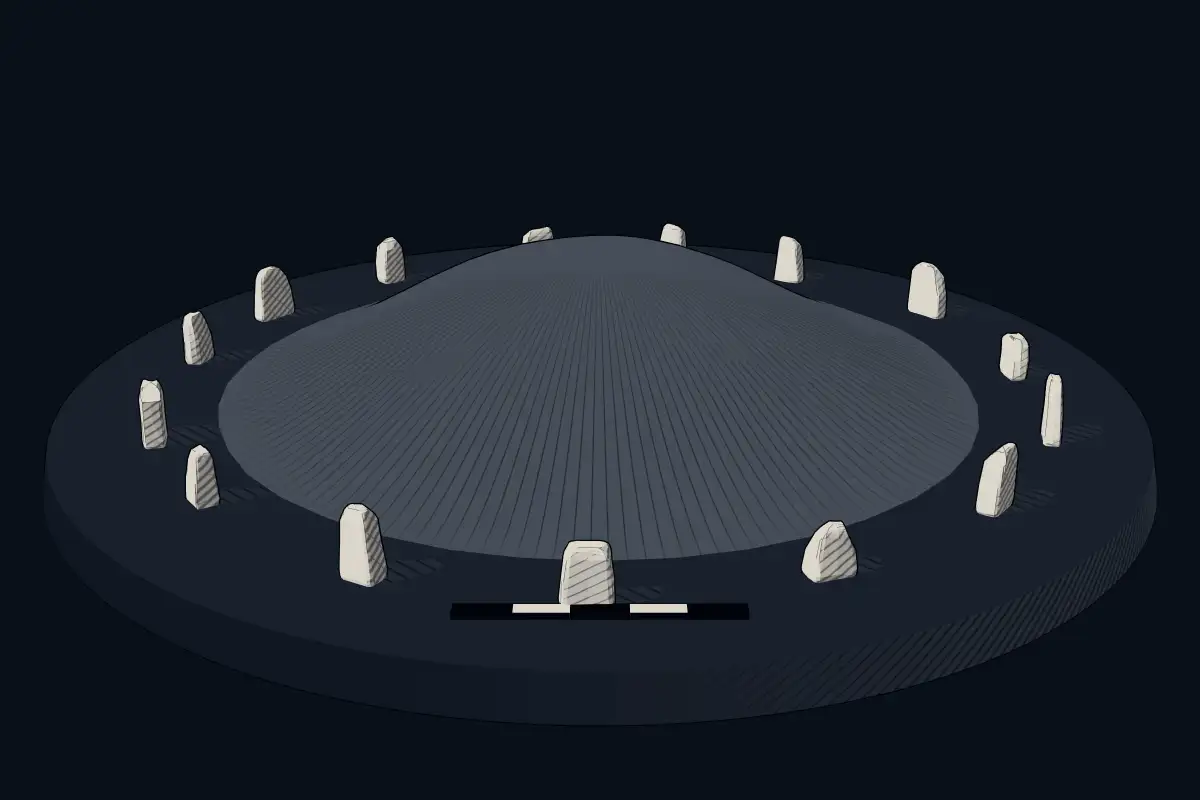
The reconstruction is ours, not a survey: it shows what a monument of this type looks like, at the size the record gives for this one.
Photographs
5 photographs, each with its author and licence
More photographs
Lore
Evidence & Lore
What the sources actually support — and, kept apart, what has been claimed.
What the evidence supports
Dates
Est. 5000–3000 BCEHow this date was established: Type comparisonTypical range for megalithic mounds in France; this site has not been dated itself. The Neolithic Saint-Michel de Carnac tumulus was built between 5,000 and 3,400 BC and the Bougon tumuli between 4,500 and 3,000 BC.Source for this date
Where it stands
France
The pin marks the monument itself — its exact point.
- Coordinates
- 46°33′58″ N, 4°55′35″ EFor a GPS or map app: 46.56612, 4.92635
Access is as our sources describe it; we have not visited the site to check.
Nearby
The closest sites in the Atlas, by straight line.


Sources
Every record behind this page, with the link it came from.
2 sources behind this page
- 01Wikidata Q18380087wikidata.org
- 02Source for this dateen.wikipedia.org
Image files
- Tumulus Près-de-l'Eau (Lacrost) 1.jpgTangopasoPublic domain
- Tumulus Près-de-l'Eau (Lacrost) 2.jpgTangopasoPublic domain
- Hôtel-Dieu de Tournus (Urn tumulus 1).jpgTangopasoPublic domain
- Hôtel-Dieu de Tournus (Big urn).jpgTangopasoPublic domain
- Hôtel-Dieu de Tournus (Urn tumulus 2).jpgTangopasoPublic domain
Report a correctionWrong date, name, photograph or source? Tell us and it will be put right.
Around this place
The ten nearest sites, by compass
Credit
Text, licence and sources
Text from the Wikipedia article "Nécropole des Près-de-l'Eau" (French), licensed CC BY-SA 4.0; authors are listed in the page history. Reused under CC BY-SA 4.0. Read on Wikipedia · Edit history and authors