
Overview
About this site
Overview
The Lamalou dolmen is a dolmen at Rouet, in the département of Hérault, France. It is dated by typological estimate to between 4000 and 3000 BCE and is a classified historical monument, listed by decree of 19 August 1954. Its state of conservation is exceptional for the region.
It is one of the few Languedoc dolmens to have kept almost all of its structural elements: tumulus, passage, antechamber, chamber and covering slabs.
Read on Wikipedia4 min readCC BY-SA 4.0
Where it sits in time
The site's dated range, placed against world reference points.
The scale is logarithmic: each step to the left is about ten times older than the last.
Article
Lamalou dolmen
The dolmen is enclosed in a large tumulus 15 m in diameter and 3 m high, the base of which was consolidated with a circular row of slabs set vertically.
DescriptionSources for this section
- Wikipedia (French): Dolmen de LamalouCC BY-SA 4.0
Sources for this section
- Wikipedia (French): Dolmen de LamalouCC BY-SA 4.0
The dolmen is enclosed in a large tumulus 15 m in diameter and 3 m high, the base of which was consolidated with a circular row of slabs set vertically. The monument opens to the south-west, in the direction of the natural slope.
The passage is 5.10 m long and about 1 m wide. It is slightly arched and off-axis, which may result from the thrust of the mass of the tumulus. It is bounded by dry-stone walls reaching a maximum of about 1 m in height near the entrance of the antechamber. The entrance of the passage was marked by a large threshold stone mentioned by Arnal but since lost. The end part, 3 m from the threshold, is covered by two slabs resting directly on the dry-stone walls. It is not known whether the passage was originally covered throughout; if so, the height under the slabs would have required crawling to reach the chamber.
The passage and antechamber are separated by a partition of two vertical slabs, one of which is pierced by an opening in the shape of an oven door (0.74 m wide by 0.90 m high). The antechamber measures about 2 m long by 1.80 m wide, with a height varying from 0.90 to 1 m. Its walls are of dry stone made of thin slabs; the north wall had a slight corbelling when discovered, but the south wall had already collapsed at the time of the excavations. The antechamber is covered by two slabs, and this covering was reinforced during the restoration by a third slab placed on top.
The chamber has a slightly trapezoidal plan: 2.24 m wide on the entrance side and 2.17 m on the rear side, with a depth of about 2.10 m. It is bounded by orthostates inclined towards the interior, the gaps between which are filled with dry-stone walling. The entrance is formed by two slabs whose upper parts partly overlap, leaving a triangular opening at the base 0.50 m wide and 1 m high. A broken slab (0.80 m by 0.64 m) found in front of the opening probably corresponds to the original door; it has a notch in its upper part. The end slab is slightly taller than the side slabs, so the height under the slab reaches 1.88 m at the entrance and 2.10 m at the rear. The whole is covered by a single oval capstone (3.50 m by 2.50 m and 0.22 m thick), which overhangs the antechamber by 1.20 m. The floor of the chamber is covered with rough paving, while the floor of the antechamber was probably of beaten earth.
The dolmen shows very close architectural similarities to a neighbouring dolmen, the dolmen des Feuilles.
FindsSources for this section
- Wikipedia (French): Dolmen de LamalouCC BY-SA 4.0
Sources for this section
- Wikipedia (French): Dolmen de LamalouCC BY-SA 4.0
The archaeological layer, covered with a layer of small stones, yielded an important assemblage in all parts of the dolmen, but the antechamber proved the richest. More than 50 Kg of very fragmented human bones and about 2 270 intact teeth were recovered during the excavations.
The flint material is abundant: 2 large fine blades and 6 broad blades, 2 daggers, 8 microlithic fragments, 2 fragments of arrowheads (1 of them with a tang), 12 scrapers and 253 fragments and flakes of various kinds. The bone industry consists of 18 awls made from rabbit tibiae.
Items of personal ornament are numerous: more than 80 beads (of steatite, callaïs, calcite and bronze) and about twenty pendants (perforated animal teeth and shell). The pottery consists of fragments of poorly fired vessels with very simple decoration (raised cords and deep incisions), corresponding to a minimum of 11 vessels. The finds are kept at the museum and depot at Lattes.
ConservationSources for this section
- Wikipedia (French): Dolmen de LamalouCC BY-SA 4.0
Sources for this section
- Wikipedia (French): Dolmen de LamalouCC BY-SA 4.0
The monument was restored in 1977.
Tradition and region
About this kind of monument
French dolmens
France is the dolmen country of Europe: the Dolmen de Bagneux at Saumur is the largest of some 4,500 dolmens scattered across 60 French departments, and one of the largest in Europe. A dolmen is a single-chamber megalithic tomb with two or more upright stones carrying a great capstone. Most date to the Late Neolithic, about 4000 to 3000 BCE, and many were covered with earth or smaller stones to form a mound.
Some of the oldest megalithic monuments in Europe are in western France. The Cairn of Barnenez in Finistère dates to the early Neolithic, around 4000 BCE, and with the Tumulus of Bougon and the Locmariaquer megaliths it is among the earliest megalithic monuments in Europe; it also has megalithic art. La Roche-aux-Fées near Essé in Ille-et-Vilaine is a covered corridor about 20 metres long, built of some 48 blocks, the heaviest around 45 tonnes, and divided into two chambers. It is thought to date from 3000 to 2500 BCE, and its entrance is aligned on sunrise at the winter solstice.
Folklore: the name of La Roche-aux-Fées, "the fairies' rock", comes from a legend that fairies placed the stones. Such stories are traditions about the monuments, not evidence of how they were built.
Because the Atlas draws on national inventories, its French records include many small and ruined dolmens, often reduced to a capstone resting on a few supports. Dates rest on the typology of the monument and, where a dolmen has been excavated, on radiocarbon dating of material from the chamber.
When visiting, look for the capstone and its supports, for the low rise of the old mound around the stones, and for the direction in which the entrance faces.
Paraphrased from Wikipedia: Dolmen, Wikipedia: Dolmen de Bagneux, Wikipedia: La Roche-aux-Fées, Wikipedia: Barnenez, Wikipedia: Carnac stones · CC BY-SA 4.0
From the article
Dated moments in the story
- 1954
L'édifice est classé au titre des monuments historiques par arrêté du 19 août 1954. Il a été restauré en 1977.
Source
See it in 3D
An interpretive reconstruction of the monument, standing on the real ground at its exact point, under the sun for that place and season. Drag to look around it.
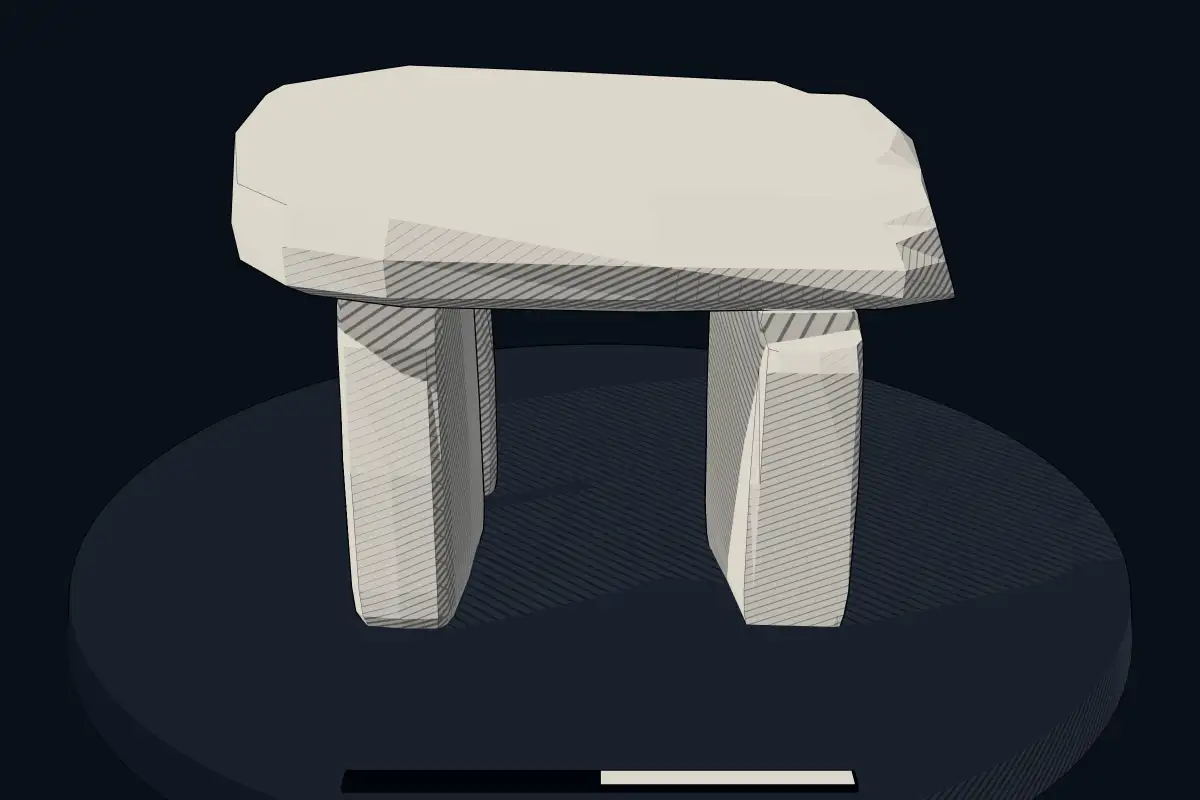
The reconstruction is ours, not a survey: it shows what a monument of this type looks like, at the size the record gives for this one.
Photographs
6 photographs, each with its author and licence
More photographs
Lore
Evidence & Lore
What the sources actually support — and, kept apart, what has been claimed.
What the evidence supports
Dates
Est. 4000–3000 BCEHow this date was established: Type comparisonTypical range for dolmens in France; this site has not been dated itself. Most dolmens date from the Late Neolithic period (4000-3000 BCE).Source for this date
Where it stands
France
The pin marks the monument itself — its exact point.
- Coordinates
- 43°49′26″ N, 3°47′59″ EFor a GPS or map app: 43.82400, 3.79960
Access is as our sources describe it; we have not visited the site to check.
Nearby
The closest sites in the Atlas, by straight line.


Sources
Every record behind this page, with the link it came from.
2 sources behind this page
- 01Wikidata Q21037029wikidata.org
- 02Source for this dateen.wikipedia.org
Image files
- Tumulus de Lamalou 142355mod.jpgJYB DevotCC BY-SA 4.0
- Tumulus de Lamalou 2314-2317mod.jpgJYB DevotCC BY-SA 4.0
- PicPatrimoineFredCRouet3401.jpgPicPatrimoineFredCCC BY 4.0
- PicPatrimoineFredCRouet34010.jpgPicPatrimoineFredCCC BY 4.0
- Le dolmen du Lamalou - SLH.jpgPicPatrimoineSLHCC BY 4.0
- Cairn dolmen.jpgOriginal uploaded by Hugo.soria (Transfered by Tangopaso )CC BY-SA 3.0
Report a correctionWrong date, name, photograph or source? Tell us and it will be put right.
Around this place
The ten nearest sites, by compass
Credit
Text, licence and sources
Adapted from the Wikipedia article "Dolmen de Lamalou" (French), licensed CC BY-SA 4.0; authors are listed in the page history. Reused under CC BY-SA 4.0. Read on Wikipedia · Edit history and authors
- Wikipedia (French): Dolmen de LamalouCC BY-SA 4.0
- Wikidata Q21037029CC0