
dolmen du Col de l'Aubret
DatedEst. 4000–3000 BCE
Photo Anthony Morel · CC BY-SA 4.0Source file on Wikimedia Commons

Overview
About this site
Overview
The dolmen du Col de l'Aubret, also called the dolmen de Graniès, is a dolmen in the commune of Monoblet in the département of Gard, France. The catalogue gives a typological estimate for its date of between 4000 and 3000 BCE.
It was used as an ossuary on several occasions and in distinct periods, with more than 20 individuals buried in it. Slabs were taken from the dolmen to metal the neighbouring road, and it was damaged as a result.
Read on Wikipedia2 min readCC BY-SA 4.0
Where it sits in time
The site's dated range, placed against world reference points.
The scale is logarithmic: each step to the left is about ten times older than the last.
Article
dolmen du Col de l'Aubret
Before excavation the entrance to the chamber was closed by two fixed vertical slabs separated by an access 0,65 m wide, blocked with rubble.
DescriptionSources for this section
- Wikipedia (French): Dolmen du col de l'AubretCC BY-SA 4.0
Sources for this section
- Wikipedia (French): Dolmen du col de l'AubretCC BY-SA 4.0
The chamber measures 2 m long by 1,67 m wide, and its floor is paved with slabs. Before excavation the entrance to the chamber was closed by two fixed vertical slabs separated by an access 0,65 m wide, blocked with rubble. All the slabs are of limestone.
ExcavationsSources for this section
- Wikipedia (French): Dolmen du col de l'AubretCC BY-SA 4.0
Sources for this section
- Wikipedia (French): Dolmen du col de l'AubretCC BY-SA 4.0
The dolmen was first excavated in 1884 by A. Jeanjean, in a superficial manner, and a second time in the early twentieth century by Lieutenant Gimon and Doctor Camichel. Jeanjean collected fragments of black pottery, a flint scraper, a metal plaque and human bones attributed to two distinct individuals.
FindsSources for this section
- Wikipedia (French): Dolmen du col de l'AubretCC BY-SA 4.0
Sources for this section
- Wikipedia (French): Dolmen du col de l'AubretCC BY-SA 4.0
The excavation by Gimon and Camichel yielded a larger body of material, including a large quantity of human bones and more than 500 teeth, a bronze needle, fragments of coarse red pottery tempered with feldspar grains, and many items of personal ornament. The ornaments comprise a large quantity of beads (31 of steatite, 25 of aragonite and about a hundred of chalk), a limestone pendant, a bronze ring and several fragments of bronze rings. Together the finds indicate that the dolmen was used as an ossuary several times and at distinct periods. The excavation was reported by E. Gimon in the Bulletin de la Société préhistorique de France in 1904.
ContextSources for this section
- Wikipedia (French): Dolmen du col de l'AubretCC BY-SA 4.0
Sources for this section
- Wikipedia (French): Dolmen du col de l'AubretCC BY-SA 4.0
France is the dolmen country of Europe, with some 4,500 dolmens scattered across 60 French departments. A dolmen is a single-chamber megalithic tomb with two or more upright stones carrying a great capstone. Most date to the Late Neolithic, about 4000 to 3000 BCE, and many were covered with earth or smaller stones to form a mound.
Tradition and region
About this kind of monument
French dolmens
France is the dolmen country of Europe: the Dolmen de Bagneux at Saumur is the largest of some 4,500 dolmens scattered across 60 French departments, and one of the largest in Europe. A dolmen is a single-chamber megalithic tomb with two or more upright stones carrying a great capstone. Most date to the Late Neolithic, about 4000 to 3000 BCE, and many were covered with earth or smaller stones to form a mound.
Some of the oldest megalithic monuments in Europe are in western France. The Cairn of Barnenez in Finistère dates to the early Neolithic, around 4000 BCE, and with the Tumulus of Bougon and the Locmariaquer megaliths it is among the earliest megalithic monuments in Europe; it also has megalithic art. La Roche-aux-Fées near Essé in Ille-et-Vilaine is a covered corridor about 20 metres long, built of some 48 blocks, the heaviest around 45 tonnes, and divided into two chambers. It is thought to date from 3000 to 2500 BCE, and its entrance is aligned on sunrise at the winter solstice.
Folklore: the name of La Roche-aux-Fées, "the fairies' rock", comes from a legend that fairies placed the stones. Such stories are traditions about the monuments, not evidence of how they were built.
Because the Atlas draws on national inventories, its French records include many small and ruined dolmens, often reduced to a capstone resting on a few supports. Dates rest on the typology of the monument and, where a dolmen has been excavated, on radiocarbon dating of material from the chamber.
When visiting, look for the capstone and its supports, for the low rise of the old mound around the stones, and for the direction in which the entrance faces.
Paraphrased from Wikipedia: Dolmen, Wikipedia: Dolmen de Bagneux, Wikipedia: La Roche-aux-Fées, Wikipedia: Barnenez, Wikipedia: Carnac stones · CC BY-SA 4.0
From the article
Dated moments in the story
- 500 CE
La fouille de Gimon et Camichel permit de recueillir un matériel archéologique plus important dont une grande quantité d'ossements humains et plus de 500 dents, une aiguille en bronze, des fragments de poterie rouge à pâte grossière et dégraissant à grains de feldspath et de nombreux éléments de parure.
Source - 1884
Le dolmen a été fouillé une première fois en 1884 par A.
Source
See it in 3D
An interpretive reconstruction of the monument, standing on the real ground at its exact point, under the sun for that place and season. Drag to look around it.
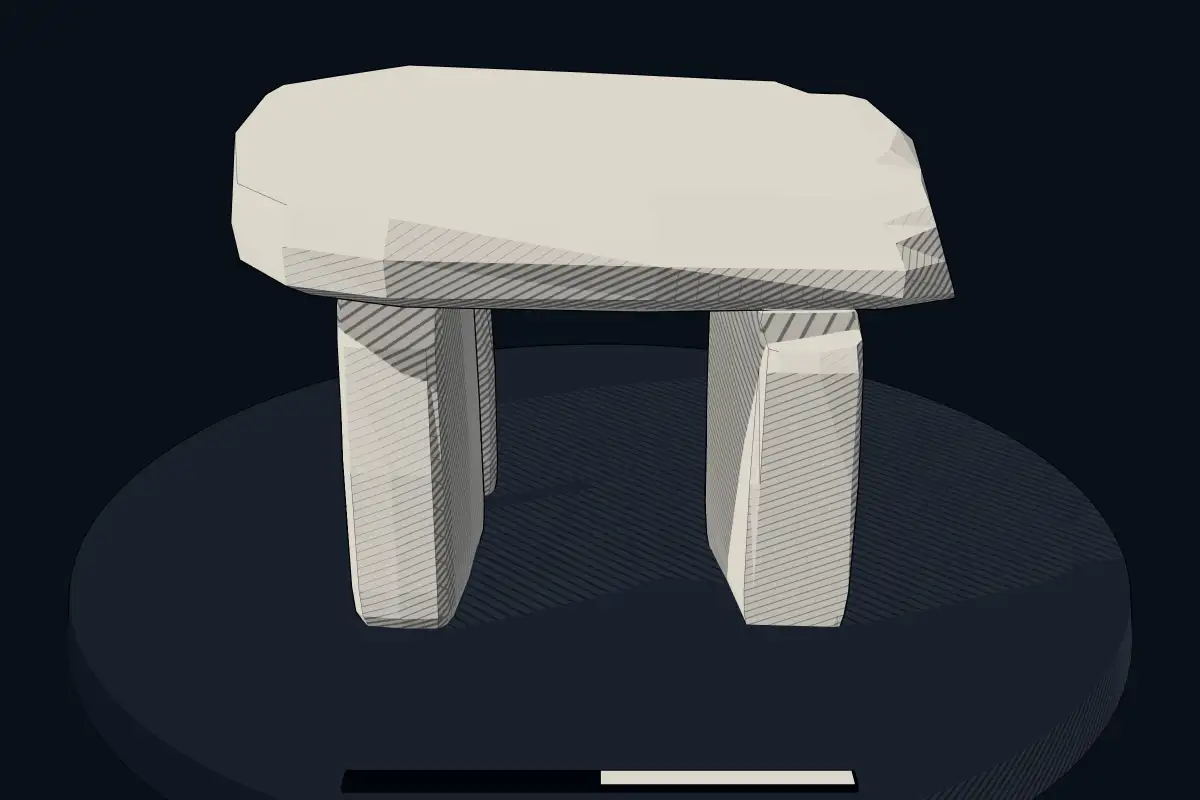
The reconstruction is ours, not a survey: it shows what a monument of this type looks like, at the size the record gives for this one.
Photographs
1 photograph, each with its author and licence
Lore
Evidence & Lore
What the sources actually support — and, kept apart, what has been claimed.
What the evidence supports
Dates
Est. 4000–3000 BCEHow this date was established: Type comparisonTypical range for dolmens in France; this site has not been dated itself. Most dolmens date from the Late Neolithic period (4000-3000 BCE).Source for this date
Where it stands
France
The pin marks the monument itself — its exact point.
- Coordinates
- 43°58′34″ N, 3°53′32″ EFor a GPS or map app: 43.97611, 3.89222
Access is as our sources describe it; we have not visited the site to check.
Nearby
The closest sites in the Atlas, by straight line.
 Rascassols dolmen4000–3000 BCE
Photo: The original uploader was Hugo.soria at French Wikipedia . · CC BY-SA 3.0
 Menhir de Rieu Massel2800–1800 BCE
 Dolmen de Ferrières4000–3000 BCE
- DolmenCapucin dolmen4000–3000 BCE
- Dolmendolmen de Viastre
- Dolmendolmens de Saint-Pierre4000–3000 BCE
- Dolmendolmen des Feuilles I4000–3000 BCE
 Lamalou dolmen4000–3000 BCE


Sources
Every record behind this page, with the link it came from.
2 sources behind this page
- 01Wikidata Q47483169wikidata.org
- 02Source for this dateen.wikipedia.org
Image files
- Dolmen du Col de l'Aubret.jpgAnthony MorelCC BY-SA 4.0
Report a correctionWrong date, name, photograph or source? Tell us and it will be put right.
Around this place
The ten nearest sites, by compass
Credit
Text, licence and sources
Adapted from the Wikipedia article "Dolmen du col de l'Aubret" (French), licensed CC BY-SA 4.0; authors are listed in the page history. Reused under CC BY-SA 4.0. Read on Wikipedia · Edit history and authors