
Allée couverte des Grèves de Frécul
DatedEst. 4000–3000 BCE
Photo Hg marigny · CC BY-SA 3.0Source file on Wikimedia Commons

Overview
About this site
What the sources say
L'allée couverte des Grèves de Frécul était initialement située à Barbuise, avant d'être déplacée dans la cour du musée Saint-Loup à Troyes.
Article in FrenchRead on Wikipedia5 min readCC BY-SA 4.0
Where it sits in time
The site's dated range, placed against world reference points.
The scale is logarithmic: each step to the left is about ten times older than the last.
The full article
Allée couverte des Grèves de Frécul: the whole story
In briefSources for this section
Sources for this section
The Allée couverte des Grèves de Frécul is a dolmen in France, dated by typological estimate to 4000 BCE to 3000 BCE. It originally stood at Barbuise, about 3,5 km south-south-west of the town, in the bois du Charnier, near the farm of Frécul. It is now in the courtyard of the musée Saint-Loup at Troyes.
The monument was a north-south passage linking a burial chamber to the largest of the dolmens of Frécul. It includes seven orthostates, three covering slabs and four smaller slabs at the chamber entrance. The chamber measures 4,40 m long, 1,55 m wide and 1,25 m high.
The allée was excavated in place in 1864 and moved in 1874 to the courtyard of the musée Saint-Loup so that stone quarrying would not destroy it. Finds included flint tools, a black rock adze, the butt of a green stone axe, animal bones, a shell and pottery sherds linked to the Seine-Oise-Marne culture and the Bronze Age. Two vessels are known from drawings but have disappeared.
The monument was registered as a historic monument in 1993. The surrounding plain of the Seine was heavily occupied in the Neolithic and the Bronze Age, with burials, enclosures, settlements and other monuments recorded at nearby sites. Monuments of this kind in France often date to the Late Neolithic, about 4000 to 3000 BCE, and many were covered with earth or smaller stones to form a mound.
No English Wikipedia article exists for it; the full text below is the French article "Allée couverte des Grèves de Frécul", shown in the original language.
Summary in EnglishSources for this section
Sources for this section
Allée couverte des Grèves de Frécul is a dolmen in Barbuise, France. A typological estimate: 4000 BCE to 3000 BCE. No English Wikipedia article exists for it; the full text below is the French article "Allée couverte des Grèves de Frécul", shown in the original language.
LocalisationSources for this section
Sources for this section
À l'origine, l'allée couverte était située 100 m au nord du dolmen des Grèves de Frécul, à l'est de la ferme de Frécul (sur la commune de La Saulsotte, à environ 3,5 km à l'est du bourg) mais dans le bois du Charnier (sur la commune de Barbuise, à environ 3,5 km sud-sud-ouest du bourg).
Les environs immédiats, dans cette plaine alluviale de la Seine, ont été largement occupés au Néolithique et à l'âge du bronze :
les Gargoulottes, sur La Saulsotte et sur Barbuise (bâtiments, monuments de type Passy et sépultures du Néolithique moyen, sépultures et enclos du Bronze final) ;
Frécul, sur Barbuise (sépultures et enceintes néolithiques) ;
la Ferme du Frécul, sur La Saulsotte (sépulture collective, dolmen de La Saulsotte détruit en 1936 ;
l'Érable, sur Barbuise (enceinte Cerny, habitats et enclos du Bronze final-Hallstatt ancien, occupation de La Tène moyenne-Augustéen, parcellaire antique) ;
les Grèves de Frécul, sur Barbuise (sépultures, dolmen) ;
des bâtiments du Néolithique final entre la ferme du Frécul et les Gargoulottes ;
les Grèves de la Villeneuve (enclos du Bronze final IIIb), Barbuise-Courtavant, fouillés par Jacques Piette...
Le territoire de La Saulsotte inclut au moins 12 monuments et celui de Barbuise au moins 4 - quoique de localisation très
incertaine pour la majorité d'entre eux.
Historique, descriptionSources for this section
Sources for this section
L'allée est fouillée in situ en 1864. Orientée nord/sud dans sa longueur, elle reliait une chambre sépulcrale au plus grand des dolmens de Frécul. L'allée comporte sept orthostates, trois tables de couverture et quatre dalles plus petites à l'entrée de la chambre. La chambre ainsi délimitée mesure 4,40 m de longueur sur 1,55 m de largeur et 1,25 m de hauteur.
Elle est déplacée en 1874 dans la cour du musée Saint-Loup pour éviter sa destruction par les carriers.
MobilierSources for this section
Sources for this section
Selon Philippe Salmon, l'édifice contenait de nombreux ossements entassés sans ordre particulier. Le mobilier archéologique retrouvé se compose d'outils en silex (3 lames dont une de 12 cm de long, 2 fragments de haches polies), d'une herminette en roche noire, d'un talon de hache en roche verte, d'ossements d'animaux (os de gallinacé, dent de bœuf), d'un coquillage et de tessons de poteries rattachées à la culture Seine-Oise-Marne et à l'âge du bronze. Deux vases, dont un du style pot-de-fleur, sont connus par des dessins mais sont aujourd'hui disparus.
ProtectionSources for this section
Sources for this section
L'édifice est inscrit au titre des monuments historiques en 1993.
AnnexesSources for this section
Sources for this section
Articles connexes
Sites mégalithiques de l'Aube
Liste des monuments historiques de l'Aube
Bibliographie
: document utilisé comme source pour la rédaction de cet article.
Anne Augereau (préf. Didier Binder), chap. 1.3.3.2 « Cadre général de l'étude et état de la documentation — Barbuise-Courtavant/ Les Grèves de Frécul (Aube) », dans L’industrie du silex du Ve au IVe millénaire dans le sud-est du Bassin parisien (Première partie. Cadres et problématiques, matériaux et méthodes), Paris, éd. de la Maison des sciences de l'homme, 2004, 213 p. (lire en ligne), p. 19-57.
Gautier Basset, « Approche spatiale des sépultures collectives néolithiques en Champagne : l'exemple de Barbuise (Aube) et La Saulsotte (Aube) » ((Drac Grand Est, Sra) Université de Bordeaux, PACEA, UMR 5199), Journée archéologique champenoise, 2017, p. 49-52 (lire en ligne [PDF], consulté en mai 2023). .
D. Jourdain, « A la découverte des mégalithes... », dans A la découverte des mégalithes de l'Aube - dolmens-menhirs et polissoirs, éd. des musées de Troyes et de l'ARPEPP, 1990, 103 p. (ISBN 2-901635-15 (édité erroné), BNF 35094982), p. 82. .
How this page was madeSources for this section
Sources for this section
The summary at the top of this page was written by MiniMax-M3 (2026-11-08) from the cited Wikipedia article “Allée couverte des Grèves de Frécul”, translated from French. The numbers in it were checked automatically against the source text. The rest of the page is the article itself, the structured records and computed distances.
Tradition and region
About this kind of monument
French dolmens
France is the dolmen country of Europe: the Dolmen de Bagneux at Saumur is the largest of some 4,500 dolmens scattered across 60 French departments, and one of the largest in Europe. A dolmen is a single-chamber megalithic tomb with two or more upright stones carrying a great capstone. Most date to the Late Neolithic, about 4000 to 3000 BCE, and many were covered with earth or smaller stones to form a mound.
Some of the oldest megalithic monuments in Europe are in western France. The Cairn of Barnenez in Finistère dates to the early Neolithic, around 4000 BCE, and with the Tumulus of Bougon and the Locmariaquer megaliths it is among the earliest megalithic monuments in Europe; it also has megalithic art. La Roche-aux-Fées near Essé in Ille-et-Vilaine is a covered corridor about 20 metres long, built of some 48 blocks, the heaviest around 45 tonnes, and divided into two chambers. It is thought to date from 3000 to 2500 BCE, and its entrance is aligned on sunrise at the winter solstice.
Folklore: the name of La Roche-aux-Fées, "the fairies' rock", comes from a legend that fairies placed the stones. Such stories are traditions about the monuments, not evidence of how they were built.
Because the Atlas draws on national inventories, its French records include many small and ruined dolmens, often reduced to a capstone resting on a few supports. Dates rest on the typology of the monument and, where a dolmen has been excavated, on radiocarbon dating of material from the chamber.
When visiting, look for the capstone and its supports, for the low rise of the old mound around the stones, and for the direction in which the entrance faces.
Paraphrased from Wikipedia: Dolmen, Wikipedia: Dolmen de Bagneux, Wikipedia: La Roche-aux-Fées, Wikipedia: Barnenez, Wikipedia: Carnac stones · CC BY-SA 4.0
From the article
Dated moments in the story
- 1864
L'allée est fouillée in situ en 1864. Orientée nord/sud dans sa longueur, elle reliait une chambre sépulcrale au plus grand des dolmens de Frécul.
Source - 1874
Elle est déplacée en 1874 dans la cour du musée Saint-Loup pour éviter sa destruction par les carriers.
Source - 1990
Jourdain, « A la découverte des mégalithes... », dans A la découverte des mégalithes de l'Aube - dolmens-menhirs et polissoirs, éd. des musées de Troyes et de l'ARPEPP, 1990, 103 p.
Source - 1993
L'édifice est inscrit au titre des monuments historiques en 1993.
Source - 2004
Cadres et problématiques, matériaux et méthodes), Paris, éd. de la Maison des sciences de l'homme, 2004, 213 p. (lire en ligne), p.
Source - 2017
19-57. Gautier Basset, « Approche spatiale des sépultures collectives néolithiques en Champagne : l'exemple de Barbuise (Aube) et La Saulsotte (Aube) » ((Drac Grand Est, Sra) Université de Bordeaux, PACEA, UMR 5199), Journée archéologique champenoise, 2017, p.
Source - 2023
49-52 (lire en ligne [PDF], consulté en mai 2023). .
Source
See it in 3D
An interpretive reconstruction of the monument, standing on the real ground at its exact point, under the sun for that place and season. Drag to look around it.
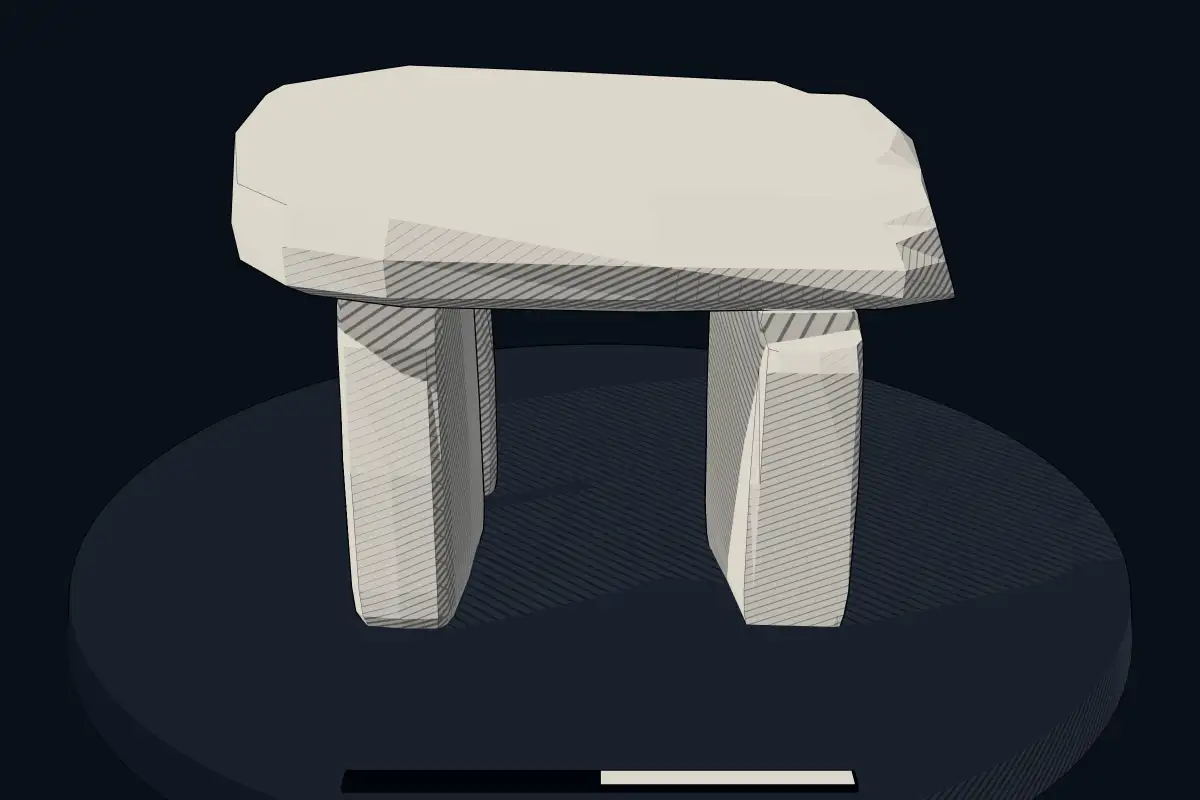
The reconstruction is ours, not a survey: it shows what a monument of this type looks like, at the size the record gives for this one.
Photographs
5 photographs, each with its author and licence
More photographs


Lore
Evidence & Lore
What the sources actually support — and, kept apart, what has been claimed.
What the evidence supports
Dates
Est. 4000–3000 BCEHow this date was established: Type comparisonTypical range for dolmens in France; this site has not been dated itself. Most dolmens date from the Late Neolithic period (4000-3000 BCE).Source for this date
Where it stands
France
The pin marks the monument itself — its exact point.
- Coordinates
- 48°18′03″ N, 4°04′49″ EFor a GPS or map app: 48.30080, 4.08015
Access is as our sources describe it; we have not visited the site to check.
Nearby
The closest sites in the Atlas, by straight line.
 Tombelle d'Aulnay5000–3000 BCE
Photo: G.Garitan pour le versement et les modifications · Public domain
- Megalithpierres du Four gaulois et du Réservoir4500–3300 BCE
 Dolmens de la Pierre Couverte4000–3000 BCE
 Pierre Couverte4000–3000 BCE
 Menhir de la Pierre à l'Abbé2800–1800 BCE
 Tumulus de Baudement5000–3000 BCE
 Pierre-au-Coq2800–1800 BCE
 Pierre-au-Coq2800–1800 BCE


Sources
Every record behind this page, with the link it came from.
2 sources behind this page
- 01Wikidata Q3034125wikidata.org
- 02Source for this dateen.wikipedia.org
Image files
Report a correctionWrong date, name, photograph or source? Tell us and it will be put right.
Around this place
The ten nearest sites, by compass
Credit
Text, licence and sources
Text from the Wikipedia article "Allée couverte des Grèves de Frécul" (French), licensed CC BY-SA 4.0; authors are listed in the page history. Reused under CC BY-SA 4.0. Read on Wikipedia · Edit history and authors