mámoas do Chan da Cruz
DatedEst. 4000–3000 BCE
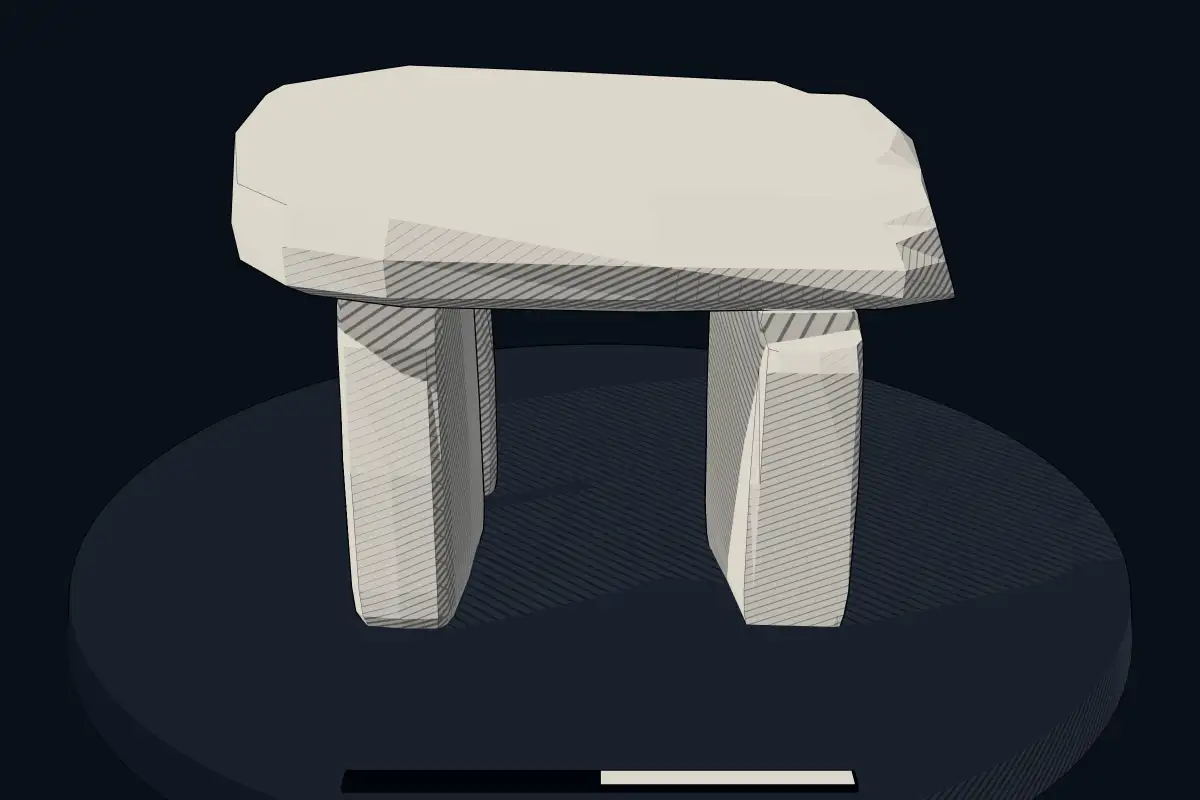
No licensed photograph yetWe have no photograph we may publish for this site, so the interpretive 3D view leads instead.
Overview
About this site
What the sources say
As mámoas do Chan da Cruz son unha necrópole megalítica composta por seis mámoas, situada no concello de Vilaboa, a uns 234 metros sobre o nivel do mar. Realizáronse tres campañas arqueolóxicas en 1972, 1982 e 1983, da man do Museo de Pontevedra.
Article in GalicianRead on Wikipedia4 min readCC BY-SA 4.0
Where it sits in time
The site's dated range, placed against world reference points.
The scale is logarithmic: each step to the left is about ten times older than the last.
The full article
mámoas do Chan da Cruz: the whole story
In briefSources for this section
- Wikipedia (Galician): Mámoas do Chan da CruzCC BY-SA 4.0
Sources for this section
- Wikipedia (Galician): Mámoas do Chan da CruzCC BY-SA 4.0
The mámoas do Chan da Cruz are a megalithic necropolis of six mámoas in the municipality of Vilaboa, Spain, at about 234 metres above sea level. The site is a group of burial mounds, with some of the mounds preserving their central structures and others showing damage from later disturbance.
The mounds stand on a low hill with a gentle slope and granite outcrops at its summit. Beneath the largest mound, natural schist outcrops were used to make the monument’s base. Two mounds in the highest area remain in the best condition, while two have central areas opened to the outside, probably when their dolmen stones were removed. One mound is almost gone because of deliberate breakage for eucalyptus planting, and another was crossed by gullies or paths, although its centre remains held in place by a tree.
Archaeological campaigns were carried out in 1972, 1982 and 1983 by the Museo de Pontevedra. The first was an emergency excavation of a mound with a circular looting crater nearly three and a half metres across and forty centimetres deep. Finds included eight arrowheads, a polished axe, a polishing stone, a quern handle, two harness fittings and three pottery fragments. The 1972 mound stood 80 centimetres high; later campaigns identified six mounds in total.
The mámoas do Chan da Cruz are generally dated between 4000 BCE and 3000 BCE by typological estimate. Ramón Sobrino Lorenzo-Ruza recorded one mound in 1950, and Alfredo García Alén later identified eight. The site has been investigated across three campaigns, but the pack gives no further information about its original builders, burial practices or specific traditional names.
No English Wikipedia article exists for it; the full text below is the Galician article "Mámoas do Chan da Cruz", shown in the original language.
Summary in EnglishSources for this section
- Wikipedia (Galician): Mámoas do Chan da CruzCC BY-SA 4.0
Sources for this section
- Wikipedia (Galician): Mámoas do Chan da CruzCC BY-SA 4.0
mámoas do Chan da Cruz is a dolmen in Vilaboa, Vilaboa, Spain. A typological estimate: 4000 BCE to 3000 BCE. No English Wikipedia article exists for it; the full text below is the Galician article "Mámoas do Chan da Cruz", shown in the original language.
Campañas arqueolóxicasSources for this section
- Wikipedia (Galician): Mámoas do Chan da CruzCC BY-SA 4.0
Sources for this section
- Wikipedia (Galician): Mámoas do Chan da CruzCC BY-SA 4.0
A primeira referencia é de Ramón Sobrino Lorenzo-Ruza, que en 1950 estudou e excavou en diversos lugares do Morrazo. Catalogou unha mámoa, situada na marxe esquerda da estrada que conduce ao CIR de Figueirido. Posteriormente, Alfredo García Alén atopou un total de oito.
En 1972 realizouse unha escavación de urxencia sobre unha mámoa, centrándose no cráter de espolio. As campañas posteriores exploraron o resto da mámoa.
Campaña de 1972
Atopáronse catro mámoas, situadas nun outeiro de pendente suave, na que non se apreciaban aflloracións graníticas, agás no cumio. A superficie estaba inzada de pequenos fragmentos de cuarzo. Excavouse a mámoa que estaba en mellor estado de conservación, que presentaba no centro un cráter circular feito por espoliadores, de case tres metros e medio de diámetro, corenta centímetros de fondo. A altura do túmulo é de 80 centímetros.
No mesmo lugar atopouse un enxoval consistente en oito puntas de frecha, un machado pulimentado, un pulidoiro, unha man de muíño, dúas albardas e tres fragmentos cerámicos.
Campañas de 1982 e 1983
Durantes estas campañas atopáronse un total de seis mámoas, dúas máis que na escavación do 1972. Os seusi túmulos presentaban mostras claras de saqueos pero diferenciábanse no dano que estes provocaron na súa estrutura.
Dous dos túmulos, os situados na zona máis alta, son os que se conservan en mellores condicións. O outeiro onde se atopa o maior deles presenta forma arredondada con pendente suave. No cumio existen existen afloramentos graníticos, mentres que no chan natural, baixo o túmulo, observáronse afloramentos de esquistos, que foron utilizados para a elaboración do chan base do monumento.
Hai outros dous túmulos coa zona central desfeita e comunicada ao exterior mediante unha gabia, indicio probábel de extracción das pedras que constituían os dólmens.
A quinta das mámoas está case desaparecida polo efecto das roturacións efectuadas para a plantación de eucaliptos.
A sexta das mámoas perdeu varias partes da súa masa tumularia ao ser cruzada por varios regos ou camiños. Este túmulo conserva a zona central retida por unha árbore.
Véxase taménSources for this section
- Wikipedia (Galician): Mámoas do Chan da CruzCC BY-SA 4.0
Sources for this section
- Wikipedia (Galician): Mámoas do Chan da CruzCC BY-SA 4.0
Ligazóns externas
Mámoa de Chan da Cruz 1 na páxina web colaborativa Patrimonio Galego.
Mámoa de Chan da Cruz 2 na páxina web colaborativa Patrimonio Galego.
How this page was madeSources for this section
- Wikipedia (Galician): Mámoas do Chan da CruzCC BY-SA 4.0
Sources for this section
- Wikipedia (Galician): Mámoas do Chan da CruzCC BY-SA 4.0
The summary at the top of this page was written by MiniMax-M3 (2026-11-07) from the cited Wikipedia article “Mámoas do Chan da Cruz”, translated from Galician. The numbers in it were checked automatically against the source text. The rest of the page is the article itself, the structured records and computed distances.
Tradition and region
About this kind of monument
Dolmens of Andalusia, Extremadura and Galicia
Spain has a great many megalithic tombs, and the Atlas's Spanish dolmens run from Andalusia in the south to Galicia in the north-west. The finest are at Antequera in Andalusia, where the Dolmen of Menga, dated to about 3750 to 3650 BCE, is among the largest ancient megalithic structures in Europe. It is 27.5 metres long, 6 metres wide and 3.5 metres high, built with thirty-two megaliths, the largest weighing about 180 tonnes. After the chamber was finished it was covered with soil and built up into the hill seen today; when it was opened in the nineteenth century archaeologists found the skeletons of several hundred people. The Dolmen of Viera stands 70 metres away, and the tholos of El Romeral lies about 4 kilometres off; the three were inscribed as the Antequera Dolmens Site, a UNESCO World Heritage Site, in 2016.
In the south-west, the Dolmen de Soto at Trigueros in Huelva province is a Neolithic tomb estimated to date between 3000 and 2500 BCE, one of about 200 Neolithic burial sites in the province. It was found in 1922 when its owner, Armando de Soto Morillas, wanted to build a house; the German archaeologist Hugo Obermaier found eight bodies in a fetal position with artefacts, and its engraved and painted uprights have been studied more recently.
In Galicia and Portugal a dolmen is an anta, and in Catalan-speaking areas dolmens have folk names such as cova (cave), caixa (crate or coffin), taula (table) and arca (chest). These names are tradition: they record what people made of the monuments, not what they were built for.
When visiting Menga, look at the great capstones from inside the corridor, and at the way the mound was built up over the chamber.
Paraphrased from Wikipedia: Dolmen of Menga, Wikipedia: Dolmen of Viera, Wikipedia: Antequera Dolmens Site, Wikipedia: Dolmen de Soto, Wikipedia: Dolmen · CC BY-SA 4.0
From the article
Dated moments in the story
- 1950
A primeira referencia é de Ramón Sobrino Lorenzo-Ruza, que en 1950 estudou e excavou en diversos lugares do Morrazo.
Source - 1972
Realizáronse tres campañas arqueolóxicas en 1972, 1982 e 1983, da man do Museo de Pontevedra.
Source - 1972
En 1972 realizouse unha escavación de urxencia sobre unha mámoa, centrándose no cráter de espolio.
Source
See it in 3D
An interpretive reconstruction of the monument, standing on the real ground at its exact point, under the sun for that place and season. Drag to look around it.
The reconstruction is ours, not a survey: it shows what a monument of this type looks like, at the size the record gives for this one.
Lore
Evidence & Lore
What the sources actually support — and, kept apart, what has been claimed.
What the evidence supports
Dates
Est. 4000–3000 BCEHow this date was established: Type comparisonTypical range for dolmens in Spain; this site has not been dated itself. Most dolmens date from the Late Neolithic period (4000-3000 BCE); the Dolmen of Menga in Andalusia dates to about 3750-3650 BCE.Source for this date
Where it stands
Spain
The pin marks the monument itself — its exact point.
- Coordinates
- 42°27′02″ N, 8°44′39″ WFor a GPS or map app: 42.45048, -8.74427
Access is as our sources describe it; we have not visited the site to check.
Nearby
The closest sites in the Atlas, by straight line.
 Mámoa de Pedralonga4000–3000 BCE
 Mámoa do Rei da Chan de Castiñeiras4000–3000 BCE
 Chan de Armada4300–1200 BCE
 Chan da Arquiña4000–3000 BCE
Photo: José Antonio Gil Martínez from Vigo, Spain · CC BY 2.0
 Lapa de Gargantáns3000–2000 BCE
Photo: Lameiro at Galician Wikipedia ( Original text: ) · Public domain
 Mámoa do Rei4000–3000 BCE
Photo: José Antonio Gil Martínez from Vigo, Spain · CC BY 2.0
- DolmenFreiría Coast Mound4000–3000 BCE
 Dolmen a Casa dos Mouros4000–3000 BCE


Sources
Every record behind this page, with the link it came from.
2 sources behind this page
- 01Wikidata Q133756426wikidata.org
- 02Source for this dateen.wikipedia.org
Report a correctionWrong date, name, photograph or source? Tell us and it will be put right.
Around this place
The ten nearest sites, by compass
Credit
Text, licence and sources
Text from the Wikipedia article "Mámoas do Chan da Cruz" (Galician), licensed CC BY-SA 4.0; authors are listed in the page history. Reused under CC BY-SA 4.0. Read on Wikipedia · Edit history and authors