
Mámoa do Rei da Chan de Castiñeiras
DatedEst. 4000–3000 BCE
Photo Noelia Infante · Public domainSource file on Wikimedia Commons

Overview
About this site
Overview
The Mámoa do Rei, also known as Chan de Castiñeiras 1, is a dolmen in the municipality of Vilaboa, in the province of Pontevedra, Galicia, Spain. The catalogue gives a typological estimate of 4000 to 3000 BCE.
The word mámoa is used in the north-west of the Iberian Peninsula for the funerary tumuli characteristic of the Neolithic. This is the largest monument of the Chan de Castiñeiras group, and it was excavated in 1975 and restored between 2001 and 2003.
Read on Wikipedia2 min readCC BY-SA 4.0
Where it sits in time
The site's dated range, placed against world reference points.
The scale is logarithmic: each step to the left is about ten times older than the last.
Article
Mámoa do Rei da Chan de Castiñeiras
The monument belongs to the Conjunto megalítico de Chan de Castiñeiras and stands near Lake Castiñeiras.
DescriptionSources for this section
- Wikipedia (French): Mámoa do Rei (Vilaboa)CC BY-SA 4.0
Sources for this section
- Wikipedia (French): Mámoa do Rei (Vilaboa)CC BY-SA 4.0
The monument belongs to the Conjunto megalítico de Chan de Castiñeiras and stands near Lake Castiñeiras. The tumulus measures about 26 m in diameter and contains a polygonal funerary chamber of 14 orthostates covered by 4 slabs. A small access passage contains engravings and traces of polychromy. Outside the mound lie the remains of a peripheral ring of stones that delimits the tumulus.
It is the largest monument of the Chan de Castiñeiras complex, which also includes six other dolmens and two cists.
ExcavationsSources for this section
- Wikipedia (French): Mámoa do Rei (Vilaboa)CC BY-SA 4.0
Sources for this section
- Wikipedia (French): Mámoa do Rei (Vilaboa)CC BY-SA 4.0
The site was excavated in 1975 by a team directed by Ramón Sobrino Lorenzo-Ruza. Between 2001 and 2003 works were carried out to enhance the monument, comprising a trial trench, an excavation and a complete reconstruction of the dolmen inside the tumulus.
FindsSources for this section
- Wikipedia (French): Mámoa do Rei (Vilaboa)CC BY-SA 4.0
Sources for this section
- Wikipedia (French): Mámoa do Rei (Vilaboa)CC BY-SA 4.0
A large quantity of material was recovered, including pottery fragments, flint arrowheads and a flint knife, and rock crystals.
ConservationSources for this section
- Wikipedia (French): Mámoa do Rei (Vilaboa)CC BY-SA 4.0
Sources for this section
- Wikipedia (French): Mámoa do Rei (Vilaboa)CC BY-SA 4.0
The monument was declared a Bien de Interés Cultural in 2011, under the code GA36058007.
Tradition and region
About this kind of monument
Dolmens of Andalusia, Extremadura and Galicia
Spain has a great many megalithic tombs, and the Atlas's Spanish dolmens run from Andalusia in the south to Galicia in the north-west. The finest are at Antequera in Andalusia, where the Dolmen of Menga, dated to about 3750 to 3650 BCE, is among the largest ancient megalithic structures in Europe. It is 27.5 metres long, 6 metres wide and 3.5 metres high, built with thirty-two megaliths, the largest weighing about 180 tonnes. After the chamber was finished it was covered with soil and built up into the hill seen today; when it was opened in the nineteenth century archaeologists found the skeletons of several hundred people. The Dolmen of Viera stands 70 metres away, and the tholos of El Romeral lies about 4 kilometres off; the three were inscribed as the Antequera Dolmens Site, a UNESCO World Heritage Site, in 2016.
In the south-west, the Dolmen de Soto at Trigueros in Huelva province is a Neolithic tomb estimated to date between 3000 and 2500 BCE, one of about 200 Neolithic burial sites in the province. It was found in 1922 when its owner, Armando de Soto Morillas, wanted to build a house; the German archaeologist Hugo Obermaier found eight bodies in a fetal position with artefacts, and its engraved and painted uprights have been studied more recently.
In Galicia and Portugal a dolmen is an anta, and in Catalan-speaking areas dolmens have folk names such as cova (cave), caixa (crate or coffin), taula (table) and arca (chest). These names are tradition: they record what people made of the monuments, not what they were built for.
When visiting Menga, look at the great capstones from inside the corridor, and at the way the mound was built up over the chamber.
Paraphrased from Wikipedia: Dolmen of Menga, Wikipedia: Dolmen of Viera, Wikipedia: Antequera Dolmens Site, Wikipedia: Dolmen de Soto, Wikipedia: Dolmen · CC BY-SA 4.0
From the article
Dated moments in the story
- 1975
Il a été fouillé en 1975 par une équipe sous la direction de Ramón Sobrino Lorenzo-Ruza (ga).
Source - 2001
Entre 2001 et 2003, des travaux de mise en valeur ont été réalisés, comprenant : un sondage, une fouille et une reconstruction complète du dolmen intratumulaire.
Source - 2011
Il a été déclaré Bien d'intérêt culturel en 2011 sous le code GA36058007 .
Source
See it in 3D
An interpretive reconstruction of the monument, standing on the real ground at its exact point, under the sun for that place and season. Drag to look around it.
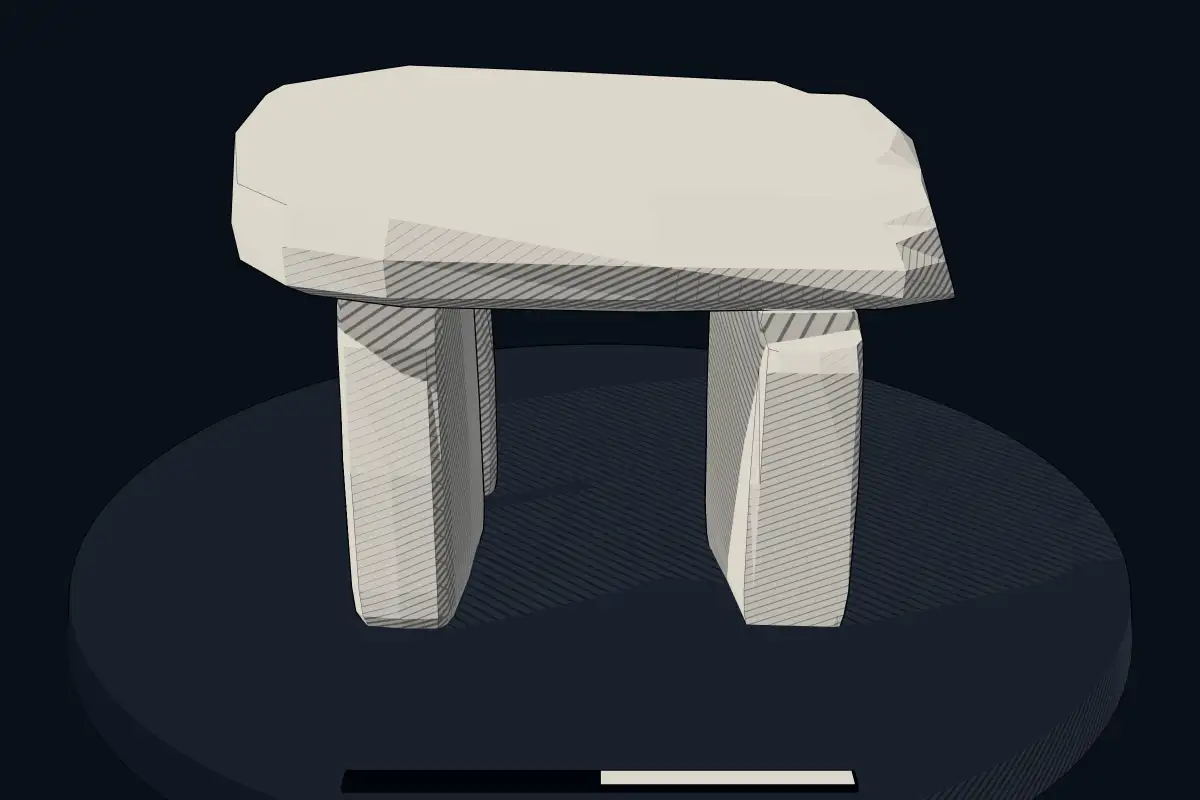
The reconstruction is ours, not a survey: it shows what a monument of this type looks like, at the size the record gives for this one.
Photographs
3 photographs, each with its author and licence
More photographs


Lore
Evidence & Lore
What the sources actually support — and, kept apart, what has been claimed.
What the evidence supports
Dates
Est. 4000–3000 BCEHow this date was established: Type comparisonTypical range for dolmens in Spain; this site has not been dated itself. Most dolmens date from the Late Neolithic period (4000-3000 BCE); the Dolmen of Menga in Andalusia dates to about 3750-3650 BCE.Source for this date
Where it stands
Spain
The pin marks the monument itself — its exact point.
- Coordinates
- 42°21′30″ N, 8°40′22″ WFor a GPS or map app: 42.35832, -8.67268
Access is as our sources describe it; we have not visited the site to check.
Nearby
The closest sites in the Atlas, by straight line.
 Mámoa de Pedralonga4000–3000 BCE
 Chan de Armada4300–1200 BCE
 Chan da Arquiña4000–3000 BCE
Photo: José Antonio Gil Martínez from Vigo, Spain · CC BY 2.0
 Mámoa do Rei4000–3000 BCE
Photo: José Antonio Gil Martínez from Vigo, Spain · CC BY 2.0
- Dolmenmámoas do Chan da Cruz4000–3000 BCE
- DolmenFreiría Coast Mound4000–3000 BCE
 Dolmen a Casa dos Mouros4000–3000 BCE
 miliario de Santiaguiño de Antas


Sources
Every record behind this page, with the link it came from.
2 sources behind this page
- 01Wikidata Q50689201wikidata.org
- 02Source for this dateen.wikipedia.org
Image files
- Chan de Castiñeiras I.jpgNoelia InfantePublic domain
- Mámoa do Rei, Vilaboa 01.jpgBene RiobóCC BY-SA 4.0
- Mámoa do Rei, Vilaboa 02.jpgBene RiobóCC BY-SA 4.0
Report a correctionWrong date, name, photograph or source? Tell us and it will be put right.
Around this place
The ten nearest sites, by compass
Credit
Text, licence and sources
Adapted from the Wikipedia article "Mámoa do Rei (Vilaboa)" (French), licensed CC BY-SA 4.0; authors are listed in the page history. Reused under CC BY-SA 4.0. Read on Wikipedia · Edit history and authors
- Wikipedia (French): Mámoa do Rei (Vilaboa)CC BY-SA 4.0
- Wikidata Q50689201CC0