
Overview
About this site
Overview
The Dolmen de Azután is a megalithic structure in the municipality of Azután, province of Toledo, Spain. It was the first megalithic site in the interior of the Southern Meseta to yield radiocarbon dates that placed the Middle and Late Neolithic and Chalcolithic populations of the middle Tagus basin in chronological and cultural context.
It is a chamber-and-passage tomb under a tumulus, with burials from the Middle and Late Neolithic and the Chalcolithic, and a settlement beneath the mound. It is protected as a bien de interés cultural.
Read on Wikipedia2 min readCC BY-SA 4.0
Where it sits in time
The site's dated range, placed against world reference points.
The scale is logarithmic: each step to the left is about ten times older than the last.
Article
Dolmen de Azután
The dolmen has a chamber and passage built of large orthostats with a lintelled cover, set beneath a perimeter tumulus.
DescriptionSources for this section
- Wikipedia (Spanish): Dolmen de AzutánCC BY-SA 4.0
Sources for this section
- Wikipedia (Spanish): Dolmen de AzutánCC BY-SA 4.0
The dolmen has a chamber and passage built of large orthostats with a lintelled cover, set beneath a perimeter tumulus. The funerary space was decorated throughout. Engravings include fine incisions of wavy bands and zigzags and broad engravings of geometric and anthropomorphic subjects, and some bas-relief. Paintings occur on the orthostats of the chamber, and free-standing sculptural figures (a menhir) were found in the chamber.
ExcavationsSources for this section
- Wikipedia (Spanish): Dolmen de AzutánCC BY-SA 4.0
Sources for this section
- Wikipedia (Spanish): Dolmen de AzutánCC BY-SA 4.0
Systematic excavations took place from the early 1980s until 2001, although intact archaeological deposits remain, as do the remains of a settlement beneath the dolmen mound.
DatingSources for this section
- Wikipedia (Spanish): Dolmen de AzutánCC BY-SA 4.0
Sources for this section
- Wikipedia (Spanish): Dolmen de AzutánCC BY-SA 4.0
Inhumations and collective ossuaries were deposited from the Middle to the Late Neolithic (fifth millennium BCE) and during the Chalcolithic (in its maritime Beaker phase, fourth millennium BCE). The settlement beneath the mound belongs to the sixth millennium BCE. The catalogue gives a typological estimate of 4000 to 3000 BCE.
FindsSources for this section
- Wikipedia (Spanish): Dolmen de AzutánCC BY-SA 4.0
Sources for this section
- Wikipedia (Spanish): Dolmen de AzutánCC BY-SA 4.0
The grave goods and other remains comprise abundant pottery, bone industry, chipped and polished stone tools, and some necklace beads.
SettingSources for this section
- Wikipedia (Spanish): Dolmen de AzutánCC BY-SA 4.0
Sources for this section
- Wikipedia (Spanish): Dolmen de AzutánCC BY-SA 4.0
The site is close to the river Tagus and to the streams of Linares and La Anguilucha, and is associated with underground water outcrops in the same area. Such association with watercourses, and the link between the funerary area and an underlying settlement, are among the features that make the site important.
Tradition and region
About this kind of monument
Dolmens of Andalusia, Extremadura and Galicia
Spain has a great many megalithic tombs, and the Atlas's Spanish dolmens run from Andalusia in the south to Galicia in the north-west. The finest are at Antequera in Andalusia, where the Dolmen of Menga, dated to about 3750 to 3650 BCE, is among the largest ancient megalithic structures in Europe. It is 27.5 metres long, 6 metres wide and 3.5 metres high, built with thirty-two megaliths, the largest weighing about 180 tonnes. After the chamber was finished it was covered with soil and built up into the hill seen today; when it was opened in the nineteenth century archaeologists found the skeletons of several hundred people. The Dolmen of Viera stands 70 metres away, and the tholos of El Romeral lies about 4 kilometres off; the three were inscribed as the Antequera Dolmens Site, a UNESCO World Heritage Site, in 2016.
In the south-west, the Dolmen de Soto at Trigueros in Huelva province is a Neolithic tomb estimated to date between 3000 and 2500 BCE, one of about 200 Neolithic burial sites in the province. It was found in 1922 when its owner, Armando de Soto Morillas, wanted to build a house; the German archaeologist Hugo Obermaier found eight bodies in a fetal position with artefacts, and its engraved and painted uprights have been studied more recently.
In Galicia and Portugal a dolmen is an anta, and in Catalan-speaking areas dolmens have folk names such as cova (cave), caixa (crate or coffin), taula (table) and arca (chest). These names are tradition: they record what people made of the monuments, not what they were built for.
When visiting Menga, look at the great capstones from inside the corridor, and at the way the mound was built up over the chamber.
Paraphrased from Wikipedia: Dolmen of Menga, Wikipedia: Dolmen of Viera, Wikipedia: Antequera Dolmens Site, Wikipedia: Dolmen de Soto, Wikipedia: Dolmen · CC BY-SA 4.0
From the article
Dated moments in the story
- 1980
El dolmen ha sido objeto de excavaciones sistemáticas desde principios de la década de 1980 hasta el año 2001, si bien aún conserva testigos arqueológicos intactos, así como restos de un hábitat infrayacente al túmulo dolménico.
Source
See it in 3D
An interpretive reconstruction of the monument, standing on the real ground at its exact point, under the sun for that place and season. Drag to look around it.
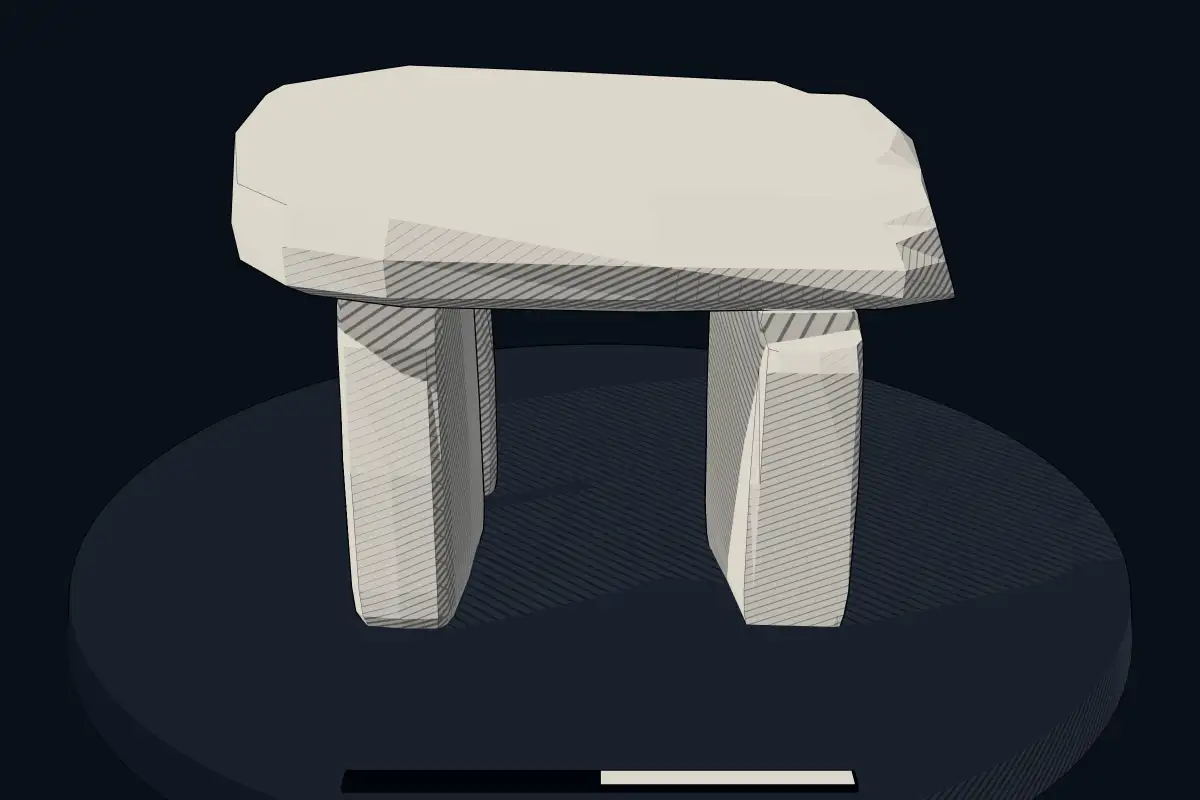
The reconstruction is ours, not a survey: it shows what a monument of this type looks like, at the size the record gives for this one.
Photographs
4 photographs, each with its author and licence
More photographs
Lore
Evidence & Lore
What the sources actually support — and, kept apart, what has been claimed.
What the evidence supports
Dates
Est. 4000–3000 BCEHow this date was established: Type comparisonTypical range for dolmens in Spain; this site has not been dated itself. Most dolmens date from the Late Neolithic period (4000-3000 BCE); the Dolmen of Menga in Andalusia dates to about 3750-3650 BCE.Source for this date
Where it stands
Spain
The pin marks the monument itself — its exact point.
- Coordinates
- 39°46′50″ N, 5°08′54″ WFor a GPS or map app: 39.78061, -5.14840
Access is as our sources describe it; we have not visited the site to check.
Nearby
The closest sites in the Atlas, by straight line.


Sources
Every record behind this page, with the link it came from.
2 sources behind this page
- 01Wikidata Q5812480wikidata.org
- 02Source for this dateen.wikipedia.org
Image files
- Dolmen de Azután 04.jpgRodelarCC BY-SA 4.0
- Dolmen de Azután 05.jpgRodelarCC BY-SA 4.0
- Dolmen de Azután (51507833323).jpgÁngel M. Felicísimo from Mérida, EspañaCC BY 2.0
- Dolmen de Azután (51508534420).jpgÁngel M. Felicísimo from Mérida, EspañaCC BY 2.0
Report a correctionWrong date, name, photograph or source? Tell us and it will be put right.
Around this place
The ten nearest sites, by compass
Credit
Text, licence and sources
Adapted from the Wikipedia article "Dolmen de Azután" (Spanish), licensed CC BY-SA 4.0; authors are listed in the page history. Reused under CC BY-SA 4.0. Read on Wikipedia · Edit history and authors
- Wikipedia (Spanish): Dolmen de AzutánCC BY-SA 4.0
- Wikidata Q5812480CC0