
Menhir (standing stone)The Bronze Age
Süntelstein
DatedEst. 2800–1800 BCE
Photo Basotxerri · CC BY-SA 4.0Source file on Wikimedia Commons
Overview
About this site
Overview
The Süntelstein, also called the Devil's Stone or Sun Stone, is a menhir in a small clearing on the Steenshöhe in the Wiehengebirge, in the Vehrte district of Belm (Osnabrücker Land), Lower Saxony, Germany. It is a granite erratic boulder about 3.7 m high, set upright by people, and is thought to belong to the Neolithic menhirs of the region.
The stone has been treated in scientific and local-history literature since the early 19th century, but it has never been excavated.
Read on Wikipedia2 min readCC BY-SA 4.0
Where it sits in time
The site's dated range, placed against world reference points.
The scale is logarithmic: each step to the left is about ten times older than the last.
Article
Süntelstein
A crack runs across the middle of the stone at half height, and a second crack runs from the top down to the first.
DescriptionSources for this section
- Wikipedia (German): SüntelsteinCC BY-SA 4.0
Sources for this section
- Wikipedia (German): SüntelsteinCC BY-SA 4.0
The boulder is about 3.7 m high, 2.6 m wide and 1.7 m thick. Its top is rounded and one side, facing south, is flat. The north side is curved and shows breakouts in its lower part. A crack runs across the middle of the stone at half height, and a second crack runs from the top down to the first. A later painting of a devil's face, following the contours and cracks of the stone, is on one side. Beneath the green algal growth and encrusted deposits the granite is dark red.
The boulder was carried from Scandinavia to the Osnabrücker Land by ice, as glacial debris, almost 200,000 years ago in the Middle Saale glaciation.
DatingSources for this section
- Wikipedia (German): SüntelsteinCC BY-SA 4.0
Sources for this section
- Wikipedia (German): SüntelsteinCC BY-SA 4.0
The elongated stone stands upright and must therefore have been raised by people. It is presumed to belong to the Neolithic menhirs found near the megalithic graves of the Osnabrücker Land, such as the Hekeser Steine. A nearby bank supports this, and a historical source of 1848 mentions a ring of smaller stones that surrounded the Süntelstein. The catalogue gives an estimated date of 2800 to 1800 BCE, based on type.
NameSources for this section
- Wikipedia (German): SüntelsteinCC BY-SA 4.0
Sources for this section
- Wikipedia (German): SüntelsteinCC BY-SA 4.0
The name Süntel now refers only to a ridge lying to the east in Lower Saxony. Formerly it seems to have been used for the whole mountain chain of the Wiehengebirge, Wesergebirge and Süntel, so that the stone would lie in the western part of the Süntel.
FolkloreSources for this section
- Wikipedia (German): SüntelsteinCC BY-SA 4.0
Sources for this section
- Wikipedia (German): SüntelsteinCC BY-SA 4.0
The stone appears in the writings of the Brothers Grimm. According to the story they record, peasants near Osnabrück say that the devil carried the stone through the air and dropped it, and they point to the place on it where the chain by which he held it was fixed. The stone projects thirteen feet out of the ground in that account.
ConservationSources for this section
- Wikipedia (German): SüntelsteinCC BY-SA 4.0
Sources for this section
- Wikipedia (German): SüntelsteinCC BY-SA 4.0
The Süntelstein is registered as a natural monument under the number ND OS 54 and as a geotope under the number 3614/15. The responsible authority is the Landkreis Osnabrück.
Tradition and region
About this kind of monument
Central and southern European menhirs
Outside the Atlantic fringe, menhirs also occur across central and southern Europe. In the Czech Republic there are about 40 real menhirs and dozens of stones that could also be menhirs, and others have been erected recently. The largest real menhir is Kamenný pastýř, the "stony shepherd", near Klobuky, 3.3 metres high; the Czech menhirs are probably the last outcrop of a tradition that ran across northern Germany. Some of the Czech stones in the Atlas may be natural boulders.
Italy has its most famous menhirs in Sardinia, where at least 332 standing stones can be seen. They include elaborate "statue-menhirs" that show a human face at the top and gendered symbols on the flat front; over a hundred of this standardised type have been found, mostly around the village of Laconi. In the Sardinian language they are called perdas fittas or perdas lungas. In Switzerland, in the canton of Vaud, several menhirs form linear patterns at Clendy in Yverdon-les-Bains, and date back to the third millennium BCE.
A statue menhir is a carved standing stone of the later European Neolithic, in which a slab or pillar has a stylised human figure cut into it, sometimes with hints of clothing or weapons. They are most commonly found in southern and western France, Catalonia, Corsica, Sardinia, Italy and the Alps.
Menhirs are usually difficult to date, and those without excavation can only be given a broad range. A stone's present position is not always its original one.
When visiting, check whether a stone stands in its original position and look for signs of shaping.
Paraphrased from Wikipedia: Menhir, Wikipedia: List of menhirs, Wikipedia: Statue menhir · CC BY-SA 4.0
From the article
Dated moments in the story
- 1848
Ein Indiz dafür ist ein in der Nähe befindlicher Wall, und in einer historischen Quelle von 1848 wird ein Kranz kleinerer Steine erwähnt, der den Süntelstein umgab.
Source
See it in 3D
An interpretive reconstruction of the monument, standing on the real ground at its exact point, under the sun for that place and season. Drag to look around it.
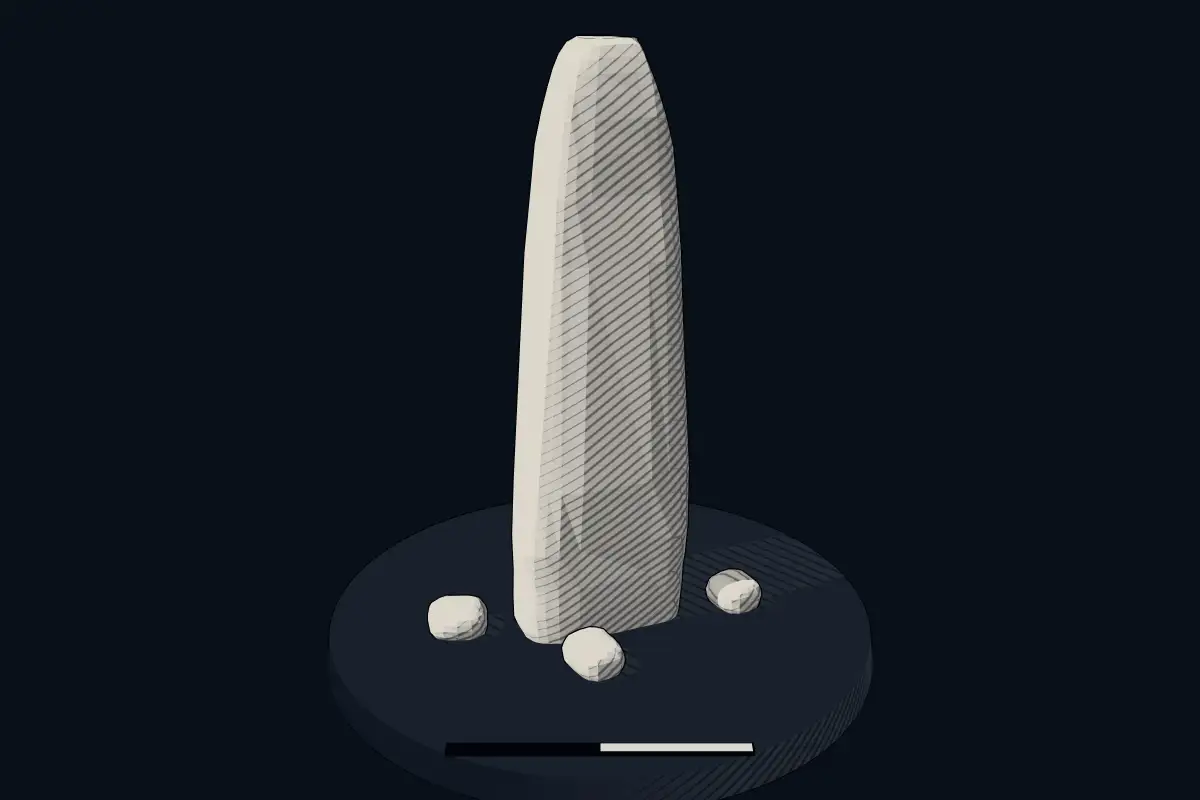
The reconstruction is ours, not a survey: it shows what a monument of this type looks like, at the size the record gives for this one.
Photographs
6 photographs, each with its author and licence
More photographs
Lore
Evidence & Lore
What the sources actually support — and, kept apart, what has been claimed.
What the evidence supports
Dates
Est. 2800–1800 BCEHow this date was established: Type comparisonTypical range for menhirs in Germany; this site has not been dated itself. Standing stones are associated with the Beaker people of the European late Neolithic and early Bronze Age c. 2800-1800 BC.Source for this date
Where it stands
Germany
The pin marks the monument itself — its exact point.
- Coordinates
- 52°21′27″ N, 8°08′57″ EFor a GPS or map app: 52.35750, 8.14905
Access is as our sources describe it; we have not visited the site to check.
Nearby
The closest sites in the Atlas, by straight line.


Sources
Every record behind this page, with the link it came from.
2 sources behind this page
- 01Wikidata Q2382182wikidata.org
- 02Source for this dateen.wikipedia.org
Image files
- Vehrte - Süntelstein -BT- 01.jpgBasotxerriCC BY-SA 4.0
- Vehrte - Süntelstein -BT- 02.jpgBasotxerriCC BY-SA 4.0
- Belm Suentelstein in Vehrte.JPGSail overCC BY-SA 3.0
- Suentelstein2.jpgMegalithicguyCC BY-SA 3.0
- NLD Süntelstein 01.jpgC. S. Fuchs, Niedersächsisches Landesamt für DenkmalpflegeCC BY-SA 4.0
- NLD Süntelstein 02.jpgC. S. Fuchs, Niedersächsisches Landesamt für DenkmalpflegeCC BY-SA 4.0
Report a correctionWrong date, name, photograph or source? Tell us and it will be put right.
Lore, kept apart
Legends and claims
These are stories and claims reported by the sources. They are not evidence, and they never stand in for the dating above.
- Tradition
„Bei Osnabrück liegt ein uralter Stein, dreizehn Fuß aus der Erde ragend, von dem die Bauern sagen, der Teufel hätte ihn durch die Luft geführt und fallen lassen.
„Bei Osnabrück liegt ein uralter Stein, dreizehn Fuß aus der Erde ragend, von dem die Bauern sagen, der Teufel hätte ihn durch die Luft geführt und fallen lassen. Sie zeigen auch die Stelle daran, in welcher die Kette gesessen, woran er ihn gehalten, nennen ihn den Süntelstein.“ Der Süntelstein ist unter der Nummer ND OS 54 als Naturdenkmal und unter der Nummer 3614/15 als Geotop registriert. Zuständige Behörde ist der Landkreis Osnabrück.
Source
Around this place
The ten nearest sites, by compass
Credit
Text, licence and sources
Adapted from the Wikipedia article "Süntelstein" (German), licensed CC BY-SA 4.0; authors are listed in the page history. Reused under CC BY-SA 4.0. Read on Wikipedia · Edit history and authors
- Wikipedia (German): SüntelsteinCC BY-SA 4.0
- Wikidata Q2382182CC0