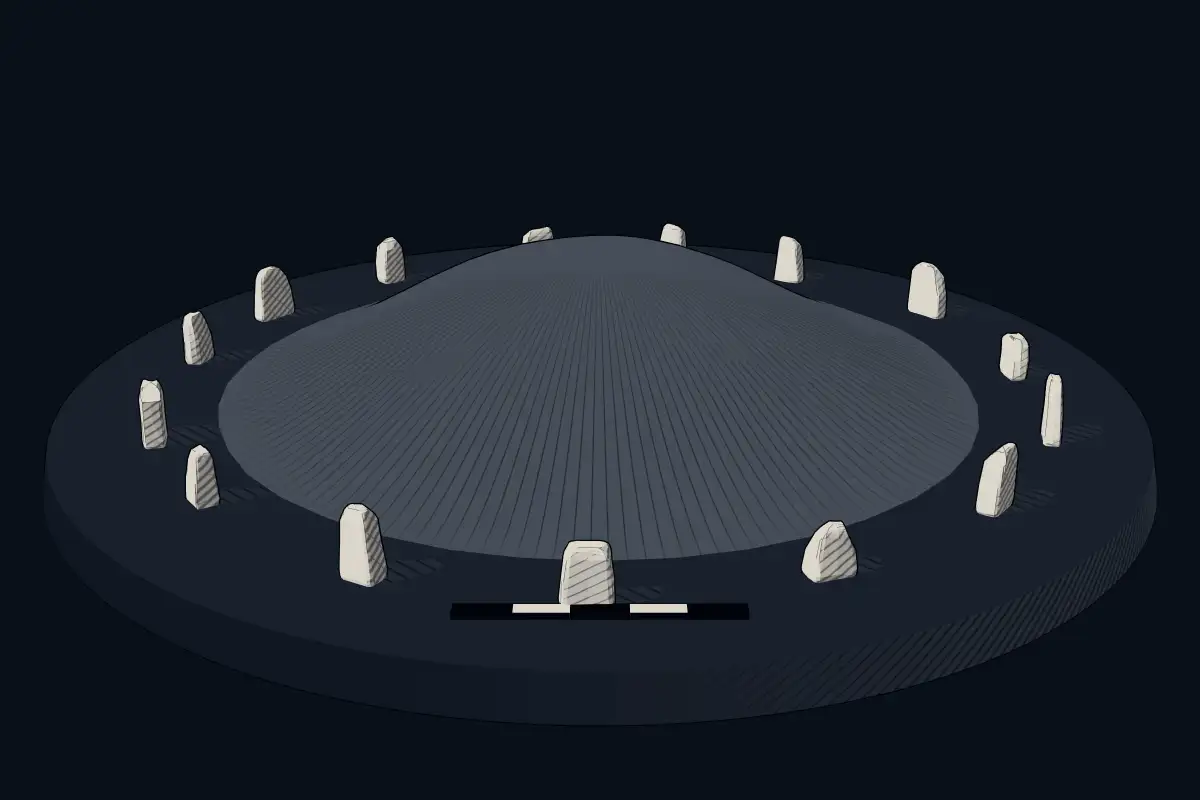
Megalithic mound (tumulus with integral stones)
Langer Berg
DatedEst. 3500–500 BCE
No licensed photograph yetWe have no photograph we may publish for this site, so the interpretive 3D view leads instead.
Overview
About this site
Overview
The Lange Berg was a burial mound, probably of the Bronze Age, at Baalberge, a district of Bernburg in the Salzlandkreis, Saxony-Anhalt, Germany. It was destroyed in the middle of the 19th century.
Some details of its structure and finds are known only because a local resident was questioned about them. The mound contained stone cists with urns holding cremated remains, together with grave goods including a bronze knife.
Read on Wikipedia3 min readCC BY-SA 4.0
Where it sits in time
The site's dated range, placed against world reference points.
The scale is logarithmic: each step to the left is about ten times older than the last.
Article
Langer Berg
Several other burial mounds originally existed in and around Baalberge, and all except the Schneiderberg were destroyed in the late 18th and 19th centuries.
SettingSources for this section
- Wikipedia (German): Langer Berg (Baalberge)CC BY-SA 4.0
Sources for this section
- Wikipedia (German): Langer Berg (Baalberge)CC BY-SA 4.0
The Lange Berg lay east of Baalberge near the post windmill. Several other burial mounds originally existed in and around Baalberge, and all except the Schneiderberg were destroyed in the late 18th and 19th centuries. The Schinderberg, near today's cemetery, was destroyed in 1793. The Evangelienberg lay between Baalberge and Bernburg, a mound at Rönitz was removed in 1794, and the Tochauer Berg near Kleinwirschleben was also destroyed.
Several preserved mounds remain in the wider area: the Stockhof mound near Gröna to the west, and the Pfingstberg, the Pohlsberg and the Spitze Hoch near Latdorf and the Fuchsberg near Weddegast to the north. Also to the north lie the three megalithic tombs Heringsberg near Grimschleben, Bierberg near Gerbitz and Steinerne Hütte near Latdorf.
Research historySources for this section
- Wikipedia (German): Langer Berg (Baalberge)CC BY-SA 4.0
Sources for this section
- Wikipedia (German): Langer Berg (Baalberge)CC BY-SA 4.0
The existence of several burial mounds at Baalberge was first recorded by Johann Christoph Bekmann in his Historie des Fürstenthums Anhalt of 1710 and in the Baalberge church chronicle of 1742.
In the middle of the 19th century the mound was transferred to a farmer, who was to use its earth to level hollows in a neighbouring field. Between 1853 and 1854 the mound was removed completely, and several stone cists came to light. The farmer kept some of the objects they contained. Paul Höfer, who took part in an excavation at the Schneiderberg in 1901, learned some details about the Lange Berg from the farmer's son and published them the following year.
A lecture published in 1896 by a school director named Fischer may also refer to the Lange Berg. It cites statements about a burial mound opened near Baalberge in 1825. Höfer supposed that this was a misprint and that 1852 was meant.
DescriptionSources for this section
- Wikipedia (German): Langer Berg (Baalberge)CC BY-SA 4.0
Sources for this section
- Wikipedia (German): Langer Berg (Baalberge)CC BY-SA 4.0
According to Adolf Reinicke, son of the farmer responsible for the removal, the mound contained about five to seven stone cists. They were made of stone slabs and were mostly painted red inside. If Fischer's lecture refers to the Lange Berg, the cists were painted white at the top, black in the middle and red only at the bottom.
FindsSources for this section
- Wikipedia (German): Langer Berg (Baalberge)CC BY-SA 4.0
Sources for this section
- Wikipedia (German): Langer Berg (Baalberge)CC BY-SA 4.0
The cists held several urns with cremated remains and some grave goods: smaller pottery vessels, a stone axe, a bronze knife and several hollow bronze arm rings. The knife and the axe were still in the family's possession in 1901 and were described in more detail by Paul Höfer. The other objects had been lost in the meantime, and after 1945 the axe could no longer be found either.
The knife has a total length of 25.3 cm. The blade ends in a shoulder from which a tang extends; the handle itself is not preserved. The blade is decorated on both sides with concentric circles, lines and rows of small arcs, and the shoulder with concentric semicircles and transverse lines. The tang was roughened to give it a better grip.
According to Höfer, the axe was made of a stone resembling greywacke. It is 21.3 cm long, 3.4 cm thick and 2 cm high.
DatingSources for this section
- Wikipedia (German): Langer Berg (Baalberge)CC BY-SA 4.0
Sources for this section
- Wikipedia (German): Langer Berg (Baalberge)CC BY-SA 4.0
The only secure indication of the date of the mound is the bronze knife. According to Höfer, it belongs to the Late Bronze Age, more precisely to period V as defined by Oscar Montelius. Whether the mound was used in several phases, and perhaps contained older Neolithic burials like the neighbouring Schneiderberg, can no longer be established.
Tradition and region
About this kind of monument
German Hügelgräber and megalithic mounds
Burial mounds are found across Germany, from the northern plain to the south. Those of the Middle Bronze Age give a whole culture its name: the Tumulus culture (Hügelgräberkultur), which was dominant in Central Europe from about 1600 to 1300 BCE and buried its dead beneath mounds. It descended from the Unetice culture and covered parts of southern Germany, the Czech Republic, Austria, Switzerland, Poland and France. Its society was a warrior society, as the weapons in the graves show. The Late Bronze Age Urnfield culture, which followed it, preferred cremation, and the Hallstatt culture of the Early Iron Age revived the great mound for chieftains.
Hallstatt-period mounds can be spectacular. The Hochdorf grave in Baden-Württemberg, of about 530 BCE, was found in 1968 and excavated in 1978 to 1979. Its mound, originally 6 metres high and about 60 metres across, had been worn down to about 1 metre. Inside lay a man of about fifty on a bronze recliner with eight wheels, wearing a gold-plated torc, with a four-wheeled wagon and drinking horns.
In the north, many mounds are older and belong to the Funnel Beaker culture, whose stone-chambered tombs are described in the articles on northern German megalithic tombs. Here a mound may cover a megalithic chamber, and the Atlas's classification sometimes cannot tell the two apart without a field visit.
Dating usually combines typology, pottery and metalwork and, where timber survives, tree-ring dating. Many mounds have been ploughed down, as Hochdorf shows.
When visiting, look for mounds in groups in woodland, where they survive best, for the hollow of an old central trench, and for kerbs of stone.
Paraphrased from Wikipedia: Tumulus culture, Wikipedia: Hallstatt culture, Wikipedia: Funnel beaker culture, Wikipedia: Tumulus, Wikipedia: Heuneburg, Wikipedia: Hochdorf Chieftain's Grave · CC BY-SA 4.0
From the article
Dated moments in the story
- 1710
Die Existenz mehrerer Grabhügel bei Baalberge wurde erstmals von Johann Christoph Bekmann in seiner 1710 erschienenen Historie des Fürstenthums Anhalt sowie in der Baalberger Kirchenchronik von 1742 überliefert.
Source - 1793
Am heutigen Friedhof lag der Schinderberg, der 1793 zerstört wurde.
Source - 1794
1794 wurde ein Grabhügel bei Rönitz abgetragen.
Source - 1825
Dieser zitiert Aussagen über einen 1825 bei Baalberge geöffneten Grabhügel.
Source - 1852
Höfer vermutete, dass es sich um einen Druckfehler handelte und eigentlich 1852 gemeint war.
Source - 1853
Zwischen 1853 und 1854 wurde der Hügel vollständig abgetragen, wobei mehrere Steinkisten zutage traten.
Source - 1896
Möglicherweise bezieht sich auch ein 1896 veröffentlichter Vortrag eines Gymnasialdirektors Fischer auf den Langen Berg.
Source - 1901
Paul Höfer, der 1901 an einer Ausgrabung am Schneiderberg teilnahm, konnte vom Sohn des Bauern einige Details zum Langen Berg erfahren, die er im folgenden Jahr publizierte.
Source - 1901
Das Messer und die Axt befanden sich 1901 noch in Familienbesitz und konnten von Paul Höfer näher beschrieben werden.
Source - 1945
Nach 1945 war auch die Axt nicht mehr auffindbar.
Source
See it in 3D
An interpretive reconstruction of the monument, standing on the real ground at its exact point, under the sun for that place and season. Drag to look around it.
The reconstruction is ours, not a survey: it shows what a monument of this type looks like, at the size the record gives for this one.
Lore
Evidence & Lore
What the sources actually support — and, kept apart, what has been claimed.
What the evidence supports
Dates
Est. 3500–500 BCEHow this date was established: Type comparisonTypical range for megalithic mounds in Germany; this site has not been dated itself. German barrows ( Hugelgraber) run from the Neolithic (construction in central and south-west Germany c. 3500 BC and northern and central Germany c. 3400 BC) to the Late Bronze and Iron Age.Source for this date
Where it stands
Germany
The pin marks the monument itself — its exact point.
- Coordinates
- 51°45′49″ N, 11°48′10″ EFor a GPS or map app: 51.76362, 11.80275
Access is as our sources describe it; we have not visited the site to check.
Nearby
The closest sites in the Atlas, by straight line.


Sources
Every record behind this page, with the link it came from.
2 sources behind this page
- 01Wikidata Q22692760wikidata.org
- 02Source for this dateen.wikipedia.org
Report a correctionWrong date, name, photograph or source? Tell us and it will be put right.
Around this place
The ten nearest sites, by compass
Credit
Text, licence and sources
Adapted from the Wikipedia article "Langer Berg (Baalberge)" (German), licensed CC BY-SA 4.0; authors are listed in the page history. Reused under CC BY-SA 4.0. Read on Wikipedia · Edit history and authors