
Menhir (standing stone)The Bronze Age
Langer Stein
DatedEst. 2800–1800 BCE
Photo Nixnubix · CC BY-SA 4.0Source file on Wikimedia Commons
Overview
About this site
Overview
The Langer Stein, described in the literature as the Menhir von Ober-Saulheim, is a standing stone near Saulheim in the district of Alzey-Worms, Rhineland-Palatinate, Germany, and a protected Kulturdenkmal. The catalogue gives a typological estimate of 2800 to 1800 BCE.
The limestone pillar is 320 cm high. It is also called Der Lange Stein and Teufelsstein, and several legends are attached to it.
Read on Wikipedia3 min readCC BY-SA 4.0
Where it sits in time
The site's dated range, placed against world reference points.
The scale is logarithmic: each step to the left is about ten times older than the last.
Article
Langer Stein
The menhir lies south of Saulheim and north-east of Wörrstadt, on the north-eastern slope of the Wörrstädter Höhe, at a car park beside the L 401.
DescriptionSources for this section
- Wikipedia (German): Menhir von Ober-SaulheimCC BY-SA 4.0
Sources for this section
- Wikipedia (German): Menhir von Ober-SaulheimCC BY-SA 4.0
The menhir lies south of Saulheim and north-east of Wörrstadt, on the north-eastern slope of the Wörrstädter Höhe, at a car park beside the L 401. A hedge surrounds it.
The stone is made of limestone. It measures 320 cm in height, 160 cm in width and 80 cm in depth. It is columnar, slightly curved and ends in a rounded point. On the north side a deep groove runs along the whole length of the stone. Seen from the west the stone looks strongly phallic, whereas the north side recalls female forms. On the south-eastern side a late Gothic niche containing an image of the Virgin Mary was chiselled in at the end of the Middle Ages.
HistorySources for this section
- Wikipedia (German): Menhir von Ober-SaulheimCC BY-SA 4.0
Sources for this section
- Wikipedia (German): Menhir von Ober-SaulheimCC BY-SA 4.0
The Long Stone served for a long time as a place of judgment. A second stone is said to have stood nearby, which was probably the base of a wooden cross. Because of its shape it was given the popular name Des Teufels Suppenschüssel (the Devil's soup tureen).
FolkloreSources for this section
- Wikipedia (German): Menhir von Ober-SaulheimCC BY-SA 4.0
Sources for this section
- Wikipedia (German): Menhir von Ober-SaulheimCC BY-SA 4.0
Several legends are told about the stone. According to the first, the Devil saw that a church was being built in Wörrstadt and hurled a stone from the Donnersberg; he aimed too far, and the stone landed between Wörrstadt and Saulheim.
A second legend holds that a rich man buried a treasure at this spot. Because the Devil wanted his soul, he placed the stone on top of it. The man could no longer reach his treasure and hanged himself from the next tree. The treasure has since been guarded by an owl, or in another variant by a dwarf. When a young man passed by, the dwarf offered him part of the treasure on condition that he afterwards commit one of the three deadly sins of drunkenness, adultery or murder. He chose drunkenness as the lesser evil, but in his intoxication also committed adultery and finally murdered the cuckolded husband who caught him.
A third legend tells of a poor woman from Wörrstadt who hid her savings on top of the stone during the French Revolutionary Wars. After the war all the money was still there.
A fourth legend is based on a real event. In 1883 an attempt was made to remove the stone, and two men were killed. Since then it has been said that the stone strikes dead anyone who tries to topple it.
Tradition and region
About this kind of monument
Central and southern European menhirs
Outside the Atlantic fringe, menhirs also occur across central and southern Europe. In the Czech Republic there are about 40 real menhirs and dozens of stones that could also be menhirs, and others have been erected recently. The largest real menhir is Kamenný pastýř, the "stony shepherd", near Klobuky, 3.3 metres high; the Czech menhirs are probably the last outcrop of a tradition that ran across northern Germany. Some of the Czech stones in the Atlas may be natural boulders.
Italy has its most famous menhirs in Sardinia, where at least 332 standing stones can be seen. They include elaborate "statue-menhirs" that show a human face at the top and gendered symbols on the flat front; over a hundred of this standardised type have been found, mostly around the village of Laconi. In the Sardinian language they are called perdas fittas or perdas lungas. In Switzerland, in the canton of Vaud, several menhirs form linear patterns at Clendy in Yverdon-les-Bains, and date back to the third millennium BCE.
A statue menhir is a carved standing stone of the later European Neolithic, in which a slab or pillar has a stylised human figure cut into it, sometimes with hints of clothing or weapons. They are most commonly found in southern and western France, Catalonia, Corsica, Sardinia, Italy and the Alps.
Menhirs are usually difficult to date, and those without excavation can only be given a broad range. A stone's present position is not always its original one.
When visiting, check whether a stone stands in its original position and look for signs of shaping.
Paraphrased from Wikipedia: Menhir, Wikipedia: List of menhirs, Wikipedia: Statue menhir · CC BY-SA 4.0
See it in 3D
An interpretive reconstruction of the monument, standing on the real ground at its exact point, under the sun for that place and season. Drag to look around it.
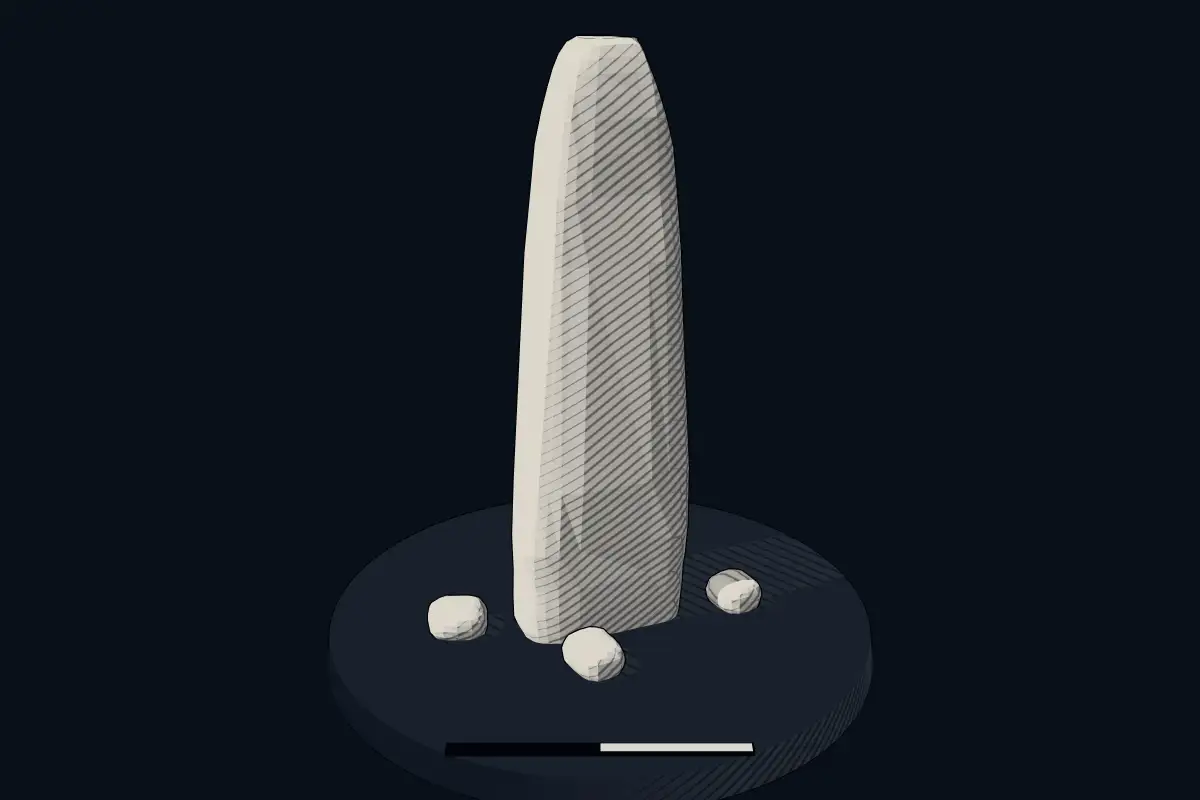
The reconstruction is ours, not a survey: it shows what a monument of this type looks like, at the size the record gives for this one.
Photographs
4 photographs, each with its author and licence
More photographs
Lore
Evidence & Lore
What the sources actually support — and, kept apart, what has been claimed.
What the evidence supports
Dates
Est. 2800–1800 BCEHow this date was established: Type comparisonTypical range for menhirs in Germany; this site has not been dated itself. Standing stones are associated with the Beaker people of the European late Neolithic and early Bronze Age c. 2800-1800 BC.Source for this date
Where it stands
Germany
The pin marks the monument itself — its exact point.
- Coordinates
- 49°51′14″ N, 8°08′40″ EFor a GPS or map app: 49.85387, 8.14447
Access is as our sources describe it; we have not visited the site to check.
Nearby
The closest sites in the Atlas, by straight line.


Sources
Every record behind this page, with the link it came from.
2 sources behind this page
- 01Wikidata Q17325147wikidata.org
- 02Source for this dateen.wikipedia.org
Image files
- Langer Stein - 2.JPGNixnubixCC BY-SA 4.0
- Langer Stein - 3.JPGNixnubixCC BY-SA 4.0
- Langer Stein - 4.JPGNixnubixCC BY-SA 4.0
- Langer Stein - 1.JPGNixnubixCC BY-SA 4.0
Report a correctionWrong date, name, photograph or source? Tell us and it will be put right.
Lore, kept apart
Legends and claims
These are stories and claims reported by the sources. They are not evidence, and they never stand in for the dating above.
- Tradition
Um den Stein ranken sich mehrere Sagen.
Um den Stein ranken sich mehrere Sagen. Laut der ersten kam der Stein an seinen Standort, als der Teufel sah, dass in Wörrstadt eine Kirche gebaut wurde. Darauf schleuderte er einen Stein vom Donnersberg. Doch er zielte zu weit und der Stein landete zwischen Wörrstadt und Saulheim. Eine weitere erzählt, dass ein reicher Mann an dieser Stelle einen Schatz vergrub. Da der Teufel seine Seele bekommen wollte, setzte er den Stein darauf. Der Mann kam nun nicht mehr an seinen Schatz heran und erhängte sich am nächsten Baum. Der Schatz wird seitdem von einer Eule (nach einer anderen Variante von einem Zwerg) bewacht. Als eines Tages ein Jüngling vorbeikam, bot ihm der Zwerg einen Teil des Schatzes an, vorausgesetzt, der Jüngling würde anschließend eine der drei Todsünden Trunkenheit, Ehebruch oder Mord begehen. Er wählte als geringstes Übel die Trunkenheit, beging aber in seinem Rausch auch noch Ehebruch und ermordete schließlich noch den gehörnten Ehemann als dieser ihn ertappte. Eine dritte Sage berichtet von einer armen Frau aus Wörrstadt, die während der französischen Revolutionskriege ihre Ersparnisse auf der Spitze des Steins versteckte. Nach Kriegsende war das gesamte Geld noch vorhanden. Eine vierte Sage beruht auf einer wahren Begebenheit. 1883 wurde versucht, den Stein zu entfernen. Dabei kamen zwei Männer ums Leben. Seitdem geht die Sage, dass der Stein jeden erschlägt, der versucht, ihn umzulegen.
Source
Around this place
The ten nearest sites, by compass
Credit
Text, licence and sources
Adapted from the Wikipedia article "Menhir von Ober-Saulheim" (German), licensed CC BY-SA 4.0; authors are listed in the page history. Reused under CC BY-SA 4.0. Read on Wikipedia · Edit history and authors