Menhir (standing stone)The Bronze Age
Hinkelstein
DatedEst. 2800–1800 BCE
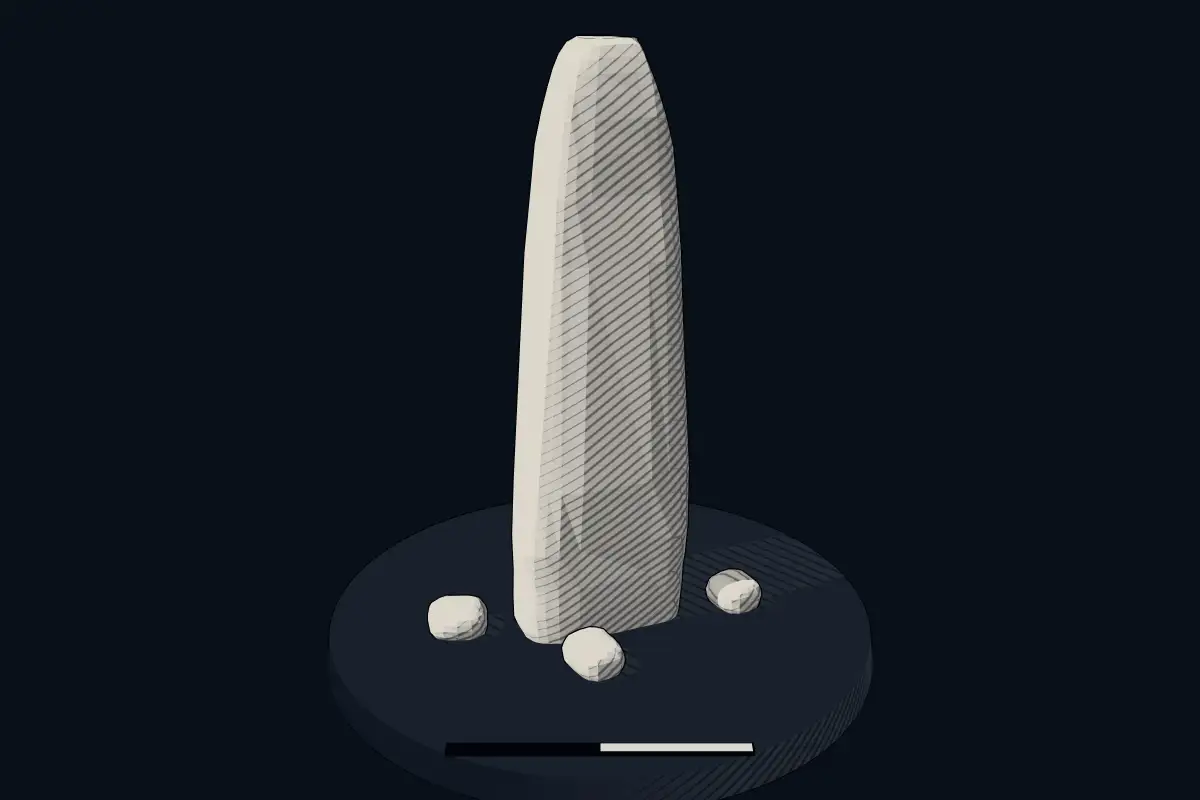
No licensed photograph yetWe have no photograph we may publish for this site, so the interpretive 3D view leads instead.
Overview
About this site
Overview
The Hinkelstein near Armsheim, in the district of Alzey-Worms in Rhineland-Palatinate, Germany, is a menhir. It is recorded under the name Hynkelstein in 1576 and is protected as a Kulturdenkmal (cultural monument). The catalogue record gives a typological estimate of 2800 to 1800 BCE.
The stone's original position is not known. It was moved a short distance east in 1975 because of the construction of a motorway rest area.
Read on Wikipedia2 min readCC BY-SA 4.0
Where it sits in time
The site's dated range, placed against world reference points.
The scale is logarithmic: each step to the left is about ten times older than the last.
Article
Hinkelstein
The menhir is made of limestone, whose source was identified as the Geiersberg, 2 km away.
DescriptionSources for this section
- Wikipedia (German): Hinkelstein (Armsheim)CC BY-SA 4.0
Sources for this section
- Wikipedia (German): Hinkelstein (Armsheim)CC BY-SA 4.0
The menhir is made of limestone, whose source was identified as the Geiersberg, 2 km away. Its surface is deeply furrowed and weathered, and in the lower part it has a hole passing right through it. It is 170 cm high, 120 cm wide and 55 cm deep. Its shape is an irregular slab ending in an oblique point.
HistorySources for this section
- Wikipedia (German): Hinkelstein (Armsheim)CC BY-SA 4.0
Sources for this section
- Wikipedia (German): Hinkelstein (Armsheim)CC BY-SA 4.0
Perhaps the stone once served as the crowning of a burial mound that has since been destroyed. Probably from the Middle Ages onward it was used, together with the Dicker Stein, the Spitzer Stein, the now destroyed Haugstein and one further menhir, as a boundary stone between Armsheim and Flonheim.
Later historySources for this section
- Wikipedia (German): Hinkelstein (Armsheim)CC BY-SA 4.0
Sources for this section
- Wikipedia (German): Hinkelstein (Armsheim)CC BY-SA 4.0
In 1975 the stone was moved a short distance to the east because of the construction of a motorway rest area. The Dicker Stein and the Spitzer Stein, which were moved in 1979 and again in 2001, now stand 500 m to the north-east on a small green space in the village, in the Bahnhofstraße. The Langer Stein von Flonheim lies 1.5 km to the south.
Tradition and region
About this kind of monument
Central and southern European menhirs
Outside the Atlantic fringe, menhirs also occur across central and southern Europe. In the Czech Republic there are about 40 real menhirs and dozens of stones that could also be menhirs, and others have been erected recently. The largest real menhir is Kamenný pastýř, the "stony shepherd", near Klobuky, 3.3 metres high; the Czech menhirs are probably the last outcrop of a tradition that ran across northern Germany. Some of the Czech stones in the Atlas may be natural boulders.
Italy has its most famous menhirs in Sardinia, where at least 332 standing stones can be seen. They include elaborate "statue-menhirs" that show a human face at the top and gendered symbols on the flat front; over a hundred of this standardised type have been found, mostly around the village of Laconi. In the Sardinian language they are called perdas fittas or perdas lungas. In Switzerland, in the canton of Vaud, several menhirs form linear patterns at Clendy in Yverdon-les-Bains, and date back to the third millennium BCE.
A statue menhir is a carved standing stone of the later European Neolithic, in which a slab or pillar has a stylised human figure cut into it, sometimes with hints of clothing or weapons. They are most commonly found in southern and western France, Catalonia, Corsica, Sardinia, Italy and the Alps.
Menhirs are usually difficult to date, and those without excavation can only be given a broad range. A stone's present position is not always its original one.
When visiting, check whether a stone stands in its original position and look for signs of shaping.
Paraphrased from Wikipedia: Menhir, Wikipedia: List of menhirs, Wikipedia: Statue menhir · CC BY-SA 4.0
From the article
Dated moments in the story
- 1576
Der Hinkelstein (1576 als Hynkelstein bezeichnet) ist ein Menhir bei Armsheim im Landkreis Alzey-Worms in Rheinland-Pfalz.
Source - 1975
1975 wurde er wegen des Baus eines Autobahnrastplatzes ein Stück nach Osten versetzt.
Source - 1979
Der Dicke Stein und der Spitze Stein, die 1979 und nochmals 2001 ebenfalls versetzt wurden, befinden sich heute 500 m nordöstlich auf einer kleinen Grünanlage direkt im Ort in der Bahnhofstraße.
Source
See it in 3D
An interpretive reconstruction of the monument, standing on the real ground at its exact point, under the sun for that place and season. Drag to look around it.
The reconstruction is ours, not a survey: it shows what a monument of this type looks like, at the size the record gives for this one.
Lore
Evidence & Lore
What the sources actually support — and, kept apart, what has been claimed.
What the evidence supports
Dates
Est. 2800–1800 BCEHow this date was established: Type comparisonTypical range for menhirs in Germany; this site has not been dated itself. Standing stones are associated with the Beaker people of the European late Neolithic and early Bronze Age c. 2800-1800 BC.Source for this date
Where it stands
Germany
The pin marks the monument itself — its exact point.
- Coordinates
- 49°48′15″ N, 8°03′18″ EFor a GPS or map app: 49.80415, 8.05496
Access is as our sources describe it; we have not visited the site to check.
Nearby
The closest sites in the Atlas, by straight line.


Sources
Every record behind this page, with the link it came from.
2 sources behind this page
- 01Wikidata Q17322285wikidata.org
- 02Source for this dateen.wikipedia.org
Report a correctionWrong date, name, photograph or source? Tell us and it will be put right.
Around this place
The ten nearest sites, by compass
Credit
Text, licence and sources
Adapted from the Wikipedia article "Hinkelstein (Armsheim)" (German), licensed CC BY-SA 4.0; authors are listed in the page history. Reused under CC BY-SA 4.0. Read on Wikipedia · Edit history and authors
- Wikipedia (German): Hinkelstein (Armsheim)CC BY-SA 4.0
- Wikidata Q17322285CC0