Großsteingrab Lensahn
DatedEst. 3500–2800 BCE
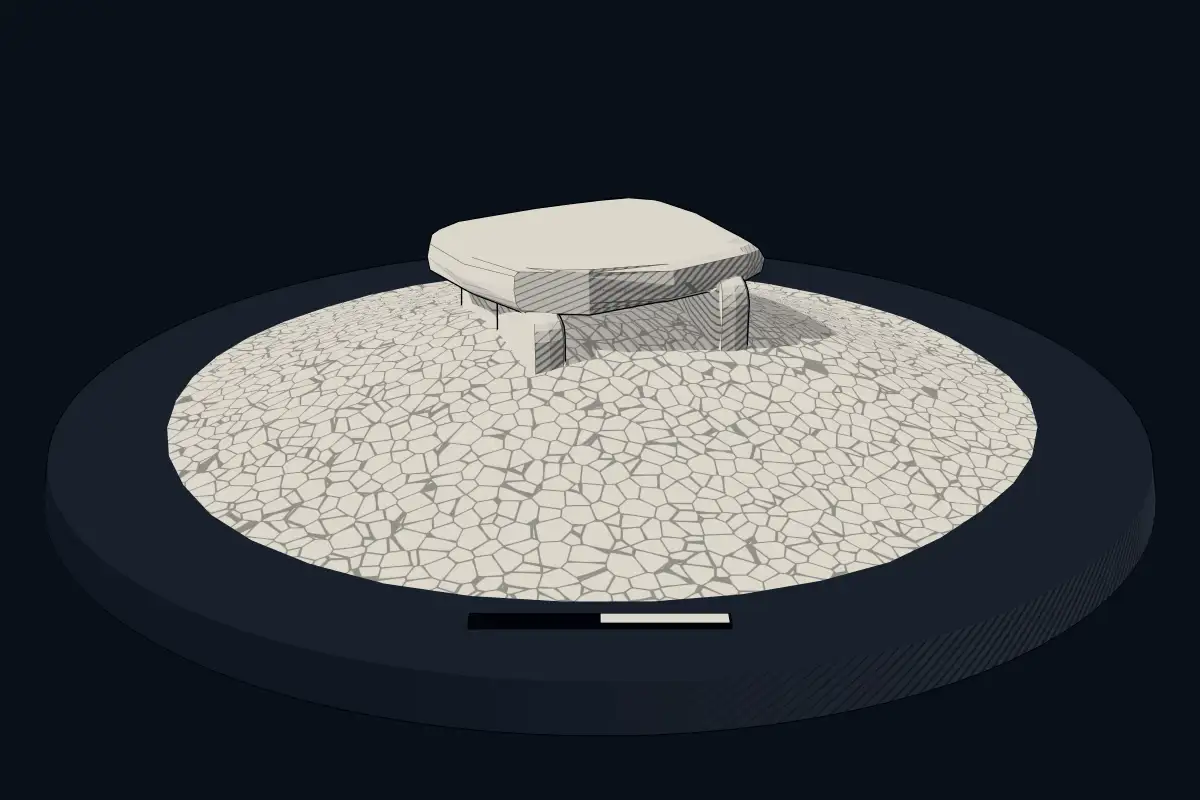
No licensed photograph yetWe have no photograph we may publish for this site, so the interpretive 3D view leads instead.
Overview
About this site
Overview
The Großsteingrab Lensahn is a megalithic tomb of the Neolithic Funnel Beaker culture near Lensahn, in the district of Ostholstein in Schleswig-Holstein, Germany. It carries the Sprockhoff number 277.
The monument is a long barrow of which only the mound survives; the catalogue gives a typological date between 3500 and 2800 BCE.
Read on Wikipedia1 min readCC BY-SA 4.0
Where it sits in time
The site's dated range, placed against world reference points.
The scale is logarithmic: each step to the left is about ten times older than the last.
Article
Großsteingrab Lensahn
The tomb lies north-east of Lensahn, in a wood directly on the municipal boundary with Kabelhorst.
SettingSources for this section
- Wikipedia (German): Großsteingrab LensahnCC BY-SA 4.0
Sources for this section
- Wikipedia (German): Großsteingrab LensahnCC BY-SA 4.0
The tomb lies north-east of Lensahn, in a wood directly on the municipal boundary with Kabelhorst.
DescriptionSources for this section
- Wikipedia (German): Großsteingrab LensahnCC BY-SA 4.0
Sources for this section
- Wikipedia (German): Großsteingrab LensahnCC BY-SA 4.0
The monument is a Hünenbett (a long barrow bounded by a stone enclosure) of which only the mound fill survives. The enclosure stones were removed in 1942. No burial chamber can be seen.
ContextSources for this section
- Wikipedia (German): Großsteingrab LensahnCC BY-SA 4.0
Sources for this section
- Wikipedia (German): Großsteingrab LensahnCC BY-SA 4.0
Nordic megalith architecture emerged in northern Europe mainly between 3500 and 2800 BCE. Monuments of this kind are classed by type as simple dolmens, extended dolmens, passage graves, great dolmens, unchambered long barrows and stone cists.
Tradition and region
About this kind of monument
Megalithic tombs of the North European Plain
Across the plain from the Netherlands to Poland, the Funnel Beaker culture left thousands of megalithic tombs. Nordic megalith architecture emerged in northern Europe mainly between 3500 and 2800 BCE. Counts have risen as surveys improved: Schleswig-Holstein now reports 3,212 megalithic monuments and 958 long mounds, Mecklenburg-Vorpommern 5,991 megaliths (against 648 in 2010), and Lower Saxony 1,155. Altogether 11,162 megaliths are known in these three regions, and with Brandenburg and Saxony-Anhalt the figure for northern Germany rises to 11,648. Denmark has 5,001 registered monuments, the Netherlands 101, Sweden 639 and Poland 18. Johannes Müller has suggested that originally more than 75,000 megaliths were built.
Monuments are classed by type: simple dolmens, extended dolmens, passage graves, great dolmens, unchambered long barrows and stone cists. The oldest are the simple dolmens, which appeared around 3500 BCE and are found across almost the whole area of Nordic megalith architecture. Their entrances were built to be reopened. A megalithic entrance had to seal the tomb, yet allow the community to gain access to the interior again, even after a long time, to perform rituals.
In the Netherlands the hunebedden were built between 3470 and 3250 BCE and used until about 2760 BCE; 54 of the original 100 survive, 52 of them in Drenthe. Poland has only 18 registered monuments, and the long barrows in parts of Poland were typically earthen rather than megalithic.
Dating combines radiocarbon dates from bone and pottery. The tombs were used by later cultures too, so a single tomb can hold remains from different periods.
When visiting, look at how the capstones sit on the supporting stones, how the entrance is built, and the frame of kerbstones around the mound.
Paraphrased from Wikipedia: Nordic megalith architecture, Wikipedia: Megaliths in the Netherlands, Wikipedia: Funnel beaker culture, Wikipedia: Megaliths in Mecklenburg-Vorpommern · CC BY-SA 4.0
From the article
Dated moments in the story
- 1942
Die Umfassungssteine wurden 1942 entfernt.
Source
Lore
Evidence & Lore
What the sources actually support — and, kept apart, what has been claimed.
What the evidence supports
Dates
Est. 3500–2800 BCEHow this date was established: Type comparisonTypical range for megalithic tombs in Germany; this site has not been dated itself. German stone tombs (Grosssteingraber) belong to the Nordic megalith tradition which emerged predominantly between 3500 and 2800 BC.Source for this date
Where it stands
Germany
The pin marks the monument itself — its exact point.
- Coordinates
- 54°13′43″ N, 10°54′53″ EFor a GPS or map app: 54.22866, 10.91483
Access is as our sources describe it; we have not visited the site to check.
Nearby
The closest sites in the Atlas, by straight line.
 Großsteingrab Cismar3500–2800 BCE
- Megalithic tombGroßsteingrab Wangels LA 693500–2800 BCE
 Steinkammer von Grammdorf3500–2800 BCE
- DolmenGanggrab von Wangels-Meischenstorf3500–2800 BCE
- Megalithic tombGroßsteingrab Meischenstorf3500–2800 BCE
 Eiskellerberg bei Siggeneben3500–2500 BCE
- Megalithic tombGroßsteingrab Testorf3500–2800 BCE
- MegalithGroßsteingrab Neu-Testorf II3500–2500 BCE


Sources
Every record behind this page, with the link it came from.
2 sources behind this page
- 01Wikidata Q65455874wikidata.org
- 02Source for this dateen.wikipedia.org
Report a correctionWrong date, name, photograph or source? Tell us and it will be put right.
Around this place
The ten nearest sites, by compass
- Großsteingrab Cismar4.4 km SE
- Großsteingrab Wangels LA 696.5 km NW
- Steinkammer von Grammdorf6.7 km NW
- Ganggrab von Wangels-Meischenstorf8.3 km W
- Großsteingrab Meischenstorf8.3 km W
- Eiskellerberg bei Siggeneben9.2 km NE
- Großsteingrab Testorf11 km W
- Großsteingrab Neu-Testorf II11 km W
- Großsteingräber bei Neutestorf11 km W
- Großsteingrab Neu-Testorf I11 km W
Credit
Text, licence and sources
Adapted from the Wikipedia article "Großsteingrab Lensahn" (German), licensed CC BY-SA 4.0; authors are listed in the page history. Reused under CC BY-SA 4.0. Read on Wikipedia · Edit history and authors
- Wikipedia (German): Großsteingrab LensahnCC BY-SA 4.0
- Wikidata Q65455874CC0