

Overview
About this site
What the sources say
Hunebed D18 ligt in de nabijheid van Rolde in de Nederlandse provincie Drenthe.
Het hunebed ligt ten noordoosten van Rolde in de omgeving van het kerkhof en de Sint-Jacobskerk op de es. In de onmiddellijke omgeving ligt nog een tweede hunebed D17. Het hunebed is 'gerestaureerd' door Joan Lodewijk Gerhard Gregory en ziet er 'netter' uit, hunebed D17 is meer een ruïne.
Article in DutchRead on Wikipedia5 min readCC BY-SA 4.0
Where it sits in time
The site's dated range, placed against world reference points.
The scale is logarithmic: each step to the left is about ten times older than the last.
The full article
D18: the whole story
In briefSources for this section
- Wikipedia (Dutch): D18 (hunebed)CC BY-SA 4.0
Sources for this section
- Wikipedia (Dutch): D18 (hunebed)CC BY-SA 4.0
Dolmen D18 stands northeast of Rolde in Drenthe, the Netherlands, near the churchyard and Sint-Jacobskerk on the es. Another dolmen, D17, lies nearby. D18 was restored by Joan Lodewijk Gerhard Gregory, while D17 remains more of a ruin.
The monument was erected between 3400 and 3200 BCE and is attributed to the Funnel Beaker culture. It has seven capstones, 14 supporting stones, two closing stones and two portal stones. The entrance faces south. The dolmen is 12,6 metres long and 3,5 metres wide.
Its first probable mention dates from 1547, when the “Pillars of Hercules” at Rolde were said to include a sacrificial stone and a narrow passage beneath the stones. The monument was also known as ’s Duvels Kut. D17 and D18 were sold by the Boermarke of Rolde for 150 guilders. The government purchased D17 in 1872 and D18 a year later. Restorations took place in 1873, 1931, 1936, between 1957 and 1965 and in 1993.
In July 1878, William Collings Lukis and sir Henry Dryden surveyed forty hunebedden on the Hondsrug for the Society of Antiquaries. Lukis recorded D18 as having 16 supporting stones and seven capstones, with its entrance to the south. Their report was not printed at the time, but the Drentse archaeologist dr. Wijnand van der Sanden published their work in 2015, describing it as high quality. An exhibition about their work was held at the Drents Museum that year.
Summary in EnglishSources for this section
- Wikipedia (Dutch): D18 (hunebed)CC BY-SA 4.0
Sources for this section
- Wikipedia (Dutch): D18 (hunebed)CC BY-SA 4.0
D18 is a dolmen in Aa en Hunze, Germany. Wikidata describes it as: dolmen in the Netherlands. A typological estimate: 3500 BCE to 2800 BCE. No English Wikipedia article exists for it; the full text below is the Dutch article "D18 (hunebed)", shown in the original language.
BouwSources for this section
- Wikipedia (Dutch): D18 (hunebed)CC BY-SA 4.0
Sources for this section
- Wikipedia (Dutch): D18 (hunebed)CC BY-SA 4.0
Het is tussen 3400 en 3200 v.Chr. opgericht en wordt toegeschreven aan de trechterbekercultuur.
Het hunebed heeft zeven dekstenen, 14 draagstenen, twee sluitstenen en twee poortzijstenen. De poort is gericht op het zuiden.
Het hunebed is 12,6 meter lang en 3,5 meter breed.
GeschiedenisSources for this section
- Wikipedia (Dutch): D18 (hunebed)CC BY-SA 4.0
Sources for this section
- Wikipedia (Dutch): D18 (hunebed)CC BY-SA 4.0
De vermoedelijk eerste vermelding van dit hunebed stamt uit 1547. In een geschrift uit die tijd wordt melding gemaakt van de Zuilen van Hercules, die zich in vico Roelden (= Rolde) zouden bevinden. Op de zuilen ligt een offersteen en via een nauwe doorgang kon men onder de stenen komen. Volgens de monnik werden hier voor de komst van Bonifatius mensen geofferd.
Mensen, bij voorkeur vreemdelingen, werden gedwongen door de nauwe doorgang onder de altaarstenen te kruipen, terwijl ze met mest bekogeld werden.
De naam van het geheel was 's Duvels Kut (= kont van de duivel). De beschrijving zou ook kunnen slaan op hunebed D17 of D10.
Beide hunebedden werden door de Boermarke van Rolde voor 150 gulden verkocht na bemiddeling door burgemeester Alexander Carel Jan Frederik Bouwmeester. Eerst wilde men de hunebedden openbaar verkopen, maar Gedeputeerde Staten van Drenthe protesteerde en na een advies van het Ministerie van Binnenlandse Zaken werden de hunebedden aan het Rijk verkocht (in 1872 hunebed D17 en D18 volgde een jaar later).
In 1905 golden ze als een van de weinige archeologische bezienswaardigheden van Nederland. Er zijn veel ansichtkaarten verschenen met deze hunebedden erop, waarschijnlijk zijn deze hunebedden vaker afgebeeld dan alle andere in Nederland. Naast op ansichtkaarten werden deze hunebedden afgebeeld op schilderijen en tegels.
Van Giffen vermeldt dit hunebed als "in goeden staat", maar toen waren er al restauraties uitgevoerd. Hij betreurt het egaliseren van het terrein er om heen waardoor eventuele restanten van een dekheuvel en kransstenen zijn gewist.
Er vonden diverse restauraties plaats: in 1873, in 1931, in 1936, tussen 1957 en 1965 en in 1993.
Volgens Robert Dehon zouden in het hunebed wat links ligt (als je met je rug naar de kerk staat) inscripties te vinden zijn.
Society of AntiquariesSources for this section
- Wikipedia (Dutch): D18 (hunebed)CC BY-SA 4.0
Sources for this section
- Wikipedia (Dutch): D18 (hunebed)CC BY-SA 4.0
In Engeland ontstond in de jaren zeventig van de 19e eeuw bezorgdheid over de wijze waarop in Nederland hunebedden werden gerestaureerd. In die kringen was men vooral bezorgd dat met de restauraties het oorspronkelijk beeld van de situatie verloren zou gaan. De directeur van de Society of Antiquaries in Londen verzocht de oudheidkundigen William Collings Lukis en sir Henry Dryden om de staat waarin de hunebedden zich op dat moment bevonden nauwkeurig vast te leggen. Zij bezochten in juli 1878 Drenthe en brachten veertig hunebedden op de Hondsrug in kaart. Ze hebben opmetingen verricht en beschreven de aangetroffen situatie, die zij tevens vastlegden in een serie aquarellen. Hun rapportage aan de Society of Antiquaries verscheen echter niet in druk. Hun materiaal werd bewaard bij de Society of Antiquaries, het Guernsey Museum & Art Gallery en het Drents Museum. Het Ashmolean Museum in Oxford bezit kopieën van hun werk. In 2015 publiceerde de Drentse archeoloog dr. Wijnand van der Sanden alsnog hun werk. Hij voorzag hun materiaal van een uitgebreide inleiding. Ook schetste hij de ontwikkelingen met betrekking tot het archeologisch onderzoek van de hunebedden na hun onderzoek tot 2015. Hij gaf als oordeel dat het werk van Lukis en Dryden van hoge kwaliteit was. In het Drents Museum was in 2015 een tentoonstelling over het werk.
Hunebed D18 is weergegeven op Plan XI: Het hunebed was, vermeldde Lukis, 'gerestaureerd' door de commissaris van de Koning Joan Lodewijk Gerhard Gregory. Het hunebed had 16 draagstenen en 7 dekstenen. Er was geen spoor van een dekheuvel. De ingang lag op het zuiden. Lukis maakte vermelding van de vondst van een urn door de archeoloog Janssen. Volgens Janssens was er in de tijd waarin hij het hunebed onderzocht nog wel een dekheuvel, aldus Lukis, die ook aantekende dat de door Janssens gegeven oriëntatie van het hunebed zeker onjuist was.
How this page was madeSources for this section
- Wikipedia (Dutch): D18 (hunebed)CC BY-SA 4.0
Sources for this section
- Wikipedia (Dutch): D18 (hunebed)CC BY-SA 4.0
The summary at the top of this page was written by MiniMax-M3 (2026-11-07) from the cited Wikipedia article “D18 (hunebed)”, translated from Dutch. The numbers in it were checked automatically against the source text. The rest of the page is the article itself, the structured records and computed distances.
Tradition and region
About this kind of monument
German and Dutch Hünengräber (hunebedden)
The megalithic tombs of northern Germany and the Netherlands were built by the Funnel Beaker culture (about 4100 to 2800 BCE), and the style, called Nordic megalith architecture, emerged between 3500 and 2800 BCE. In the Netherlands the tombs are the hunebedden, built between 3470 and 3250 BCE by the western group of the Funnel Beaker culture and used until about 2760 BCE. Of an estimated 100 original tombs, 54 are preserved, 52 of them in the province of Drenthe and two in Groningen. After the Funnel Beaker culture ended the sites were reused by the Single Grave and Bell Beaker cultures in the Early Bronze Age and, to a lesser extent, into the Middle Ages.
In Mecklenburg-Vorpommern up to 5,000 megalith tombs were erected, and more than 1,000 are preserved and protected by law; they belong to the youngest and easternmost part of the western European tradition. Most are dolmens, often lying inside a circular or trapezoid frame of standing stones. Locally they are known as Hünengräber, "giants' tombs", or Großsteingräber, "large stone tombs"; the trapezoid frame is a Hünenbett, "giants' bed", and the circular one a Bannkreis. Between 1964 and 1974 Ewald Schuldt excavated over a hundred sites there and sorted them into simple dolmens, extended dolmens, passage graves, great dolmens, unchambered long barrows and stone cists.
Folklore: the German and Dutch names, with Hüne meaning "giant", carry the old idea that giants were buried here. This is a tradition; the stones were placed by Neolithic farmers.
When visiting, look for the capstones on their supports and the frame of kerbstones around them.
Paraphrased from Wikipedia: Megaliths in the Netherlands, Wikipedia: Megaliths in Mecklenburg-Vorpommern, Wikipedia: Nordic megalith architecture, Wikipedia: Funnel beaker culture, Wikipedia: Dolmen · CC BY-SA 4.0
From the article
Dated moments in the story
- 3200 BCE
Het is tussen 3400 en 3200 v.Chr. opgericht en wordt toegeschreven aan de trechterbekercultuur.
Source - 1547
De vermoedelijk eerste vermelding van dit hunebed stamt uit 1547. In een geschrift uit die tijd wordt melding gemaakt van de Zuilen van Hercules, die zich in vico Roelden (= Rolde) zouden bevinden.
Source - 1872
Eerst wilde men de hunebedden openbaar verkopen, maar Gedeputeerde Staten van Drenthe protesteerde en na een advies van het Ministerie van Binnenlandse Zaken werden de hunebedden aan het Rijk verkocht (in 1872 hunebed D17 en D18 volgde een jaar later).
Source - 1873
Er vonden diverse restauraties plaats: in 1873, in 1931, in 1936, tussen 1957 en 1965 en in 1993. Volgens Robert Dehon zouden in het hunebed wat links ligt (als je met je rug naar de kerk staat) inscripties te vinden zijn.
Source - 1878
Zij bezochten in juli 1878 Drenthe en brachten veertig hunebedden op de Hondsrug in kaart.
Source - 1905
In 1905 golden ze als een van de weinige archeologische bezienswaardigheden van Nederland.
Source - 2015
In 2015 publiceerde de Drentse archeoloog dr.
Source - 2015
Ook schetste hij de ontwikkelingen met betrekking tot het archeologisch onderzoek van de hunebedden na hun onderzoek tot 2015. Hij gaf als oordeel dat het werk van Lukis en Dryden van hoge kwaliteit was.
Source - 2015
In het Drents Museum was in 2015 een tentoonstelling over het werk.
Source
See it in 3D
An interpretive reconstruction of the monument, standing on the real ground at its exact point, under the sun for that place and season. Drag to look around it.
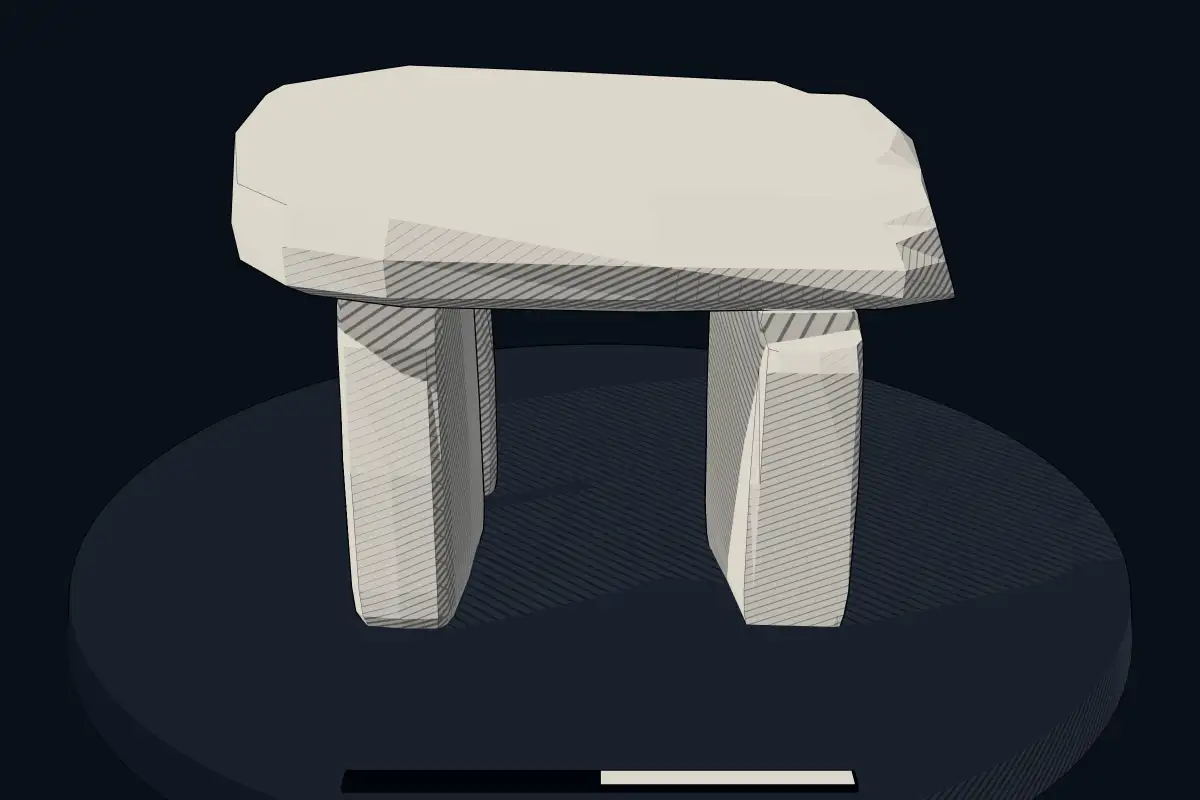
The reconstruction is ours, not a survey: it shows what a monument of this type looks like, at the size the record gives for this one.
Photographs
8 photographs, each with its author and licence
More photographs


Lore
Evidence & Lore
What the sources actually support — and, kept apart, what has been claimed.
What the evidence supports
Dates
Est. 3500–2800 BCEHow this date was established: Type comparisonTypical range for dolmens in Germany; this site has not been dated itself. German dolmens (Huengrab) belong to the Nordic megalith tradition which emerged predominantly between 3500 and 2800 BC.Source for this date
Where it stands
Germany
The pin marks the monument itself — its exact point.
- Coordinates
- 52°59′23″ N, 6°38′57″ EFor a GPS or map app: 52.98961, 6.64917
Access is as our sources describe it; we have not visited the site to check.
Nearby
The closest sites in the Atlas, by straight line.
 Duvels Kut3500–2800 BCE
 D173500–2800 BCE
 D163500–2800 BCE
- Megalithic mound (tumulus with integral stones)Terrein met vier grafheuvels3500–500 BCE
 D153500–2800 BCE
- Megalithic mound (tumulus with integral stones)Ketenberg3500–500 BCE
- Megalithic mound (tumulus with integral stones)Terrein met twee grafheuvels3500–500 BCE
- Megalithic mound (tumulus with integral stones)Terrein met een grafheuvel3500–500 BCE


Sources
Every record behind this page, with the link it came from.
2 sources behind this page
- 01Wikidata Q2168440wikidata.org
- 02Source for this dateen.wikipedia.org
Image files
- Hunebed D18 bij Rolde 2008.jpgGouwenaarPublic domain
- Hunebed Rolde.jpgMzagersCC BY-SA 3.0 nl
- Hunebed met eikeboom en staande man, Drenthe, RP-F-2005-33.jpgRijksmuseumCC0
- Hunebed D18 03.jpgEric de RedelijkheidCC BY-SA 2.0
- Karakteristieke landschappen, hunebedden, Bestanddeelnr 164-0081.jpgNationaal ArchiefCC0
- Zicht op hunebed D18,--Archeoregio 1 - Rolde - 20425889 - RCE.jpgBert van AsCC BY-SA 4.0
- Hunebed bij Rolde, Bestanddeelnr 254-5163.jpgWillem van de PollCC0
- Hunebed bij Rolde, Bestanddeelnr 254-5164.jpgWillem van de PollCC0
Report a correctionWrong date, name, photograph or source? Tell us and it will be put right.
Around this place
The ten nearest sites, by compass
Credit
Text, licence and sources
Text from the Wikipedia article "D18 (hunebed)" (Dutch), licensed CC BY-SA 4.0; authors are listed in the page history. Reused under CC BY-SA 4.0. Read on Wikipedia · Edit history and authors
- Wikipedia (Dutch): D18 (hunebed)CC BY-SA 4.0
- Wikidata Q2168440CC0