
Overview
About this site
What the sources say
Das Großsteingrab Loon ist eine megalithische Grabanlage der jungsteinzeitlichen Westgruppe der Trichterbecherkultur in Loon, einem Ortsteil von Assen in der niederländischen Provinz Drenthe. Das Grab trägt die van-Giffen-Nummer D15.
Article in GermanRead on Wikipedia5 min readCC BY-SA 4.0
Where it sits in time
The site's dated range, placed against world reference points.
The scale is logarithmic: each step to the left is about ten times older than the last.
The full article
D15: the whole story
In briefSources for this section
- Wikipedia (German): Großsteingrab LoonCC BY-SA 4.0
Sources for this section
- Wikipedia (German): Großsteingrab LoonCC BY-SA 4.0
Großsteingrab Loon is a megalithic passage grave in Loon, a district of Assen in the Dutch province of Drenthe. It is also known as D15, its van-Giffen number. The monument lies north of Loon where a field path meets the Heirweg, with Großsteingrab Balloo (D16) 2,5 km south and Großsteingrab Gasteren (D10) 3,7 km northeast.
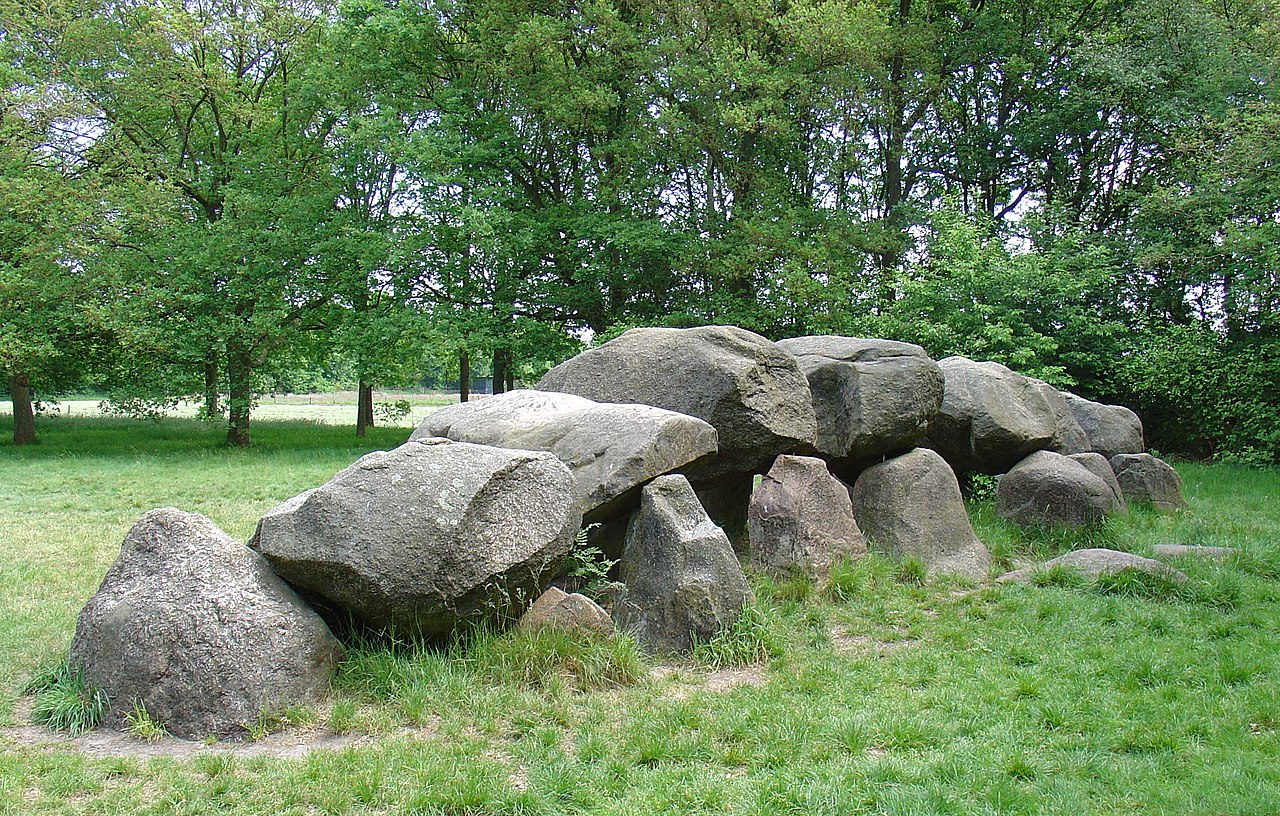
The grave is aligned east-southeast to west-northwest. Its oval stone enclosure remains in good condition: 18 of the original 23 stones survive. The burial chamber is 9,6 m long and about 3,6 m wide, with five pairs of side stones, one closing stone at each short end and five capstones. Four capstones remain in place, while the middle one lies broken inside the chamber. A short entrance passage leads to the chamber.
The monument belongs to the western group of the Funnel Beaker Culture and is dated by typological estimate to 3500–2800 BCE. It was first mentioned in 1654 by A. van Slichtenhorst, excavated by Johannes Hofstede in 1809, and restored in 1870. Later work included archaeological investigation and restoration in 1952, further restorations in 1965 and 1993, and inclusion in a 3D atlas using photogrammetry in 2017. It has been a National Monument since 1992.
The remains include cremated bones from a man, a woman and a person of uncertain sex, all of whom died in adulthood. A 1974 robbery excavation also found two Bell Beaker vessels and a small piece of copper or bronze, 4,5 cm long and 3,5 cm wide. These objects are now in the Drents Museum. Reuse of megalithic tombs by later communities is common in the Netherlands, where monuments of this kind were built by the Funnel Beaker Culture.
No English Wikipedia article exists for it; the full text below is the German article "Großsteingrab Loon", shown in the original language.
Summary in EnglishSources for this section
- Wikipedia (German): Großsteingrab LoonCC BY-SA 4.0
Sources for this section
- Wikipedia (German): Großsteingrab LoonCC BY-SA 4.0
D15 is a dolmen in Assen, Germany. Wikidata describes it as: dolmen in the Netherlands. A typological estimate: 3500 BCE to 2800 BCE. No English Wikipedia article exists for it; the full text below is the German article "Großsteingrab Loon", shown in the original language.
LageSources for this section
- Wikipedia (German): Großsteingrab LoonCC BY-SA 4.0
Sources for this section
- Wikipedia (German): Großsteingrab LoonCC BY-SA 4.0
Das Grab befindet sich nördlich von Loon an der Einmündung eines Feldwegs in den Heirweg. In der näheren Umgebung gibt es weitere Großsteingräber: 2,5 km südlich befindet sich das Großsteingrab Balloo (D16) und 3,7 km nordöstlich das Großsteingrab Gasteren (D10).
ForschungsgeschichteSources for this section
- Wikipedia (German): Großsteingrab LoonCC BY-SA 4.0
Sources for this section
- Wikipedia (German): Großsteingrab LoonCC BY-SA 4.0
17.–19. Jahrhundert
Das Grab wurde erstmals 1654 von A. van Slichtenhorst erwähnt. 1809 erfolgte eine Grabung durch Johannes Hofstede. Leonhardt Johannes Friedrich Janssen, Kurator der Sammlung niederländischer Altertümer im Rijksmuseum van Oudheden in Leiden, besuchte 1847 einen Großteil der noch erhaltenen Großsteingräber der Niederlande, darunter auch das Grab von Loon, und publizierte im folgenden Jahr das erste Überblickswerk mit Baubeschreibungen und schematischen Plänen der Gräber. 1870 wurde die Anlage erstmals restauriert. Janssens Nachfolger Willem Pleyte unternahm 1874 zusammen mit dem Fotografen Jan Goedeljee eine Reise durch Drenthe und ließ dort erstmals alle Großsteingräber systematisch fotografieren. Auf Grundlage dieser Fotos fertigte er Lithografien an. Conrad Leemans, Direktor des Rijksmuseums, unternahm 1877 unabhängig von Pleyte eine Reise nach Drenthe. Jan Ernst Henric Hooft van Iddekinge, der zuvor schon mit Pleyte dort gewesen war, fertigte für Leemans Pläne der Großsteingräber an. Leemans’ Bericht blieb allerdings unpubliziert. 1878 erfolgte eine Dokumentation durch William Collings Lukis und Henry Dryden, die auf Anregung von Augustus Wollaston Franks die Provinz Drenthe bereisten und dabei sehr genaue Grundriss- und Schnittzeichnungen von 40 Großsteingräbern anfertigten.
20. und 21. Jahrhundert
Zwischen 1904 und 1906 dokumentierte der Mediziner und Amateurarchäologe Willem Johannes de Wilde alle noch erhaltenen Großsteingräber der Niederlande durch genaue Pläne, Fotografien und ausführliche Baubeschreibungen. Der Großteil seiner Aufzeichnungen ist verloren gegangen, die Dokumentation des Grabes bei Loon ist hingegen noch erhalten. 1918 dokumentierte Albert Egges van Giffen die Anlage für seinen Atlas der niederländischen Großsteingräber. 1952 wurde das Grab archäologisch untersucht und anschließend erneut restauriert. 1965 und 1993 erfolgten weitere Restaurierungen. 1974 wurden bei einer Raubgrabung im Eingangsbereich des Grabes Gegenstände gefunden, die mehrere Jahrhunderte nach dem Bau des Grabes von Angehörigen der endneolithischen Glockenbecherkultur (2600–2200 v. Chr.) deponiert worden waren. Seit 1992 ist die Anlage ein Nationaldenkmal (Rijksmonument). 2017 wurde die Anlage zusammen mit den anderen noch erhaltenen Großsteingräbern der Niederlande in einem Projekt der Provinz Drente und der Reichsuniversität Groningen von der Stiftung Gratama mittels Photogrammetrie in einem 3D-Atlas erfasst.
BeschreibungSources for this section
- Wikipedia (German): Großsteingrab LoonCC BY-SA 4.0
Sources for this section
- Wikipedia (German): Großsteingrab LoonCC BY-SA 4.0
Bei der Anlage handelt es sich um ein ostsüdost-westnordwestlich orientiertes Ganggrab. Die ovale steinerne Umfassung ist noch gut erhalten. Von den ursprünglich 23 Steinen stehen heute noch 18. Die Hügelschüttung wurde bei der Restaurierung von 1870 weitgehend abgetragen. Die Grabkammer hat eine Länge von 9,6 m und eine Breite von etwa 3,6 m. Sie besteht aus fünf Wandsteinpaaren an den Langseiten, je einem Abschlussstein an den Schmalseiten und fünf Decksteinen. Vier Decksteine liegen noch auf den Wandsteinen auf, der mittlere liegt zerbrochen in der Kammer. Zwischen dem von Osten aus gesehenen zweiten und dem dritten Wandstein der südlichen Langseite befindet sich der Zugang zur Kammer. Diesem ist ein Gang aus zwei Wandsteinpaaren und einem Deckstein vorgelagert.
FundeSources for this section
- Wikipedia (German): Großsteingrab LoonCC BY-SA 4.0
Sources for this section
- Wikipedia (German): Großsteingrab LoonCC BY-SA 4.0
Bestattungen
Aus dem Grab stammen Reste von Leichenbrand. Die geborgene Menge betrug 752,9 g. Die Knochen gehörten zu drei Individuen, die im Erwachsenenalter gestorben waren. Es handelte sich um einen Mann, eine Frau und eine Person, deren Geschlecht nicht sicher bestimmt werden konnte.
Beigaben
Bei der Raubgrabung von 1974 wurden im Eingangsbereich der Anlage zwei Glockenbecher und ein kleines Stück Kupfer oder Bronze mit einer Länge von 4,5 cm und einer Breite von 3,5 cm gefunden. Diese Gegenstände befinden sich heute im Drents Museum.
Das Rijksmuseum van Oudheden in Leiden besitzt einige Altfunde aus dem Großsteingrab Loon: Ein Keramikgefäß der Trichterbecherkultur, ein vorgeschichtliches Feuerstein-Beil und ein frühmittelalterliches Bootsmodell aus Keramik.
Im Grab wurden auch geringe Reste von verbrannten Tierknochen gefunden. Die geborgene Menge betrug 80 g. Ein Knochen stammte möglicherweise von einem Pferd, ein anderer vom Schwein oder Rind. Unter den Knochen befand sich ein Stück, das als Meißel verwendet worden war.
How this page was madeSources for this section
- Wikipedia (German): Großsteingrab LoonCC BY-SA 4.0
Sources for this section
- Wikipedia (German): Großsteingrab LoonCC BY-SA 4.0
The summary at the top of this page was written by MiniMax-M3 (2026-11-07) from the cited Wikipedia article “Großsteingrab Loon”, translated from German. The numbers in it were checked automatically against the source text. The rest of the page is the article itself, the structured records and computed distances.
Tradition and region
About this kind of monument
German and Dutch Hünengräber (hunebedden)
The megalithic tombs of northern Germany and the Netherlands were built by the Funnel Beaker culture (about 4100 to 2800 BCE), and the style, called Nordic megalith architecture, emerged between 3500 and 2800 BCE. In the Netherlands the tombs are the hunebedden, built between 3470 and 3250 BCE by the western group of the Funnel Beaker culture and used until about 2760 BCE. Of an estimated 100 original tombs, 54 are preserved, 52 of them in the province of Drenthe and two in Groningen. After the Funnel Beaker culture ended the sites were reused by the Single Grave and Bell Beaker cultures in the Early Bronze Age and, to a lesser extent, into the Middle Ages.
In Mecklenburg-Vorpommern up to 5,000 megalith tombs were erected, and more than 1,000 are preserved and protected by law; they belong to the youngest and easternmost part of the western European tradition. Most are dolmens, often lying inside a circular or trapezoid frame of standing stones. Locally they are known as Hünengräber, "giants' tombs", or Großsteingräber, "large stone tombs"; the trapezoid frame is a Hünenbett, "giants' bed", and the circular one a Bannkreis. Between 1964 and 1974 Ewald Schuldt excavated over a hundred sites there and sorted them into simple dolmens, extended dolmens, passage graves, great dolmens, unchambered long barrows and stone cists.
Folklore: the German and Dutch names, with Hüne meaning "giant", carry the old idea that giants were buried here. This is a tradition; the stones were placed by Neolithic farmers.
When visiting, look for the capstones on their supports and the frame of kerbstones around them.
Paraphrased from Wikipedia: Megaliths in the Netherlands, Wikipedia: Megaliths in Mecklenburg-Vorpommern, Wikipedia: Nordic megalith architecture, Wikipedia: Funnel beaker culture, Wikipedia: Dolmen · CC BY-SA 4.0
From the article
Dated moments in the story
- 2200 BCE
1974 wurden bei einer Raubgrabung im Eingangsbereich des Grabes Gegenstände gefunden, die mehrere Jahrhunderte nach dem Bau des Grabes von Angehörigen der endneolithischen Glockenbecherkultur (2600–2200 v. Chr.) deponiert worden waren.
Source - 1809
1809 erfolgte eine Grabung durch Johannes Hofstede.
Source - 1847
Leonhardt Johannes Friedrich Janssen, Kurator der Sammlung niederländischer Altertümer im Rijksmuseum van Oudheden in Leiden, besuchte 1847 einen Großteil der noch erhaltenen Großsteingräber der Niederlande, darunter auch das Grab von Loon, und publizierte im folgenden Jahr das erste Überblickswerk mit...
Source - 1870
1870 wurde die Anlage erstmals restauriert.
Source - 1870
Von den ursprünglich 23 Steinen stehen heute noch 18. Die Hügelschüttung wurde bei der Restaurierung von 1870 weitgehend abgetragen.
Source - 1874
Janssens Nachfolger Willem Pleyte unternahm 1874 zusammen mit dem Fotografen Jan Goedeljee eine Reise durch Drenthe und ließ dort erstmals alle Großsteingräber systematisch fotografieren.
Source - 1877
Conrad Leemans, Direktor des Rijksmuseums, unternahm 1877 unabhängig von Pleyte eine Reise nach Drenthe.
Source - 1918
1918 dokumentierte Albert Egges van Giffen die Anlage für seinen Atlas der niederländischen Großsteingräber.
Source - 1952
1952 wurde das Grab archäologisch untersucht und anschließend erneut restauriert.
Source - 1965
1965 und 1993 erfolgten weitere Restaurierungen.
Source - 1974
Es handelte sich um einen Mann, eine Frau und eine Person, deren Geschlecht nicht sicher bestimmt werden konnte. Bei der Raubgrabung von 1974 wurden im Eingangsbereich der Anlage zwei Glockenbecher und ein kleines Stück Kupfer oder Bronze mit einer Länge von 4,5 cm und einer Breite von 3,5 cm gefunden.
Source - 1992
Seit 1992 ist die Anlage ein Nationaldenkmal (Rijksmonument).
Source - 2017
2017 wurde die Anlage zusammen mit den anderen noch erhaltenen Großsteingräbern der Niederlande in einem Projekt der Provinz Drente und der Reichsuniversität Groningen von der Stiftung Gratama mittels Photogrammetrie in einem 3D-Atlas erfasst.
Source
See it in 3D
An interpretive reconstruction of the monument, standing on the real ground at its exact point, under the sun for that place and season. Drag to look around it.
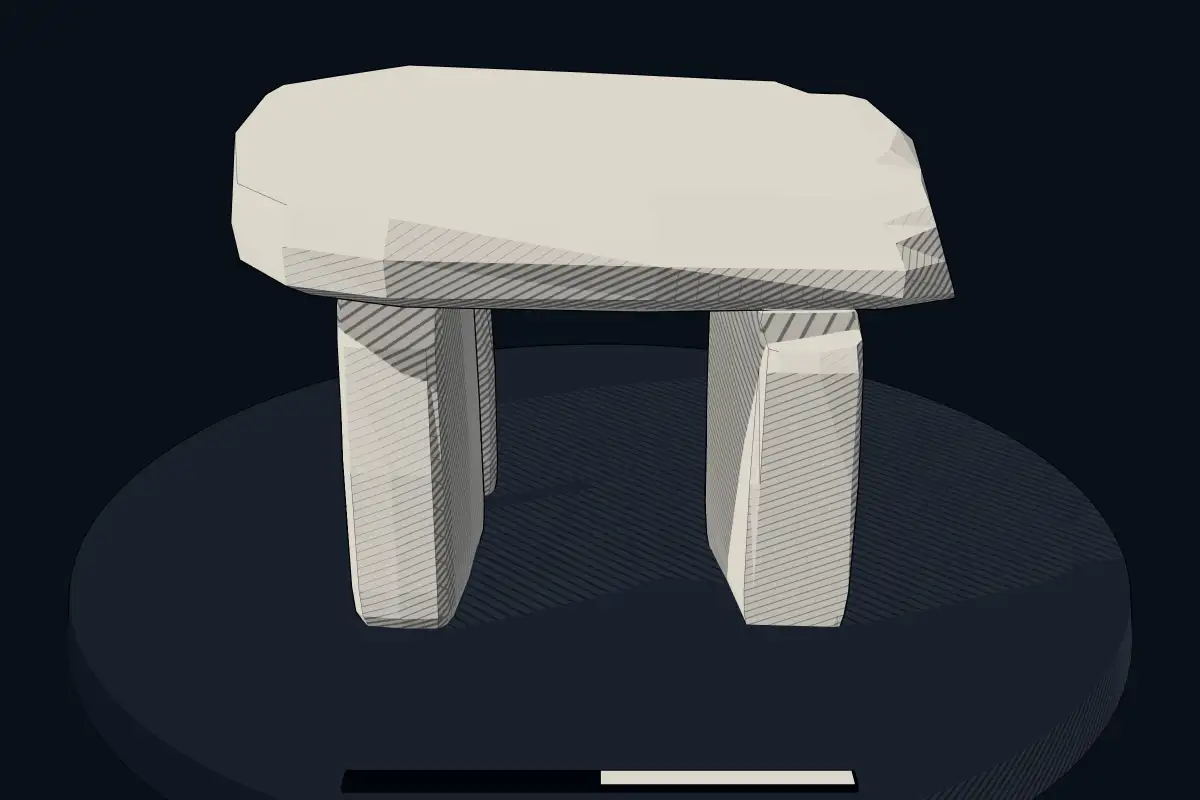
The reconstruction is ours, not a survey: it shows what a monument of this type looks like, at the size the record gives for this one.
Photographs
6 photographs, each with its author and licence
More photographs
Lore
Evidence & Lore
What the sources actually support — and, kept apart, what has been claimed.
What the evidence supports
Dates
Est. 3500–2800 BCEHow this date was established: Type comparisonTypical range for dolmens in Germany; this site has not been dated itself. German dolmens (Huengrab) belong to the Nordic megalith tradition which emerged predominantly between 3500 and 2800 BC.Source for this date
Where it stands
Germany
The pin marks the monument itself — its exact point.
- Coordinates
- 53°01′21″ N, 6°36′45″ EFor a GPS or map app: 53.02250, 6.61250
Access is as our sources describe it; we have not visited the site to check.
Nearby
The closest sites in the Atlas, by straight line.




Sources
Every record behind this page, with the link it came from.
2 sources behind this page
- 01Wikidata Q1807604wikidata.org
- 02Source for this dateen.wikipedia.org
Image files
- Hunebed D15 bij Loon2.jpgGouwenaarPublic domain
- Hunebed Loon at sunset.jpgGorissMCC BY-SA 2.0
- Hunebed Loon.jpgAlex HoekerdCC0
- Hunebed-D15-bij-Loon3.jpgGouwenaarPublic domain
- Hunebed D15 Goedeljee.jpgJan Goedeljee (1824-1905)CC BY 4.0
- Hunebed D15 bij Loon.jpgRonnPublic domain
Report a correctionWrong date, name, photograph or source? Tell us and it will be put right.
Around this place
The ten nearest sites, by compass
Credit
Text, licence and sources
Text from the Wikipedia article "Großsteingrab Loon" (German), licensed CC BY-SA 4.0; authors are listed in the page history. Reused under CC BY-SA 4.0. Read on Wikipedia · Edit history and authors
- Wikipedia (German): Großsteingrab LoonCC BY-SA 4.0
- Wikidata Q1807604CC0