
Menhirs of Corcelles
Also known asCorcelles, neolithic menhirs
DatedEst. 2800–1800 BCE
Photo cybergötti · Public domainSource file on Wikimedia Commons

Overview
About this site
What the sources say
Die Menhire von Corcelles stehen bei Corcelles-près-Concise im Kanton Waadt in der Schweiz, an einem Feldweg einige 100 m nordwestlich der Ortschaft. Die Menhirgruppe stammt aus neolithischer Zeit und trägt im Volksmund den Namen «Pierres Longues» oder «Les Pyramides».
Es handelt sich um vier Findlinge aus Granit, von denen drei Originale sind, während der vierte laut Aufschrift von 1840 von S. de Meuron als Ersatz für einen im 18. Jahrhundert entfernten Stein aufgestellt wurde. Die in einem Parallelogramm angeordneten Steine sind zwischen 2 und 2,5 Meter hoch. Der südöstliche Menhir weist Schälchen mit Durchmessern zwischen 3 und 9 cm auf.
Bei der 1994 durchgeführten Grabung entdeckte man in einem mit Kieselsteinen verfüllten Graben zwei weitere Menhire. Das vor allem aus Keramikfragmenten bestehende Fundmaterial erlaubt es, die Anlage in die 2. Hälfte des 5. Jahrtausends v. Chr. zu datieren. Es wird angenommen, dass die Megalithanlage als Ort sozialer bzw. religiöser Aktivitäten diente.
Article in GermanRead on Wikipedia3 min readCC BY-SA 4.0
Where it sits in time
The site's dated range, placed against world reference points.
The scale is logarithmic: each step to the left is about ten times older than the last.
The full article
Menhirs of Corcelles: the whole story
In briefSources for this section
- Wikipedia (German): Menhire von CorcellesCC BY-SA 4.0
Sources for this section
- Wikipedia (German): Menhire von CorcellesCC BY-SA 4.0
The Menhirs of Corcelles stand at Corcelles-près-Concise in the canton of Waadt, Switzerland, beside a field path a few 100 m northwest of the settlement. The group is also known as “Corcelles, neolithic menhirs” and belongs to the Neolithic period.
The visible group consists of four granite boulders arranged in a parallelogram. Three are original standing stones; the fourth was erected in 1840 by S. de Meuron to replace a stone removed in the 18th century. The menhirs are between 2 and 2.5 meters high. The southeastern stone has cup-like hollows measuring between 3 and 9 cm across.
Excavation in 1994 revealed two additional menhirs in a trench filled with pebbles. Most of the associated finds were ceramic fragments. These allowed the monument to be dated to the 2. Hälfte des 5. Jahrtausends v. Chr., within the broader estimated period of 2800 BCE to 1800 BCE. The site is thought to have served as a place for social or religious activities.
The group is known in local tradition as “Pierres Longues” or “Les Pyramides.” More generally, menhirs occur across central and southern Europe outside the Atlantic fringe, although their numbers, forms and histories vary considerably by region.
Wikidata describes it as: archaeological site in Corcelles-près-Concise, in the canton of Vaud, Switzerland.
Summary in EnglishSources for this section
- Wikipedia (German): Menhire von CorcellesCC BY-SA 4.0
Sources for this section
- Wikipedia (German): Menhire von CorcellesCC BY-SA 4.0
Menhirs of Corcelles is a menhir (standing stone) in Corcelles-près-Concise, Switzerland. Wikidata describes it as: archaeological site in Corcelles-près-Concise, in the canton of Vaud, Switzerland. A typological estimate: 2800 BCE to 1800 BCE. No English Wikipedia article exists for it; the full text below is the German article "Menhire von Corcelles", shown in the original language.
How this page was madeSources for this section
- Wikipedia (German): Menhire von CorcellesCC BY-SA 4.0
Sources for this section
- Wikipedia (German): Menhire von CorcellesCC BY-SA 4.0
The summary at the top of this page was written by MiniMax-M3 (2026-11-08) from the cited Wikipedia article “Menhire von Corcelles”, translated from German. The numbers in it were checked automatically against the source text. The rest of the page is the article itself, the structured records and computed distances.
Tradition and region
About this kind of monument
Central and southern European menhirs
Outside the Atlantic fringe, menhirs also occur across central and southern Europe. In the Czech Republic there are about 40 real menhirs and dozens of stones that could also be menhirs, and others have been erected recently. The largest real menhir is Kamenný pastýř, the "stony shepherd", near Klobuky, 3.3 metres high; the Czech menhirs are probably the last outcrop of a tradition that ran across northern Germany. Some of the Czech stones in the Atlas may be natural boulders.
Italy has its most famous menhirs in Sardinia, where at least 332 standing stones can be seen. They include elaborate "statue-menhirs" that show a human face at the top and gendered symbols on the flat front; over a hundred of this standardised type have been found, mostly around the village of Laconi. In the Sardinian language they are called perdas fittas or perdas lungas. In Switzerland, in the canton of Vaud, several menhirs form linear patterns at Clendy in Yverdon-les-Bains, and date back to the third millennium BCE.
A statue menhir is a carved standing stone of the later European Neolithic, in which a slab or pillar has a stylised human figure cut into it, sometimes with hints of clothing or weapons. They are most commonly found in southern and western France, Catalonia, Corsica, Sardinia, Italy and the Alps.
Menhirs are usually difficult to date, and those without excavation can only be given a broad range. A stone's present position is not always its original one.
When visiting, check whether a stone stands in its original position and look for signs of shaping.
Paraphrased from Wikipedia: Menhir, Wikipedia: List of menhirs, Wikipedia: Statue menhir · CC BY-SA 4.0
From the article
Dated moments in the story
- 1994
Bei der 1994 durchgeführten Grabung entdeckte man in einem mit Kieselsteinen verfüllten Graben zwei weitere Menhire.
Source
See it in 3D
An interpretive reconstruction of the monument, standing on the real ground at its exact point, under the sun for that place and season. Drag to look around it.
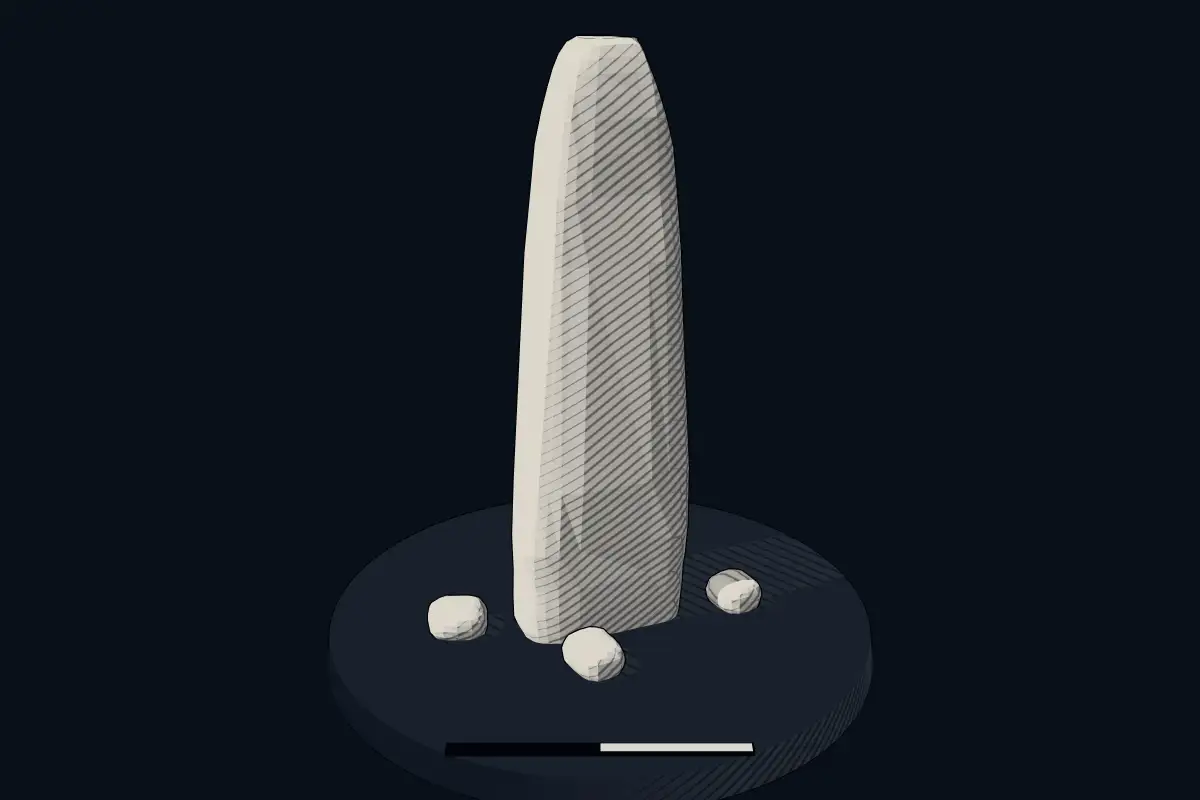
The reconstruction is ours, not a survey: it shows what a monument of this type looks like, at the size the record gives for this one.
Photographs
3 photographs, each with its author and licence
More photographs


Lore
Evidence & Lore
What the sources actually support — and, kept apart, what has been claimed.
What the evidence supports
Dates
Est. 2800–1800 BCEHow this date was established: Type comparisonTypical range for menhirs in Switzerland; this site has not been dated itself. Standing stones are associated with the Beaker people of the European late Neolithic and early Bronze Age c. 2800-1800 BC.Source for this date
Where it stands
Switzerland
The pin marks the monument itself — its exact point.
- Coordinates
- 46°51′00″ N, 6°42′08″ EFor a GPS or map app: 46.85012, 6.70221
Access is as our sources describe it; we have not visited the site to check.
Nearby
The closest sites in the Atlas, by straight line.
 Dolmen of Praz Berthoud
 Bonvillars Menhir2800–1800 BCE
 menhir de Grandson2800–1800 BCE
- Champs des Echâtelards, neolithic menhir2800–1800 BCE
- Menhir (standing stone)menhir de Saint-Aubin-Sauges2800–1800 BCE
- Menhir (standing stone)Menhir von Gorgier2800–1800 BCE
 Menhirs de Clendy
- Menhir (standing stone)menhirs de la forêt du Devens2800–1800 BCE


Sources
Every record behind this page, with the link it came from.
2 sources behind this page
- 01Wikidata Q1920563wikidata.org
- 02Source for this dateen.wikipedia.org
Image files
- Menhire von Corcelles.JPGcybergöttiPublic domain
- Menhirs de Concise - panoramio.jpgMartoufCC BY-SA 3.0
- Corcelles-pres-Concises, menhir et château.jpgLeemburg-CHCC BY-SA 4.0
Report a correctionWrong date, name, photograph or source? Tell us and it will be put right.
Lore, kept apart
Legends and claims
These are stories and claims reported by the sources. They are not evidence, and they never stand in for the dating above.
- Tradition
The group is known in local tradition as “Pierres Longues” or “Les Pyramides.” More generally, menhirs occur across central and southern Europe outside the Atlantic fringe, although their numbers, forms and histories vary considerably by re
The group is known in local tradition as “Pierres Longues” or “Les Pyramides.” More generally, menhirs occur across central and southern Europe outside the Atlantic fringe, although their numbers, forms and histories vary considerably by region.
Source
Around this place
The ten nearest sites, by compass
- Dolmen of Praz Berthoud0.9 km W
- Bonvillars Menhir3.0 km SW
- menhir de Grandson5.6 km SW
- Champs des Echâtelards, neolithic menhir5.6 km SW
- menhir de Saint-Aubin-Sauges5.6 km NE
- Menhir von Gorgier7.8 km NE
- Menhirs de Clendy8.5 km SW
- menhirs de la forêt du Devens9.3 km NE
- Vauroux, Neolithic menhir11 km NE
- ensemble mégalithique de Treytel-A Sugiez11 km NE
Credit
Text, licence and sources
Text from the Wikipedia article "Menhire von Corcelles" (German), licensed CC BY-SA 4.0; authors are listed in the page history. Reused under CC BY-SA 4.0. Read on Wikipedia · Edit history and authors
- Wikipedia (German): Menhire von CorcellesCC BY-SA 4.0
- Wikidata Q1920563CC0