Menhir von Gorgier
DatedEst. 2800–1800 BCE
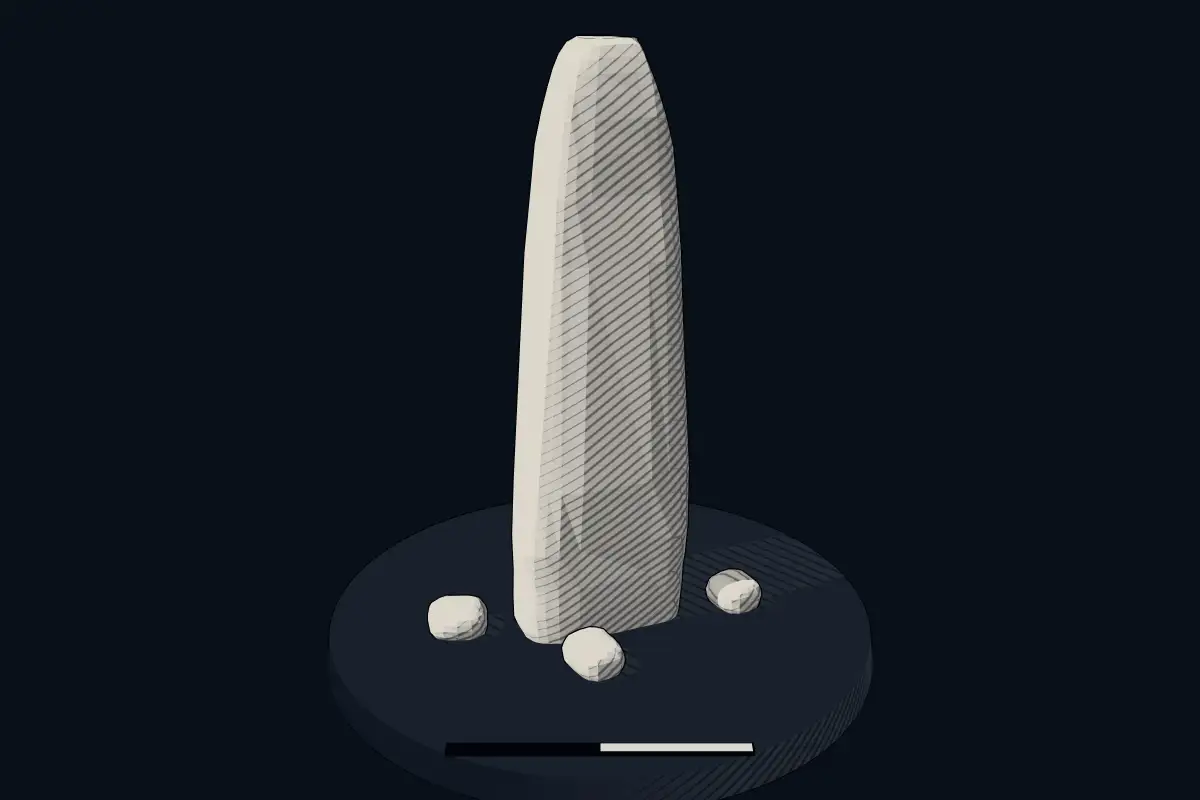
No licensed photograph yetWe have no photograph we may publish for this site, so the interpretive 3D view leads instead.
Overview
About this site
What the sources say
La forêt du lieu-dit Le Devens, qui chevauche les anciennes communes de Saint-Aubin-Sauges et de Gorgier, dans le canton de Neuchâtel, Suisse, abrite en plus de tumulus et d'autres vestiges deux menhirs d'intérêt : le Grand Menhir de la forêt du Devens, et le menhir tronqué de la forêt du Devens.
Article in FrenchRead on Wikipedia7 min readCC BY-SA 4.0
Where it sits in time
The site's dated range, placed against world reference points.
The scale is logarithmic: each step to the left is about ten times older than the last.
The full article
Menhir von Gorgier: the whole story
In briefSources for this section
Sources for this section
Menhir von Gorgier, also called the Grand Menhir de la forêt du Devens, is a Neolithic standing stone in the forest of Le Devens, a site spanning the former communes of Saint-Aubin-Sauges and Gorgier in the canton of Neuchâtel, Switzerland. It stands in a small clearing near Chemin de l'Établissement, close to the Menhir Tronqué De La Forêt Du Devens and the Menhir du Pré de Devens. Together the three stones form a triangle with a few hundred metres between the points.
The standing stone is a block of granite about 3 m high and 1.4 m wide, with a regular, tapering shape. A pit dug around it was investigated by Dr Gustave Clément in the 1860s. About thirty centimetres down, he found a broad slab of reddened granite covered with abundant charcoal, probably marking a hearth at the foot of the stone. Prehistoric ceramic fragments were also recovered.
There is no secure archaeological context nearby for dating this kind of isolated megalith, and the ceramic sherds found during the excavations were not precisely dated. The stone was probably erected during the Ve millénaire av. J.-C., in the Néolithique moyen, or in the IIIe millénaire av. J.-C., during a second phase of megalithic construction in the Néolithique final. Its date is therefore given as 2800 BCE to 1800 BCE by typological estimate.
The nearby Menhir tronqué de la Forêt Du Devens was described by Albert Vouga in 1881 as a roughly pyramidal granite block about 3 m high, balanced on a rectangular base of 2 m by 1 m. Its upper part was cut away, probably by granitiers transalpins, and the surviving 1 m of base bears cutting marks. Monoliths of this kind appeared in what is now Switzerland in the Ve millénaire av. J.-C. alongside agriculture, and may have served as path markers, orientation points, or markers of sacred and ritual places.
No English Wikipedia article exists for it; the full text below is the French article "Menhirs de la forêt du Devens", shown in the original language.
Summary in EnglishSources for this section
Sources for this section
Menhir von Gorgier is a menhir (standing stone) in Switzerland. A typological estimate: 2800 BCE to 1800 BCE. No English Wikipedia article exists for it; the full text below is the French article "Menhirs de la forêt du Devens", shown in the original language.
Le Grand MenhirSources for this section
Sources for this section
Le Grand Menhir de la forêt du Devens (aussi appelé menhir de Gorgier) est un mégalithe datant du Néolithique situé sur le territoire de Gorgier, dans le canton de Neuchâtel, en Suisse.
Situation
Le menhir se dresse dans une petite clairière de la forêt du Devens, à proximité du Chemin de l'Établissement. Il est implanté à proximité de deux autres menhirs, le Menhir Tronqué De La Forêt Du Devens et Le Menhir du Pré de Devens. Tous trois forment un triangle avec quelques centaines de mètres de distance entre les points
.
Description
Constituée d'un bloc de granit, la pierre mesure environ 3 m de hauteur pour 1,4 m de largeur. Sa forme est régulière et effilée
.
La fosse creusée autour du menhir est le résultat des fouilles entreprises dans les années 1860 par le Dr Gustave Clément, amateur d'antiquités. La large dalle de granite rougi mise au jour à une trentaine de centimètres de profondeur était recouverte de charbon de bois en grande quantité, ce qui indique vraisemblablement l'existence d'un foyer au pied du menhir. Les fragments de céramique trouvés lors de ces fouilles datent de la Préhistoire.
Ce genre de mégalithes isolés est difficile à dater, vu le manque de vestiges attestés en contexte archéologique contrôlé dans les alentours, sur lesquels se baserait la datation; les tessons de céramiques retrouvés lors des fouilles du Grand Menhir de la forêt du Devens n'ont en effet pas été datés précisément. Cependant, il est probable que le menhir a été dressé en même temps qu'une grande partie des monuments mégalithiques en Suisse pendant le Ve millénaire av. J.-C. (Néolithique moyen) ou sinon, au IIIe millénaire av. J.-C. lors d'une deuxième phase de construction de sites mégalithiques (Néolithique final).
Le Menhir TronquéSources for this section
Sources for this section
Le menhir tronqué de la Forêt du Devens est un menhir partiellement conservé à proximité du menhir de Gorgier
Situation
Le menhir se trouve aussi sur le lieu-dit Le Devens, à 300 m sud-ouest du Menhir de Gorgier et à 200 m à l'est du Menhir du Pré de Devens, avec lesquels il forme un triangle avec quelques centaines de mètres de distance entre les points.
Description
Le menhir tronqué de la forêt du Devens fut décrit par Albert Vouga en 1881 en tant qu'un bloc en granite avec une forme pyramidale régulière d'environ 3 m de hauteur et qui se trouvait en équilibre sur une base rectangulaire de 2 m sur 1 m. Le menhir étant alors recouvert de végétation, il n'en existe pas de dessin ou de mesures exactes dans sa taille originale. Il était le plus élevé des trois menhirs sur le lieu-dit Le Devens ; l'une des quatre faces était parfaitement unie, ce qui serait dû au travail de l'homme.
Pendant la deuxième moitié du XIXe siècle, la partie supérieure a été débitée, probablement par des granitiers transalpins alors installés dans la région. La base est encore visible sur 1 m de hauteur et porte des traces de ce débitage. Ce genre de débitage permettait aux granitiers de démontrer leur habileté et d'exploiter le granite dur pour la fabrication de fontaines, bassins, pressoirs ou de bornes routières.
Tout comme le Grand Menhir de la forêt du Devens, sa datation ne peut être qu'estimée au Ve millénaire av. J.-C. ou au IIIe millénaire av. J.-C. au sein de l'une des deux phases de construction mégalithique en Suisse, au Néolithique moyen ou au Néolithique final.
SignificationSources for this section
Sources for this section
C'est au cours du Ve millénaire av. J.-C. que les menhirs apparaissent dans les régions aujourd'hui sur territoire suisse. Ils arrivent avec l'agriculture, mais se concentrent principalement en Suisse Romande, notamment sur la rive nord du lac de Neuchâtel, le bassin lémanique et la haute vallée du Rhône. Leur fabrication se fait à part de blocs erratiques d'origine alpine, en raison de leur résistance à l'érosion et donc avec la garantie de pérennité du monument ; leurs formes sont géométriques (comme dans le cas des deux menhirs de la forêt du Devens) ou, plus rarement, anthropomorphiques. Les sites avec plusieurs menhirs en alignement, comme à Treytel-A Sugiez ou Saint-Aubin/Derrière La Croix, peuvent être interprétés comme des lieux revêtus d'une signification symbolique et/ou rituelle, mais la signification des menhirs individuels qui jalonnent la rive nord du lac de Neuchâtel est plus difficiles à interpréter. Depuis le bord du lac jusqu'au dernières moraines sur les flancs du Jura à 650 m d'altitude, ces menhirs ont été érigés sur des terrasses, ce qui pourrait indiquer qu'ils servaient en tant que balises de chemins, indication d'une source d'eau ou de matière première ou encore d'un croisement de chemins. Étant les seuls monuments pérennes dans la région au Néolithique, ils ont aussi pu servir en tant que points d'orientation et de structuration des terres pour ces premières communautés d'agriculteurs, tout comme ils auraient pu être érigés pour indiquer des lieux sacrés, des lieux de rituels, pour représenter des dieux ou encore pour commémorer des personnages de leur communauté.
BibliographieSources for this section
Sources for this section
Elena Burri-Wyser, Christian Falquet, France Terrier et Sonia Wüthrich, D'un Mégalithe A L'autre: entre Yverdon-Les-Bains VD et Hauterive NE, Yverdon-Les-Bains, Musée d'Yverdon et région, 2012, 84 p. (ISBN 978-2-8399-1052-1).
(de) Sonia Wüthrich (dir.), « Monumente für die Ewigkeit: Menhire in der Westschweiz », Archàologie in der Schweiz, Hier und Jetzt « Lebensweisen in der Steinzeit », 2017, p. 168-171 (ISBN 978-3-03919-397-4).
How this page was madeSources for this section
Sources for this section
The summary at the top of this page was written by MiniMax-M3 (2026-11-08) from the cited Wikipedia article “Menhirs de la forêt du Devens”, translated from French. The numbers in it were checked automatically against the source text. The rest of the page is the article itself, the structured records and computed distances.
Tradition and region
About this kind of monument
Central and southern European menhirs
Outside the Atlantic fringe, menhirs also occur across central and southern Europe. In the Czech Republic there are about 40 real menhirs and dozens of stones that could also be menhirs, and others have been erected recently. The largest real menhir is Kamenný pastýř, the "stony shepherd", near Klobuky, 3.3 metres high; the Czech menhirs are probably the last outcrop of a tradition that ran across northern Germany. Some of the Czech stones in the Atlas may be natural boulders.
Italy has its most famous menhirs in Sardinia, where at least 332 standing stones can be seen. They include elaborate "statue-menhirs" that show a human face at the top and gendered symbols on the flat front; over a hundred of this standardised type have been found, mostly around the village of Laconi. In the Sardinian language they are called perdas fittas or perdas lungas. In Switzerland, in the canton of Vaud, several menhirs form linear patterns at Clendy in Yverdon-les-Bains, and date back to the third millennium BCE.
A statue menhir is a carved standing stone of the later European Neolithic, in which a slab or pillar has a stylised human figure cut into it, sometimes with hints of clothing or weapons. They are most commonly found in southern and western France, Catalonia, Corsica, Sardinia, Italy and the Alps.
Menhirs are usually difficult to date, and those without excavation can only be given a broad range. A stone's present position is not always its original one.
When visiting, check whether a stone stands in its original position and look for signs of shaping.
Paraphrased from Wikipedia: Menhir, Wikipedia: List of menhirs, Wikipedia: Statue menhir · CC BY-SA 4.0
From the article
Dated moments in the story
- 978 CE
(ISBN 978-2-8399-1052-1). (de) Sonia Wüthrich (dir.), « Monumente für die Ewigkeit: Menhire in der Westschweiz », Archàologie in der Schweiz, Hier und Jetzt « Lebensweisen in der Steinzeit », 2017, p.
Source - 978 CE
168-171 (ISBN 978-3-03919-397-4).
Source - 1860
La fosse creusée autour du menhir est le résultat des fouilles entreprises dans les années 1860 par le Dr Gustave Clément, amateur d'antiquités.
Source - 2012
Elena Burri-Wyser, Christian Falquet, France Terrier et Sonia Wüthrich, D'un Mégalithe A L'autre: entre Yverdon-Les-Bains VD et Hauterive NE, Yverdon-Les-Bains, Musée d'Yverdon et région, 2012, 84 p.
Source
See it in 3D
An interpretive reconstruction of the monument, standing on the real ground at its exact point, under the sun for that place and season. Drag to look around it.
The reconstruction is ours, not a survey: it shows what a monument of this type looks like, at the size the record gives for this one.
Lore
Evidence & Lore
What the sources actually support — and, kept apart, what has been claimed.
What the evidence supports
Dates
Est. 2800–1800 BCEHow this date was established: Type comparisonTypical range for menhirs in Switzerland; this site has not been dated itself. Standing stones are associated with the Beaker people of the European late Neolithic and early Bronze Age c. 2800-1800 BC.Source for this date
Where it stands
Switzerland
The pin marks the monument itself — its exact point.
- Coordinates
- 46°54′16″ N, 6°46′05″ EFor a GPS or map app: 46.90440, 6.76810
Access is as our sources describe it; we have not visited the site to check.
Nearby
The closest sites in the Atlas, by straight line.
- Menhir (standing stone)menhirs de la forêt du Devens2800–1800 BCE
- Menhir (standing stone)menhir de Saint-Aubin-Sauges2800–1800 BCE
 Vauroux, Neolithic menhir2800–1800 BCE
- Stone row (alignment)ensemble mégalithique de Treytel-A Sugiez
 Menhirs of Corcelles2800–1800 BCE
 Dolmen of Praz Berthoud
 Bonvillars Menhir2800–1800 BCE
 menhir de Grandson2800–1800 BCE


Sources
Every record behind this page, with the link it came from.
2 sources behind this page
- 01Wikidata Q56302462wikidata.org
- 02Source for this dateen.wikipedia.org
Report a correctionWrong date, name, photograph or source? Tell us and it will be put right.
Around this place
The ten nearest sites, by compass
- menhirs de la forêt du Devens2.1 km E
- menhir de Saint-Aubin-Sauges2.4 km S
- Vauroux, Neolithic menhir3.0 km NE
- ensemble mégalithique de Treytel-A Sugiez3.5 km NE
- Menhirs of Corcelles7.8 km SW
- Dolmen of Praz Berthoud8.6 km SW
- Bonvillars Menhir11 km SW
- menhir de Grandson13 km SW
- Champs des Echâtelards, neolithic menhir13 km SW
- Menhirs de Clendy16 km SW
Credit
Text, licence and sources
Text from the Wikipedia article "Menhirs de la forêt du Devens" (French), licensed CC BY-SA 4.0; authors are listed in the page history. Reused under CC BY-SA 4.0. Read on Wikipedia · Edit history and authors