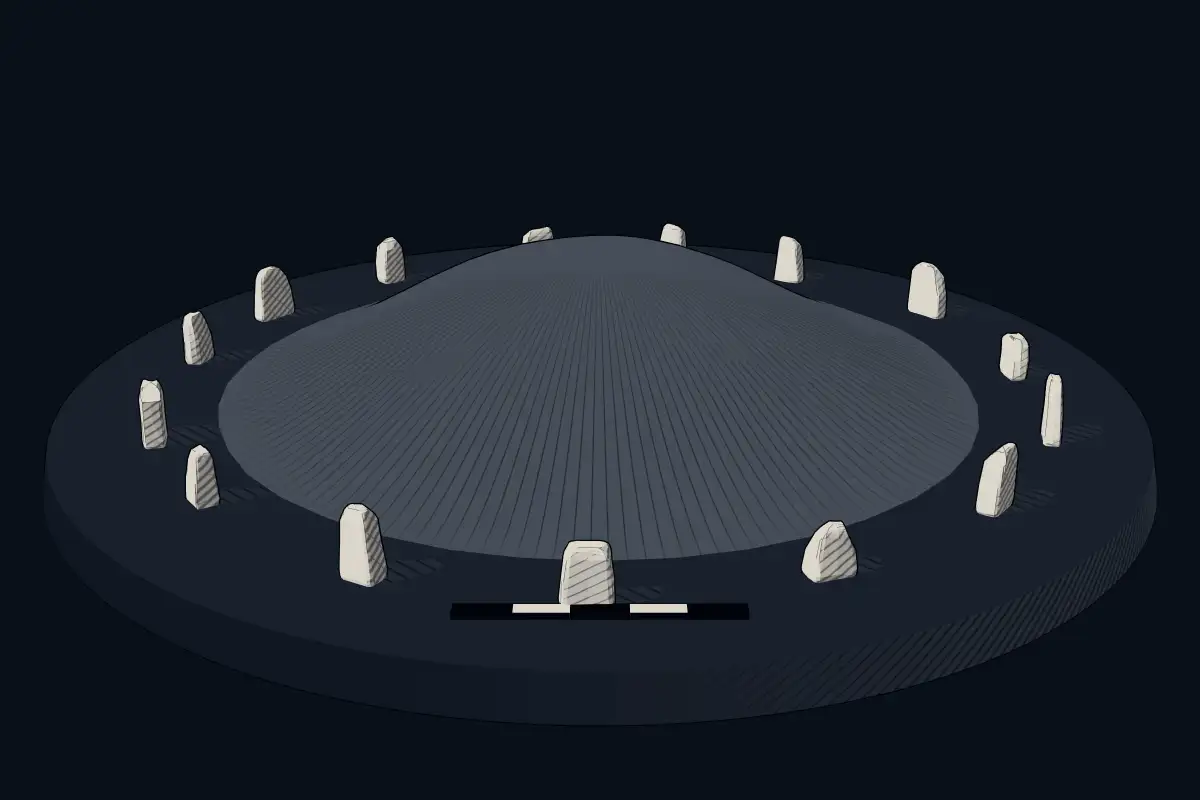
Megalithic mound (tumulus with integral stones)
Бяльмонты, курганны могільнік
No licensed photograph yetWe have no photograph we may publish for this site, so the interpretive 3D view leads instead.
Overview
About this site
Overview
Bialmonty (Belarusian Бяльмонты) is a barrow cemetery of the Baltic-Slavic population of the eighth to tenth centuries, on the territory of the former Bialmonty estate, 0.5 km south of the village of Akhremauzy in the Braslau district of the Vitebsk region, Belarus. It lies in woodland, to the right of the Braslau to Sharkawshchyna road. The site is listed as cultural heritage of Belarus (category 3, regional significance, code 213В000175).
Read on Wikipedia1 min readCC BY-SA 4.0
Article
Бяльмонты, курганны могільнік
ExcavationsSources for this section
Sources for this section
Fourteen barrows were investigated, in 1892, in 1938, in the 1970s and in 1982.
The finds include iron and bronze buckles, a finger ring, lunula-shaped temple rings, fragments of a bronze ornament and hand-modelled vessels.
FindsSources for this section
Sources for this section
The burial rite was cremation. The finds include iron and bronze buckles, a finger ring, lunula-shaped temple rings, fragments of a bronze ornament and hand-modelled vessels.
ContextSources for this section
Sources for this section
Along the southern and eastern shores of the Baltic, burial mounds mark the territories of the Baltic peoples. In Lithuanian they are called pilkapiai. Such sites are barrow cemeteries and not megaliths.
Tradition and region
About this kind of monument
Baltic barrow cemeteries
Along the southern and eastern shores of the Baltic, burial mounds mark the territories of the Baltic peoples. In Lithuanian they are called pilkapiai, and the Atlas's Lithuanian and Belarusian records are mostly cemeteries of small mounds recorded in national registers. They are barrow cemeteries and not megaliths.
The deepest root of the tradition is the West Baltic barrow culture of the early Iron Age, from which most of the Western Baltic culture arose. That culture, of the Bronze Age and Iron Age along the southern coast of the Baltic, was ethnically Baltic and shared similar monuments and funeral rites; its tribes included the Old Prussians, Galindians, Yotvingians and Skalvians. Further north, the Curonians, a medieval Baltic tribe of the fifth to sixteenth centuries CE, lived on the coast of what are now western Latvia and Lithuania, and their neighbours the Samogitians lived inland to the east. Mounds of the broader barrow tradition, the kurgans, had spread into eastern and northern Europe as early as the third millennium BCE.
Because a cemetery is made up of many small mounds, it records an ordinary community and not a single ruler. Many of these mounds have not been excavated, so the Atlas gives them a broad range and does not claim a date.
When visiting, look for a group of small round mounds under trees or on a river terrace, and note how the mounds are laid out along the terrace or ridge.
Paraphrased from Wikipedia: Western Baltic culture, Wikipedia: Curonians, Wikipedia: Samogitians, Wikipedia: Kurgan, Wikipedia: Tumulus · CC BY-SA 4.0
See it in 3D
An interpretive reconstruction of the monument, standing on the real ground at its exact point, under the sun for that place and season. Drag to look around it.
The reconstruction is ours, not a survey: it shows what a monument of this type looks like, at the size the record gives for this one.
Where it stands
Belarus
The pin marks the monument itself — its exact point.
- Coordinates
- 55°20′34″ N, 27°04′12″ EFor a GPS or map app: 55.34270, 27.07000
Access is as our sources describe it; we have not visited the site to check.
Nearby
The closest sites in the Atlas, by straight line.
- Megalithic mound (tumulus with integral stones)Замошша (археалагічныя помнікі)
- Megalithic mound (tumulus with integral stones)Богіна (курганны могільнік)
- Megalithic mound (tumulus with integral stones)Галбея, археалагічны помнік
- Megalithic mound (tumulus with integral stones)Далёкія (курганны могільнік)
- Megalithic mound (tumulus with integral stones)Мосар (курганны могільнік)
- Megalithic mound (tumulus with integral stones)Лынтупы (курганны могільнік)
- Megalithic mound (tumulus with integral stones)Майшулі (археалагічныя помнікі)
- Megalithic mound (tumulus with integral stones)Нарушова (курганны могільнік)
Sources
Every record behind this page, with the link it came from.
1 source behind this page
- 01Wikidata Q21390546wikidata.org
Report a correctionWrong date, name, photograph or source? Tell us and it will be put right.
Around this place
The ten nearest sites, by compass
- Замошша (археалагічныя помнікі)5.5 km S
- Богіна (курганны могільнік)13 km W
- Галбея, археалагічны помнік17 km SE
- Далёкія (курганны могільнік)19 km NW
- Мосар (курганны могільнік)27 km SE
- Лынтупы (курганны могільнік)28 km S
- Майшулі (археалагічныя помнікі)32 km N
- Нарушова (курганны могільнік)36 km E
- Опса38 km W
- Вусце (курганны могільнік)39 km W
Credit
Text, licence and sources
Adapted from the Wikipedia article "Бяльмонты (курганны могільнік)" (Belarusian), licensed CC BY-SA 4.0; authors are listed in the page history. Reused under CC BY-SA 4.0. Read on Wikipedia · Edit history and authors