Правият камък
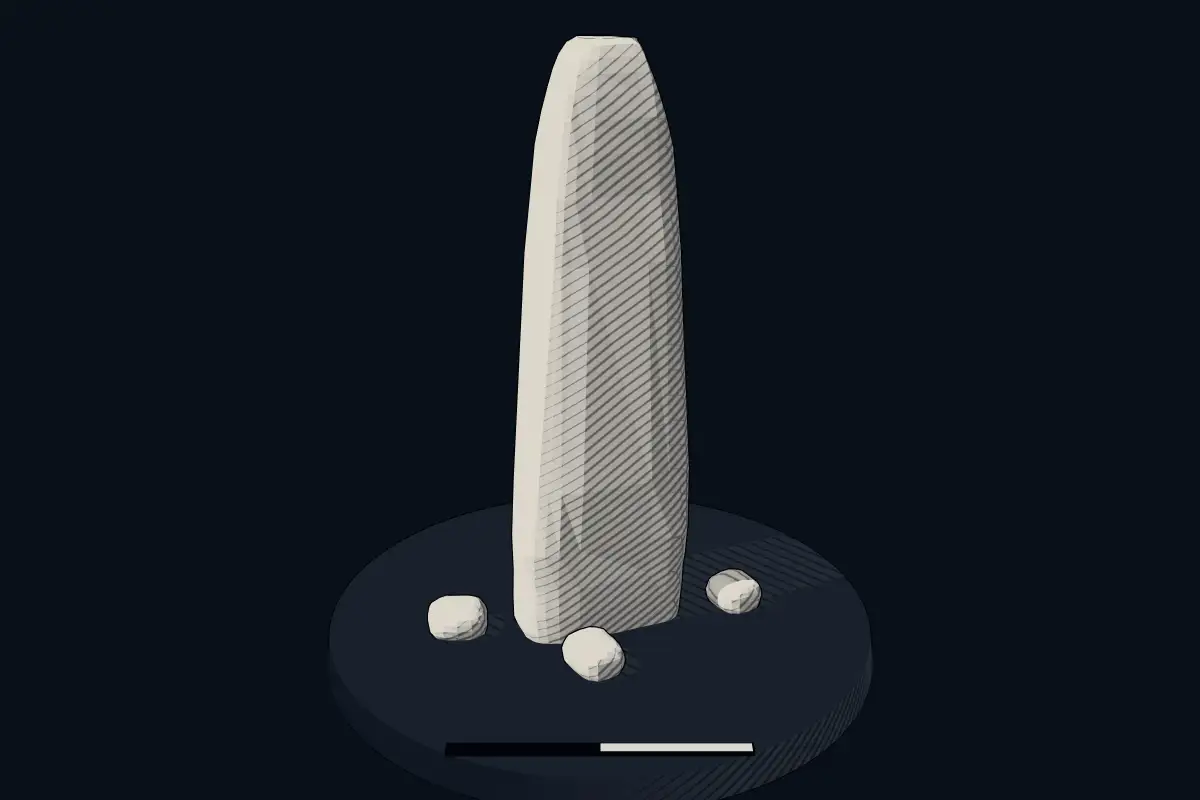
No licensed photograph yetWe have no photograph we may publish for this site, so the interpretive 3D view leads instead.
Overview
About this site
What the sources say
Правият камък е менхир на западния склон на възвишение до с. Петокладенци (Област Плевен).
Article in BulgarianRead on Wikipedia2 min readCC BY-SA 4.0
The full article
Правият камък: the whole story
In briefSources for this section
- Wikipedia (Bulgarian): Правият камъкCC BY-SA 4.0
Sources for this section
- Wikipedia (Bulgarian): Правият камъкCC BY-SA 4.0
Правият камък is a menhir, or standing stone, on the western slope of a hill near с. Петокладенци, Област Плевен, Bulgaria. It was set above a mound, probably as a cult sign. The local population also calls it „побит камък“.
The monument is a roughly split stone block with no visible signs of worked surface. It has an elongated, four-sided form that narrows toward the top. Its height above ground is 2,20 m. At the base it is 0,74 m wide and 0,58 m thick; higher up, its width is 0,72 m and its thickness 0,24 m.
Правият камък is damaged: a piece about 0,50 m high has broken away from its top. Prof. Димитрина Митова-Джонова regarded it as a cultic pagan monument that was reinterpreted in Christian times and came to be worshipped as a votive offering.
Standing stones are large upright stones placed by people. The tradition describes them as common in Europe, Africa and Asia, especially in Western Europe. Their purposes remain uncertain and may include ritual, territorial marking, or an ideological role. Some are associated with religious ceremonies and burial chambers.
No English Wikipedia article exists for it; the full text below is the Bulgarian article "Правият камък", shown in the original language.
Summary in EnglishSources for this section
- Wikipedia (Bulgarian): Правият камъкCC BY-SA 4.0
Sources for this section
- Wikipedia (Bulgarian): Правият камъкCC BY-SA 4.0
Правият камък is a menhir (standing stone) in Petokladentsi, Bulgaria. No English Wikipedia article exists for it; the full text below is the Bulgarian article "Правият камък", shown in the original language.
ОписаниеSources for this section
- Wikipedia (Bulgarian): Правият камъкCC BY-SA 4.0
Sources for this section
- Wikipedia (Bulgarian): Правият камъкCC BY-SA 4.0
Т.нар. от местното население „побит камък“ – менхир е поставен над могилен насип, вероятно като като култов знак. Обектът представлява грубо отцепен каменен блок без видими следи от обработка, с удължена, четиристранна форма, стеснена в горния край. Височината му над земята е 2,20 m, а в основата си е широк 0,74 m и дебел 0,58 m. Във височина широчината му е 0,72 m, а дебелината – 0,24 m.
Според проф.Димитрина Митова-Джонова култовият езически паметник Правият камък е преосмислен като християнски и се почита се като оброк.
Правият камък, е с нарушена цялост – от върха му е отнето парче с височина около 0,50 m.
How this page was madeSources for this section
- Wikipedia (Bulgarian): Правият камъкCC BY-SA 4.0
Sources for this section
- Wikipedia (Bulgarian): Правият камъкCC BY-SA 4.0
The summary at the top of this page was written by MiniMax-M3 (2026-11-08) from the cited Wikipedia article “Правият камък”, translated from Bulgarian. The numbers in it were checked automatically against the source text. The rest of the page is the article itself, the structured records and computed distances.
Tradition and region
About this kind of monument
Menhirs
A menhir, also called a standing stone, orthostat or lith, is a large upright stone placed by humans, typically dating from the European middle Bronze Age, although many are far older. They stand singly or in groups, vary greatly in size, and often taper toward the top. Menhirs are found across Europe, Africa and Asia, with a concentration in Western Europe, notably in Ireland, Great Britain and Brittany. Theories about their purpose remain speculative and include rituals, territorial markers and elements of an ideological system. Some bear engravings, including human figures and symbols, and are often associated with ancient religious ceremonies and burial chambers. Because the great majority are on coasts, islands and peninsulas, it is believed that practitioners of megalithic religions travelled by sea.
Armenia has numerous menhirs known as vishapakar, "dragon stones", which are cigar-shaped, typically 3 to 6 metres tall and often found in the mountains near the sources of rivers or lakes. Many are carved in the shape of a fish. An inscription in Urartian cuneiform on one at the temple of Garni shows that they were made before the Urartian kingdom, before the eighth century BCE, and the earliest are thought to date to the eighteenth to sixteenth centuries BCE.
In Bulgaria several menhirs are known in villages such as Ovcharovo and Pethocladentsi. Standing stones in Indonesia and India are described in their own articles.
Dating is a standing difficulty: standing stones are usually hard to date, since they were raised during many different periods of prehistory. The Atlas gives a broad range and marks it as an estimate.
When visiting, look for the shape and surface of the stone, its setting on a rise or by water, and any carving.
Paraphrased from Wikipedia: Menhir, Wikipedia: List of menhirs, Wikipedia: Statue menhir · CC BY-SA 4.0
See it in 3D
An interpretive reconstruction of the monument, standing on the real ground at its exact point, under the sun for that place and season. Drag to look around it.
The reconstruction is ours, not a survey: it shows what a monument of this type looks like, at the size the record gives for this one.
Where it stands
Bulgaria
The pin marks the monument itself — its exact point.
- Coordinates
- 43°31′12″ N, 25°07′14″ EFor a GPS or map app: 43.52000, 25.12050
Access is as our sources describe it; we have not visited the site to check.
Nearby
The closest sites in the Atlas, by straight line.


Sources
Every record behind this page, with the link it came from.
1 source behind this page
- 01Wikidata Q25479755wikidata.org
Report a correctionWrong date, name, photograph or source? Tell us and it will be put right.
Around this place
The ten nearest sites, by compass
Credit
Text, licence and sources
Text from the Wikipedia article "Правият камък" (Bulgarian), licensed CC BY-SA 4.0; authors are listed in the page history. Reused under CC BY-SA 4.0. Read on Wikipedia · Edit history and authors
- Wikipedia (Bulgarian): Правият камъкCC BY-SA 4.0
- Wikidata Q25479755CC0